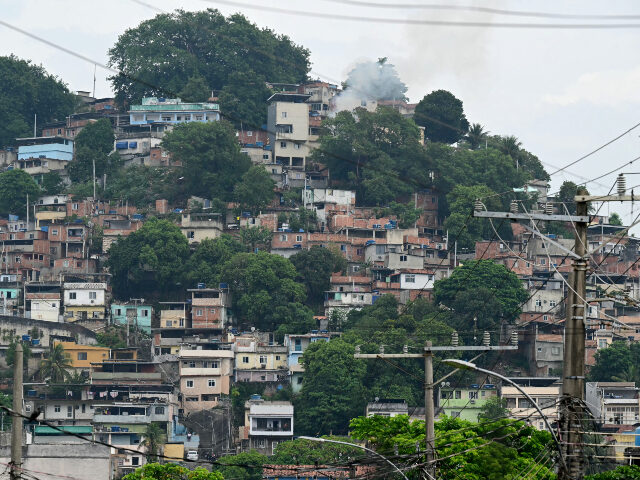

At least 64, including four police officers, were killed in a massive police raid Tuesday in Rio de Janeiro against Comando Vermelho (“Red Command”), one of the country’s deadliest drug-trafficking gangs.
“Operation Containment,” described by Rio Governor Cláudio Castro as the biggest operation in the history of Rio de Janeiro, is the deadliest in the Brazilian city to date. The operation involved approximately 2,500 law enforcement agents from different branches executing hundreds of arrest warrants and search and seizure warrants at Complexo do Alemão and Penha, two favelas in northern Rio, with the intent to crack down on the ongoing territorial expansion of Red Command in the area.
Red Command drug traffickers responded to the massive operation with several burning barricades and intense violent clashes with law enforcement, leading to a war-like scenario in the Brazilian city. Local outlets published video footage of the clashes showing almost 200 shots fired in one minute amid columns of smoke. The gang used drones to launch bombs at the police.
“This is how the police in Rio de Janeiro are received by criminals: with bombs launched by drones. This is the magnitude of the challenge we face. It’s no longer common crime; it’s narcoterrorism.” Governor Castro wrote on social media.
At least 64 individuals were killed during the security operation, including four police officers. The operation led to the arrest of 81 individuals and the seizure of dozens of rifles, a pistol, nine motorcycles, and over half a ton of drugs.
“Rio de Janeiro ends the day with an image that speaks for itself: more than 100 rifles seized by the Civil and Military Police,” Governor Castro wrote on social media on Tuesday evening alongside a picture of the seized rifles. “After that, does anyone still doubt that our security forces are doing their part?”
The operation was reportedly the result of a year-long investigation that identified a group of 94 Red Command members who were believed to be hiding in the Alemão and Penha favelas. The identified men stand accused of murder, drug trafficking, and car theft, among other crimes. The outlet G1, citing information from the Brazilian police, detailed that the order for the gang’s expansion in the area came from two of Red Command’s leaders, Márcio dos Santos Nepomuceno, currently serving time at a federal prison, and Edgar Alves de Andrade, a fugitive at large with 269 criminal records and 26 outstanding arrest warrants.
The two favelas, G1 explained, are located in Rio’s mountainous areas and are surrounded by forests, which facilitates the escape of criminals.
Red Command is one of Brazil’s oldest and most dangerous gangs, formed at a Rio prison in the 1970s through an alliance between criminals and leftist militants. The gang initially started as a “self-protection” group for prisoners, engaging in low-level crimes, evolving over time to a full-fledged transnational syndicate whose criminal actions include drug and arms trafficking, murder, money laundering, assault, rioting, among other crimes.
Brazil has long struggled with rampant crime and gang-related violence despite its legislation imposing controls on the sale and civilian use of firearms for decades. In an effort to allow citizens the right to defend themselves, conservative former President Jair Bolsonaro passed a series of executive orders throughout his administration expanding gun rights to civilians while lessening some of the harsher gun control restrictions. Bolsonaro’s pro-gun stance elicited widespread condemnation from the left, with The Guardian reporting in 2021 that some of his harshest critics deemed his pro-gun rights decrees a “threat to democracy.”
Immediately upon succeeding Bolsonaro in January 2023, current radical leftist President Luiz Inácio Lula da Silva overturned some of Bolsonaro’s gun rights measures and in July 2023, signed a “Responsible Gun Control” decree that further restricted civilian access to firearms while undoing remaining pro-gun policies from the Bolsonaro administration.
Rio de Janeiro’s City Hall reported in the early morning hours of Wednesday that the blockades that Red Command placed during the security operation had been fully cleared by 2:45 a.m. (local time). Rio’s public transport authority reportedly detailed that 71 buses were hijacked and 204 bus routes in the city had been affected by the blockades. The U.S. Consulate in Rio de Janeiro issued an emergency alert urging American nationals in Brazil to avoid the northern Rio areas affected by the security operations, and suggested a list of security actions citizens can take to minimize potential risks.
The state-owned outlet Agência Brasil reported on Wednesday morning that the city of Rio de Janeiro “woke up to a normal situation” following Tuesday’s incident. Residents of the Penha favela reportedly removed some 50 bodies from a forest area that, according to the state-owned outlet, “are not part of the official count of 64 dead,” and lined them up at a square. Metrópoles reported that Rio’s Military Police “stated that it was aware of the presence of the bodies in the square and that the circumstances of the case are being investigated.”
Agência Brasil reported on Tuesday night that Brazilian Chief of Staff Rui Costa and Justice Minister Ricardo Lewandowski will hold an emergency meeting with Rio de Janeiro State Governor Castro on Wednesday.
In a separate emergency meeting Tuesday, the Brazilian government reportedly asserted that federal police and military forces “reiterated that there had been no consultation or request for support from the Rio de Janeiro state government to carry out the operation.” Lewandowski reportedly claimed that he did not receive a request from Governor Castro for federal assistance in the security operation.
Brazil’s Supreme Federal Tribunal (STF) Minister Alexandre de Moraes, citing a request from the government’s National Human Rights Council (CNDH), reportedly gave a 24-hour deadline to the Attorney General’s Office (PGR) to provide information to the court on the massive-scale security operation in Rio after CNDH urged the top court to request that Governor Castro submit a report on the operation detailing the formal justification for its execution, and clarify “measures taken to assist the victims and ensure the accountability of agents in the event of any human rights violations.”
President Lula has not publicly commented on the security operation in Rio at press time. The Brazilian president reportedly returned from his recent official Asian tour on Tuesday night, and will meet with his staff on Wednesday morning to assess the results of the operation.
Christian K. Caruzo is a Venezuelan writer and documents life under socialism. You can follow him on Twitter here.
COMMENTS
Please let us know if you're having issues with commenting.