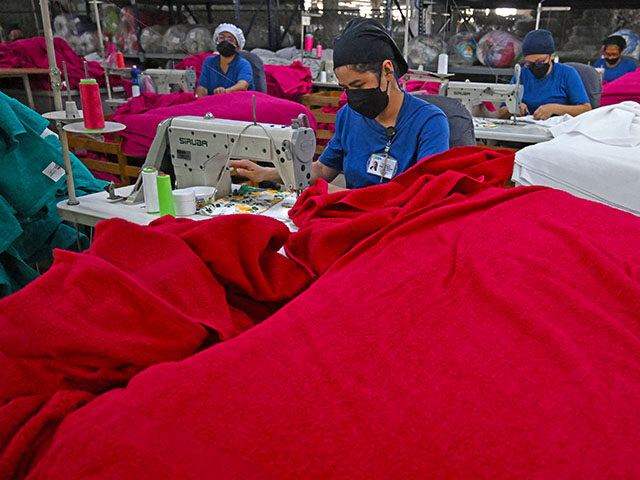

Colombian clothing manufacturers are struggling to keep up with the unfair trading practices of the Chinese low-cost shopping apps Temu and Shein, the magazine Semana reported over the weekend.
Sector representatives explained to the magazine that both Chinese platforms exploit de minimis clauses in Colombia’s Free Trade Agreement (FTA) with the United States, and China’s slave-like unethical labor practices swamp Colombia’s market with cheap low-quality products, displacing local products of better quality.
Semana stated that Colombian customers are aware that there is a difference between “what you order at Temu and what you get,” due to the low-cost and low-quality offerings sold by both Chinese platforms. In spite of that, the magazine reported, purchases made by Colombians on the Chinese platforms continue to grow, “especially in terms of clothing and accessories,” with its customer base not just increasing among the youth, but also between those aged 40-60.
“Colombia has not been immune to this phenomenon of global consumerism, which encourages people to buy unnecessary items, in many cases motivated by low prices. However, these platforms have been heavily criticized around the world for the quality of their products, the working conditions of those who produce them, and, above all, the tariff advantages that allow them to be extremely cheap for the end consumer,” Semana’s report read.
In October, far-left President Gustavo Petro called for the suspension of Colombia’s ten-percent tariff on yarn and textile inputs entering the country on grounds that the measure would help reduce costs for the Colombian clothing industry. Semana stated in its report that the measure was rejected by foreign trade entrepreneurs, local cotton growers, and Colombian clothing sector unions, who said that it would not work and would put thousands of jobs at risk — arguing that the real problem for the Colombian clothing manufacturing sector is Temu and Shein.
Luis Carmona, president of Sindelhato Fabricato, a 1,200-member Colombian textile workers union, told Semana that it is impossible to compete against China’s working conditions and the Chinese platforms’ “dumping practices” of selling below production costs.
“That is unfair and it is pure parcel trade that the government has to correct,” Carmona said, and stressed that he believes the only solution lies in having Shein and Temu pay “all the taxes they owe on their purchases.”
Semana stressed that one of Temu and Shein’s greatest advantages is that they qualify for de minimis exceptions on their low-value import shipments — a loophole that, in the case of the United States, was shut down by President Donald Trump in July.
According to Semana, de minimis rules present the Free Trade Agreement (FTA) between Colombia and the United States are allegedly being exploited by Temu and Shein, as Colombian-bound shipments that come from America do not pay taxes, unlike those that are shipped from China, which are subject to local taxation.
“International digital commerce platforms are welcome, as they help create consumption habits based on trends such as gamification, which leads more people to go digital, and it is desirable to have competition, but under conditions of parity, which is precisely what is not happening,” María Fernanda Quiñones, president of the Colombian Chamber of Electronic Commerce (CCCE), told Semana.
Quiñones explained to the magazine that there is no competition parity due to an interpretation of the FTA deal with the United States. She asserted that, according to its terms, de minimis shipments “which are worth a maximum of $200 (roughly 776,000 Colombian pesos), do not pay customs duties or Value Added Tax.”
“This also includes purchases on Amazon that do not exceed that value, which can be resolved with a concept from the Ministry of Commerce, without the need for a decree or a bill,” she said.
Quiñones, who pointed out to Semana that the United States has already shutdown de minimis loopholes, deemed the situation as “very harmful competition” in Colombia, one that not just affects clothing manufacturers but also entrepreneurs who have invested in regional digital marketplaces such as Mercado Libre and Falabella.
“It is a matter of political will, and now is the time to do it, because several countries around the world are correcting it,” Quiñones said.
Other South American countries have enacted measures to increase taxation on local shipping laws exploited by Temu and Shein throughout 2025. In June, the government of Ecuador imposed a $20 tariff on packages shipped to the country through a specialized personal courier modality that exempts said packages from paying foreign trade tariffs and taxes. The tariff was imposed after local authorities registered a surge in clothing and footwear shipped under the courier modality, with local outlets reporting at the time that Temu package imports had “collapsed” local shipping distribution companies.
Christian K. Caruzo is a Venezuelan writer and documents life under socialism. You can follow him on Twitter here.
COMMENTS
Please let us know if you're having issues with commenting.