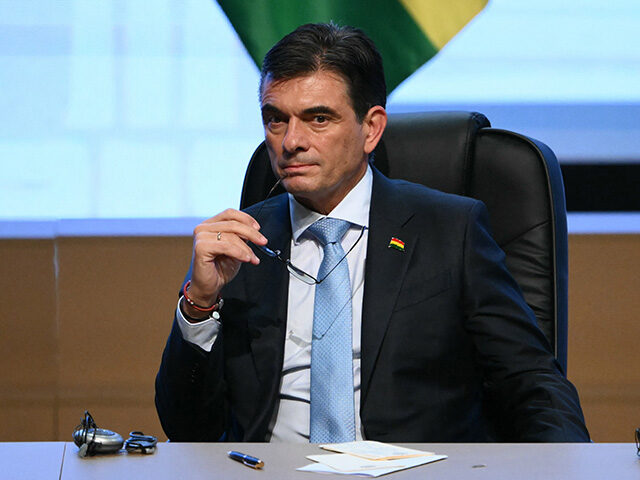

Bolivia’s state-owned cable company Entel over the weekend announced the removal of Russian state outlet RT and the left-wing propaganda network Telesur from its channel grid.
In 2009, Russia stablished RT’s Spanish branch division and, over the following years, spread its signal across several Latin American nations under the auspices of friendly leftist governments. In Bolivia, that government was run by Evo Morales — a failed dictator and fugitive of the law on pedophilia allegations; in Argentina, RT spread during the administration of convicted socialist former president Cristina Fernández de Kirchner.
According to RT, its Spanish channel is available in over 20 countries through cable operators, including the United States. Socialist former president of Ecuador, and fugitive convicted felon, Rafael Correa has his own show on the Russian channel, which first started broadcasting in Ecuador in 2015 during Correa’s administration.
Telesur is a notoriously anti-U.S. Latin American leftist propaganda network established by the Venezuelan socialist regime in 2005 during the rule of late dictator Hugo Chávez. The network is largely funded by the Venezuelan regime in addition to the Cuban and Nicaraguan communist regimes.
Bolivian cable operator Entel, citing “administrative reasons” notified its users that, starting on Sunday, January 17, both RT and Telesur would no longer be available on its channel grid. The removal applied to Entel’s regular and cable streaming services.
Telesur’s President Patricia Villegas shared a copy of the statement and criticized the measure as “as predictable as it is reprehensible,” asserting that “there are no reasons” for the decision. At press time, RT has not publicly commented on its removal from Entel’s cable grid in Bolivia.
“The argument put forward is fooling no one. Bolivia, you know it, we are still together,” Villegas wrote on a Telegram post.
The leftist propaganda network pointed out that it is the second time that it has been kicked off Entel. In November 2019, during the administration of conservative former President Jeanine Añez, Entel rescinded its contract with Telesur — which was then reinstated in November 2020 during the disastrous socialist administration of former president Luis Arce.
Telesur also criticized the Bolivian government’s decision in two different “caricatures,” one condemning President Paz for “censoring” the channel and another one claiming that it will continue to stand “with the Bolivian people’s struggles despite government censorship.
Evo Morales, who had both RT and Telesur originally broadcast in Bolivia during his rule, condemned the decision on Monday and claimed without evidence that the measure follows “instructions from the U.S. government” and allegedly “violates” Bolivians’ right to information.
Bolivian President Rodrigo Paz, who took office in November, maintains a friendly stance with the United States and restored his country’s diplomatic ties with America within the first hours of his administration. That decision drew the ire of Morales and other Bolivian socialists, who for nearly two decades maintained an antagonistic stance against the United States. As of press time, neither President Paz, nor any member of his administration, has publicly commented on Entel’s decision.
“This constitutes a serious violation of the Political Constitution of the State and is a clear sign of submission and lack of dignity,” Morales wrote on social media. “It is irrefutable proof that Bolivia is living under an authoritarian regime, where plurality of information and freedom of expression are not respected.”
In a joint statement on Monday, the Association of International Press Correspondents (ACPI) and the National Association of Journalists of Bolivia (ANPB) criticized the removal of RT and Telesur from Entel’s grid and questioned the decision, claiming that it was not “explained clearly or in detail.”
According to both organizations, the decision “violates the right of audiences to receive a serious, transparent explanation in line with the responsibility that corresponds to a state-owned company.”
“We urge the Bolivian government to fully guarantee the exercise of freedom of expression, ensuring respect for the plurality of voices, regardless of the type of actors involved, as well as the right of the population to obtain information through the channels of their choice. Similarly, we call on organizations committed to defending freedom of expression to remain vigilant and actively accompany the process of deepening democracy in Bolivia,” the statement read in part.
Christian K. Caruzo is a Venezuelan writer and documents life under socialism. You can follow him on Twitter here.
COMMENTS
Please let us know if you're having issues with commenting.