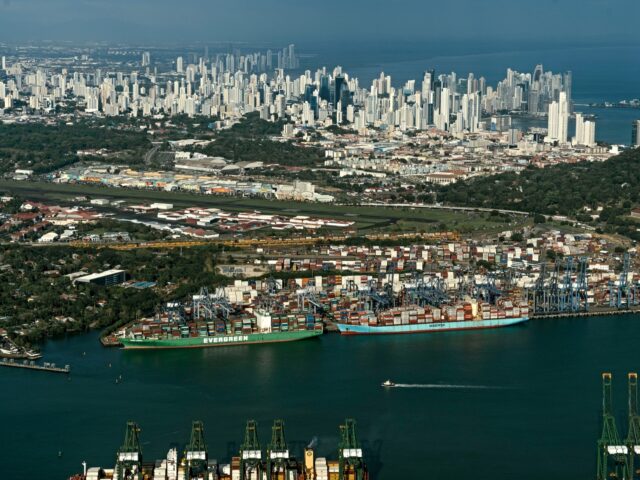
The business outlet Bloomberg reported on Thursday that its anonymous sources affirmed the Chinese Communist Party had ordered an end to “projects” in Panama following that nation’s top court ruling that a deal granting outsized power to a Hong Kong corporation over the Panama Canal was unconstitutional.
The Hong Kong-based Panama Ports Company (PPC) signed two contracts with the Panamanian state that granted it control of large territories on both sides of the Canal to develop new ports for incoming ships. Some estimates suggest that the ports PPC was contracted to develop handle as much as 40 percent of Canal traffic.
The PCC is a subsidiary of the massive Hong Kong corporation C.K. Hutchison Holdings Ltd., controlled by 97-year-old communist sympathizer Li Ka-shing. Both the conservative government of President José Raúl Mulino, who has been in office since 2024, and the government of the United States, which built the Panama Canal, have for years expressed concerns about the Chinese Communist Party gaining so much control over the pivotal waterway.
After years of legal action, the Panamanian Supreme Court ruled late last week that two contracts awarded to PCC in 1997 and 2021 were unconstitutional, as they significantly hurt the interests of Panama to the benefit of the Chinese regime-linked company. The United States celebrated the ruling, while CK Hutchison announced it would turn to arbitration against the government of Panama, seeking financial damages for the ruling.
The actions against Panama would not stop there, according to Bloomberg.
“China is asking state firms to halt talks over new projects in Panama,” the outlet reported on Thursday, “as part of Beijing’s broader retaliation after the Central American country voided CK Hutchison Holdings Ltd.’s contract to operate two ports along its strategic canal, according to people familiar with the matter.”
The report claimed that, for now, the Chinese Communist Party was only ordering its corporate apparatus not to sign any new deals in Panama, but that “projects already underway may also be affected,” threatening billions in investments in the country. As China is a communist country, private corporations do not in practice exist, and all corporations must fervently obey the Party or face their destruction and the potential arrest of their officers.
Bloomberg asked the Chinese Foreign Ministry about the report during its regular briefing on Thursday. Spokesman Lin Jian did not deny that the Communist Party had issued the order, offering only, “China’s position on issues concerning relevant Panamanian ports is clear.”
Lin recalled that the Chinese government’s Hong Kong office had issued a statement declaring that the “Panamanian Supreme Court’s ruling is an act of bad faith that disregards facts and severely undermines the lawful rights and interests of the company of China’s Hong Kong.”
“The Chinese government is committed to protecting the legitimate and lawful rights and interests of Chinese companies,” the statement threatened.
Mulino, the president of Panama, issued his own statement “energetically rejecting” the Hong Kong office’s threats.
“Panama is a state of laws and respects the decisions of the judiciary branch, which is independent from the central government,” Mulino wrote in a post published to the website Twitter. “The Foreign Ministry will pronounce itself on this matter and adopt appropriate decisions.”
The Mulino administration has been devastating for Chinese business interests in Panama. Following a visit to the country by Secretary of State Marco Rubio a year ago, the conservative president announced that Panama would exit the Belt and Road Initiative (BRI), China’s global debt-trap scheme in which it offers predatory loans to poor countries as a means of eroding their sovereignty. Mulino has been vocal in calling for improved relations between his country and the United States and prosecutors in the country began taking action against PPC after they received support from Washington. Also adding to the tensions between China and Panama during his tenure was an incident in the town of Arraiján in December in which the mayor chose to demolish a monument to “Chinese-Panamanian friendship” – which Beijing railed “trampled” on the feelings of the Chinese people.
Bloomberg suggested that, while billions in Chinese investment could be jeopardized by the Communist Party withdrawing its money, Panama has withdrawn enough recently from China that there is no guarantee of substantial damage to its economy from the alleged measure.
“The US continues to hold sizable economic sway as Panama’s top trade partner and investor, even though Beijing has been encroaching on US dominance in the broader Latin American region over the years,” Bloomberg observed. “Panama’s crops account for just a fraction of its total exports to China, while steering away from the Panama canal in most cases is bound to incur more costs and delays.”
The administration of President Donald Trump has been supportive of Mulino’s measures to distance his country from China. U.S. Ambassador to Panama Kevin Cabrera celebrated the Supreme Court ruling this weekend, asserting that it “strengthens Panama’s national security and investment climate by boosting predictability, fairness, and legal confidence.”
“Investors gain assurance that valid contracts are protected and improper ones corrected, making Panama more attractive for quality, long-term investment,” he added, suggesting the potential of an influx of American investment even as China withdraws.
COMMENTS
Please let us know if you're having issues with commenting.