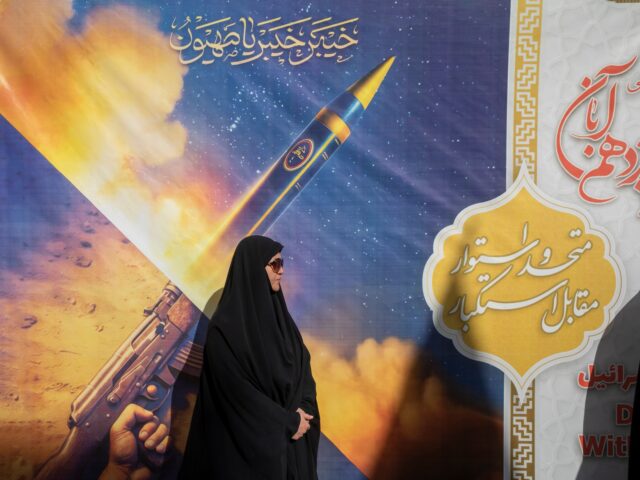

The Iranian regime held massive rallies in over 900 cities on Tuesday to commemorate the anniversary of the hostage crisis at the U.S. Embassy in 1979 – an event known as the “National Day of Fighting Global Arrogance” in the Islamic Republic of Iran.
Iranian state media reported the demonstrations were boiling with hostility toward the United States and Israel, both of which conducted military actions against Iran in June. Chants of “Death to America” and “Death to Israel” were common at Tuesday’s demonstrations.
Iran’s state-run PressTV described the scene in Tehran:
Cultural exhibitions highlighting decades of Western and Israeli “crimes” were also on display. Symbolic displays of Iranian missiles and centrifuges were presented along the route, and representations of US and Israeli flags were burned.
A symbolic trial of former U.S. President Donald Trump and Israeli Prime Minister Benjamin Netanyahu was also held.
From early morning, students, youth, and families gathered along routes leading to Palestine Square, waving Iran’s tricolor flag.
The regime spent the day congratulating itself for standing up against “global hegemony,” lionizing the hostage-takers of 1979, and demanding fealty to Supreme Leader Ayatollah Ali Khamenei. Ritual pledges of loyalty to Khamenei were conducted at many of the demonstrations.
“The day symbolizes national dignity, resistance, and defiance against foreign adversaries in Iranian collective memory,” PressTV pontificated.
The Iranian hostage crisis began on November 4, 1979, when student demonstrators overran the U.S. Embassy in Tehran and abducted more than 50 Americans who were stationed there. The hostages remained captive for 444 days, an agonizing and seemingly endless ordeal that helped to end the presidency of Jimmy Carter.
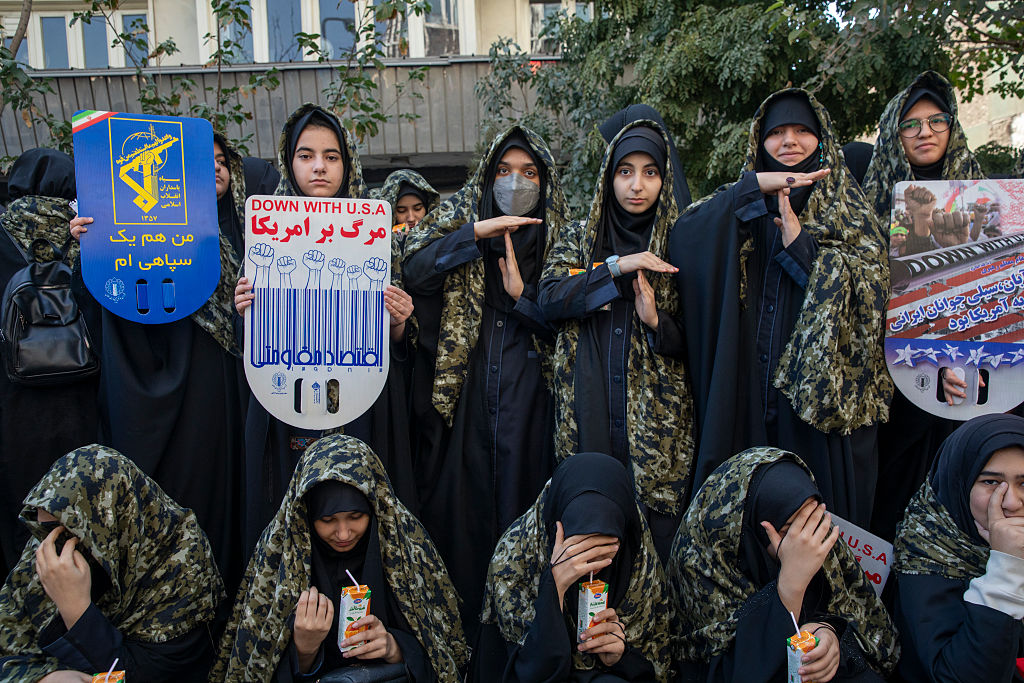
Women participating in the rally, on November 4, 2025, in Tehran, Iran. The march marks the anniversary of the seizure of the US Embassy in Tehran in 1979. Forty-six years ago on this day, supporters of Ayatollah Khomeini stormed the US Embassy in Tehran and occupied the facility for 444 days. (Majid Saeedi/Getty Images)
The Iranian regime folds two other events into its “National Day of Fighting Global Arrogance.” One is the banishment of Khamenei’s predecessor as supreme leader, Ayatollah Ruhollah Khomeini, from Iran to Turkey in 1964.
Khomeini was a fiery Islamic fundamentalist leader and outspoken critic of Shah Mohammad Reza Pahlavi, the monarch who ruled Iran until the 1979 revolution. Khomeini issued a series of calls to overthrow the government. When he eventually managed to spark an uprising in the city of Qom, the Shah had Khomeini arrested, but soon released him in a bid to calm his followers down.
Khomeini made even angrier calls to overthrow the government – among other things, he was infuriated by the Shah’s effort to develop a closer relationship with the United States and implement liberalizing programs to please the West.
The Shah finally had enough. On November 4, 1964, he arrested Khomeini again, took him straight to the airport in Tehran, and exiled him to Turkey. The Shah’s government thought exiling Khomeini instead of turning him into a martyr would reduce his influence, especially since then-secular Turkey restricted his religious activities, but they were wrong. Khomeini returned to Iran after about 15 years of exile in Turkey and Iraq, overthrew the Shah’s government, and established the Islamic Republic in 1979.
The other event commemorated by Iran on this date is the killing of five student protesters during mass demonstrations against the Shah’s government on November 4, 1978. The protests became a violent riot, and when thousands of students attempted to topple a statue of the Shah near Tehran University, security forces opened fire. A much larger massacre of demonstrators known as “Bloody Friday” occurred in September, but the timing of the November shootings caused that incident to become part of the triple commemoration on November 4.
COMMENTS
Please let us know if you're having issues with commenting.