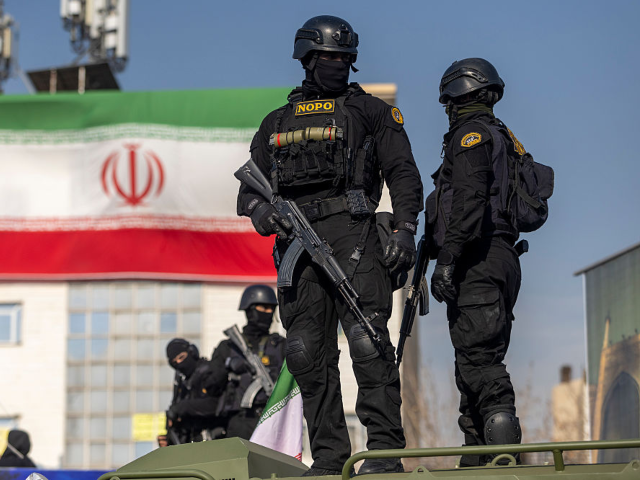

Residents of Iran’s capital of Tehran told Radio Free Europe/Radio Liberty (RFE/RL) on Monday that the city remains under “virtual martial law” after last week’s murderous crackdown on protesters, with a heavy security presence rolling through the largely-deserted streets.
“The feeling of martial law is completely in place at night. One of the reasons for that is that the armed forces randomly stop cars. They check the entire car and also mobile phones. They ask people to unlock their phones,” said a Tehran resident who fled the city a few days before speaking with RFE/RL.
The source added that regime security forces are “checking citizens’ activities on social media as well as their phone photo galleries looking for evidence of the individual’s presence at the protests.”
The streets of Tehran are filled with military and paramilitary units, including the infamous Basij oppression squads, plus plainclothes police operatives, who are also forcing their way into residential buildings to pursue suspected protesters.
The Wall Street Journal (WSJ) on Sunday quoted Tehran residents who said Basij thugs are driving through the streets on motorcycles, shouting, “Don’t come out! We’ll shoot you!” through bullhorns. Police have also been ordering terrified civilians to stay away from their windows, evidently to prevent them from shouting anti-regime protest slogans from the relative safety of their apartments.
This level of intimidation has reportedly persuaded most residents to remain indoors at night in a self-imposed curfew.
“The presence of military and security forces across these cities is so conspicuous that people are talking about a kind of military rule. Not that ordinary people are banned from moving around, but all movement happens under their heavy surveillance and control,” Kurdistan Human Rights Network activist Kaveh Kermanshahi told RFE/RL.
Several cities besides Tehran have reported heavily-armed security forces on their streets, especially in western Iran. These reports say the regime has augmented its forces by hiring mercenaries from Iraq, Syria, and Afghanistan, who are presumably even quicker to use deadly force against Iranian civilians than the police and Basij.
“Universities in Tehran remain closed to prevent student gatherings. A majority of shops and shopping centers are shuttered. Armed security forces dominate city centers. Public gatherings are dispersed within minutes,” the Jerusalem Post reported on Tuesday.
“We are hostages inside our own country. We don’t know what is happening in the next street, let alone the next city,” said an Iranian who managed to get past the regime’s Internet blackout.
Iranian officials said at least 5,000 people were killed during the protest crackdown, a figure comparable to reports from some human rights organizations, although others claim the death toll was much higher — and the regime may yet execute many of the thousands of protesters it arrested.
COMMENTS
Please let us know if you're having issues with commenting.