U.S. Central Command (CENTCOM) announced on Thursday that it has “completed the orderly departure of U.S. forces from al-Tanf Garrison in Syria,” fulfilling a “deliberate and conditions-based” plan to hand the base over to the Syrian national military.
U.S. officials said the last American troops departed from the base on Wednesday, and the Syrian Defense Ministry announced Syrian Arab Army units took control immediately afterward, with full “coordination between the Syrian and American sides.”
The Syrian Defense Ministry said its forces have already “begun deploying along the Syrian-Iraqi-Jordanian border,” and would soon be joined by border guard units.
Two sources told Reuters that the U.S. troops from al-Tanf were relocating to Jordan.
The base at al-Tanf, which is located near the intersection of the borders between Syria, Jordan, and Iran – has been controlled by the U.S.-led coalition to defeat the Islamic State since 2014.
CENTCOM said the base was transitioned to Syrian control in accordance with the U.S. policy to “begin consolidating its locations in Syria after the territorial defeat of ISIS in 2019.”
“U.S. forces remain poised to respond to any ISIS threats that arise in the region as we support partner-led efforts to prevent the terrorist network’s resurgence,” CENTCOM commander Adm. Brad Cooper said.
“Maintaining pressure on ISIS is essential to protecting the U.S. homeland and strengthening regional security,” Cooper added.
According to CENTCOM, U.S. forces have hit over 100 targets with more than 350 precision munitions over the past few months in actions against ISIS remnants in Syria, and have captured or killed over 50 ISIS fighters.
Reuters noted on Thursday that, even after the Islamic State “caliphate” sprawling across Syria and Iraq was dismantled in 2019, the al-Tanf base was still seen as “a key foothold in a battle against Iranian influence, due to its strategic position along roadways linking Damascus to Tehran.”
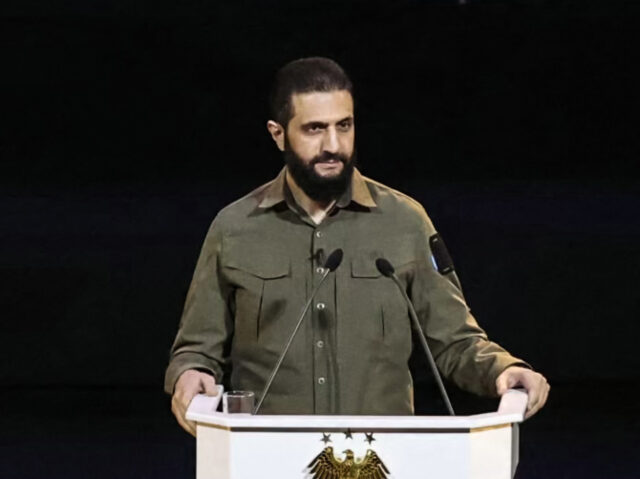
Maintaining that foothold became politically difficult after a coalition of insurgent and jihadi groups managed to overthrow Syrian dictator Bashar Assad in a surprise attack on Damascus in December 2024. The subsequent military government is led by Ahmed al-Sharaa, a former commander of the al-Qaeda terrorist group who has remodeled himself as a statesman and promised a more inclusive government for Syria.
President Donald Trump has expressed confidence in Sharaa’s willingness and ability to deliver on his promises, and has generally supported Sharaa’s push to unite Syria as a single nation with a centrally directed military force. This push had led Sharaa’s forces into unpleasant conflicts with restless and semi-autonomous groups like the Druze and Kurds.
Sharaa’s government formally joined the Global Coalition to Defeat the Islamic State in November 2025.
David Adesnik of the Foundation for Defense of Democracies (FDD) told Reuters that the United States is taking a potentially unwise gamble by handing the strategic al-Tanf base over to Sharaa’s army, which has “incorporated thousands of ex-jihadists,” and might not be as willing or able as Washington hopes to interdict weapons shipments from Iran to the Hezbollah terrorists of Lebanon.
Former Pentagon official Daniel Shapiro of the Atlantic Council said handing control of al-Tanf to Damascus was “probably the right gamble,” but it was “still somewhat unknown if they actually live up to that responsibility.”
COMMENTS
Please let us know if you're having issues with commenting.