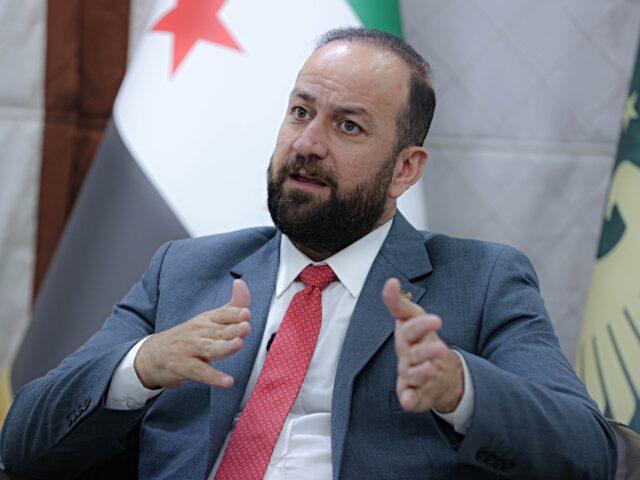

Syrian Information Minister Hamza al-Mustafa announced on Monday that his country signed a “political cooperation declaration” with the U.S.-led Global Coalition to Defeat ISIS, becoming a “partner in combating terrorism and supporting regional stability.”
“The agreement is political and until now contains no military components,” Mustafa added.
The announcement came after Syria’s interim president, Ahmed al-Sharaa, held a historic meeting with President Donald Trump at the White House. Sharaa was the first Syrian head of state to visit the White House.
Mustafa described the meeting between Trump and Sharaa as “warm, candid, and forward-looking, lasting for over an hour.” He quoted President Trump’s statement that “we have to help Syria.”
The Global Coalition to Defeat ISIS (D-ISIS) was established in September 2014 as an international coalition against the “gross, systematic abuses of human rights and violations of international law” perpetrated by the Islamic State. Syria will become the 90th member of the coalition.
The U.S. government said there was a “role for every country to play in degrading and defeating ISIS,” including non-military assistance.
“Degrading and ultimately defeating ISIS” was the preferred nomenclature of the Obama administration, which envisioned that process as taking decades to complete. President Donald Trump decisively broke ISIS in October 2019 with a special operations raid to eliminate its leader, Abu Bakr al-Baghdadi.
Although the ISIS “caliphate” in Syria and Iraq collapsed after Baghdadi’s death, the group remains a significant terrorist threat in several countries, including up to 3,000 fighters based in Syria.
U.S. forces in Syria killed a senior ISIS leader, Omar Abdul Qader, in September, and captured another named Ahmad Abdullah al-Masoud al-Badri in October. The joint operation that captured al-Badri was the fifth acknowledged instance of cooperation between Sharaa’s forces and the D-ISIS coalition.
Joining the coalition was seen as a requirement for Syria to obtain permanent sanctions relief, and could also prove to be a step toward something much bigger – possibly even Syria joining President Trump’s regional peace initiative, the Abraham Accords.
Sharaa previously ruled out joining the Abraham Accords due to ongoing border tensions with Israel, but he sounded more optimistic in a Fox News interview from Washington on Monday.
Sharaa repeated his longstanding objection that Syria is different from other members of the Abraham Accords because it shares a border with Israel and Israeli occupation of the Golan Heights made normalization impossible for the time being. However, he hinted that the time when it might become possible could arrive before the end of President Trump’s term.
“Maybe the United States administration, with President Trump, will help us reach this kind of negotiation,” Sharaa mused.
Trump said in a Truth Social post on Monday night that he “discussed all the intricacies of PEACE” with Sharaa, who he described as a “major advocate” of peaceful relations.
“I look forward to meeting and speaking again. Everyone is talking about the Great Miracle that is taking place in the Middle East. Having a stable and successful Syria is very important to all countries in the Region,” Trump wrote.
According to the Syrian readout of the White House meeting, Trump and Sharaa also discussed integrating the Kurdish-led Syrian Democratic Forces (SDF) into the national Syrian Army, in order to “unify state institutions and ensure lasting stability.”
The SDF, established in 2015, was a key U.S. ally during the war against the Islamic State in Syria. The group has remained somewhat distant from the new government in Damascus ever since Sharaa and his Hayat Tahrir al-Sham (HTS) jihadi alliance overthrew dictator Bashar Assad last December.
In October, the SDF agreed in principle to integrate with the national army as a “cohesive group.” Until now, the SDF has served as the military wing of a semi-autonomous government known as the Democratic Autonomous Administration in North and East Syria (DAANES).
The SDF, which has between 70,000 and 100,000 fighters, has been reluctant to dissolve its command structure and mix its personnel into the Syrian Army. Some SDF units were trained and equipped by the U.S. military, and they are uncomfortable with the jihadi factions that were folded into the reconstituted Syrian military.
“We are talking about a large number, tens of thousands of soldiers, as well as thousands of Internal Security Forces,” SDF Commander-in-Chief Mazloum Abdi noted in October.
“These forces cannot join the Syrian army individually, like other small factions. Rather, they will join as large military formations formed according to the rules of the Defense Ministry,” he said.
COMMENTS
Please let us know if you're having issues with commenting.