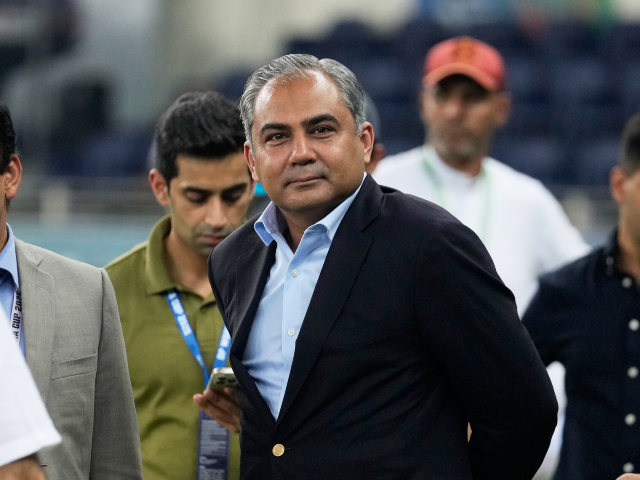

The interior minister of Pakistan, Mohsin Naqvi, held a meeting on Thursday with American Ambassador Natalie Baker to discuss attempts to continue negotiations to settle the war in Iran, expressing hope upon leaving the meeting that the rogue Iranian terror regime would return to the negotiating table.
The readout and accompanying video of the meeting from the Pakistani Foreign Ministry are notable in that Islamabad applauds President Donald Trump for taking steps toward an enduring peace between the two countries and omits any mention of doing the same, as well as pressuring Iran to pursue peace. The unspoken conclusion created by the statement is that the Pakistani government appears to see the Iranian regime as the intransigent party in the negotiations, reserving its pressure for Tehran.
The meeting and readout followed a public message from Chinese dictator Xi Jinping, in conversation with Saudi Crown Prince Mohammed bin Salman, demanding that the Strait of Hormuz be open to the free flow of commercial traffic — defying Iran’s declaration that it would intercept civilian ships attempting to travel through it as retaliation for the White House announcing a blockade of Iranian-specific traffic in the strait. Prior to that blockade, the Iranian regime announced that it would close the strait until the conflict with Iran and the United States was fully resolved. While President Trump announced last weekend that Iran had promised never to close the strait again, Iranian military officials declared a full blockade in the strait less than 24 hours later.
Naqvi, the Pakistani interior minister, reportedly used the meeting with the American envoy to share that his government “commended U.S. President Donald Trump’s initiative to extend the ceasefire.”
“The extension of the ceasefire by President Donald Trump is a welcome development; this step is significant progress towards reducing tensions,” the Interior Ministry paraphrased Naqvi as saying.
The readout added that the minister stated, “we also hope for positive progress from Iran’s side.”
Iran and the United States held a first round of talks this month in Islamabad, Pakistan, towards ending the hostilities that began in late February after the Pentagon launched an operation to eliminate Iran’s missile and drone arsenal. Israel and the United States have also eliminated dozens of Iranian senior officials, including “supreme leader” Ayatollah Ali Khamenei. While Khamenei has been officially replaced by his son, Mojtaba Khamenei, the younger “supreme leader” has made no public appearances or official audio statements, leaving unclear his ability to run the country and resulting in mixed messages from the civilian and military wings of the regime.
President Trump announced a ceasefire in early April to allow for negotiations towards an end to the war, which he suggested would require Iran to accept limits on its illicit nuclear development. Early reports this week indicated that Iranian and American officials would again meet in Islamabad to further nuclear talks, which Trump fueled by indicating that his administration was “offering a very fair and reasonable DEAL, and I hope they take it.” He followed up this assurance by once again promising to destroy Iran’s critical infrastructure.
Senior Iranian leaders repeatedly denied that they were open to joining the Islamabad talks and the negotiations ultimately did not happen. As the two-week ceasefire was set to expire on Wednesday, President Trump announced an extension, citing confusion in the Iranian government making authentic negotiation impossible.
“Based on the fact that the Government of Iran is seriously fractured,” Trump wrote on his website Truth Social, “and upon the request of Field Marshal Asim Munir, and Prime Minister Shehbaz Sharif, of Pakistan, we have been asked to hold our Attack on the Country of Iran until such time as their leaders and representatives can come up with a unified proposal.”
The ceasefire pointedly does not include an end to the American blockade of Iranian ship traffic.
Trump reiterated his view that the Iranian regime was not unified in a message on Thursday.
“Iran is having a very hard time figuring out who their leader is! They just don’t know!” he wrote. “The infighting is between the ‘Hardliners,’ who have been losing BADLY on the battlefield, and the ‘Moderates,’ who are not very moderate at all (but gaining respect!), is CRAZY!”
Trump added that Washington has “total control over the Strait of Hormuz.”
While Pakistan and China have urged Iran publicly to seek diplomacy, officials in what is left of the regime continued to dismiss the possibility this week.
“Diplomacy is a tool to secure national interests and security,” Foreign Ministry spokesman Esmaeil Baqaei told reporters on Wednesday, “and whenever we conclude that the necessary and logical groundwork is in place to use this tool for realising national interests and consolidating the Iranian nation’s achievements in frustrating enemies from achieving their sinister goals, we will take action.“
Iran’s figurehead president Masoud Pezeshkian declared, contrary to reality, that Iran had “welcomed dialogue and agreement and continues to do so” in a message on Wednesday that rejected dialogue and agreement.
“Breach of commitments, blockade and threats are main obstacles to genuine negotiations. World sees your endless hypocritical rhetoric and contradiction between claims and actions,” he added.
COMMENTS
Please let us know if you're having issues with commenting.