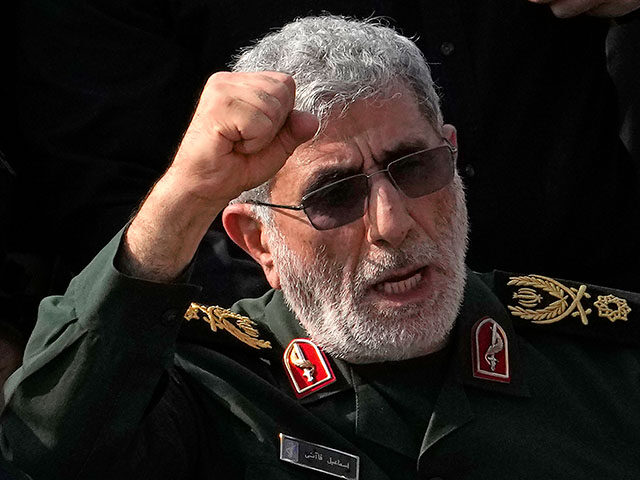

Brig. Gen. Esmail Qaani, commander of the foreign operations Quds Force unit of Iran’s Islamic Revolutionary Guard Corps (IRGC), paid an unannounced visit to Baghdad on Sunday for meetings with Iran-controlled politicians and militia groups — a clear attempt by Iran to influence the new government that is taking shape in Iraq.
The National reported on Tuesday that Qaani gave some “red lines” to Iran’s puppets and proxies in Iraq, including “no concessions to Washington on disarming armed factions” and no “tilting too far towards the White House.”
WATCH — This Is What Happened When Iran Didn’t Listen to the U.S.:
In addition to giving Iraqi Shiite politicians their marching orders, Qaani met with leaders of the notorious Shiite militia groups – bands of terrorists loyal to Tehran who were deputized by the desperate Iraqi government to fight the Islamic State a decade ago.
The militias, now collectively known as Popular Mobilization Forces (PMF), have gained political and operational influence over the Iraqi military even as they sporadically launch attacks on U.S. and allied forces.
According to The National’s sources, Qaani told PMF commanders that accepting U.S. demands to surrender their weapons would “weaken the factions’ leverage and undermine their role as a deterrent force within Iraq’s security architecture.”
The U.S. has never been happy with the violent and heavily armed Shiite militias, for obvious reasons, but it greatly increased pressure on the Iraqi government to disarm the PMF after war broke out with Iran, and the Iraqi militias launched rockets and drones at American positions.
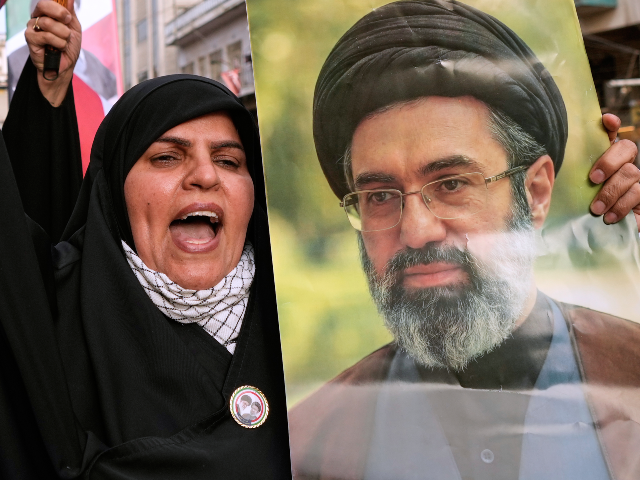
An Iraqi woman holds a portrait of Iran’s Supreme Leader Ayatollah Mojtaba Khamenei, during a protest against U.S. and Israeli attacks on multiple cities across Iran, in Baghdad, Iraq, Saturday, April 25, 2026. (AP Photo/Hadi Mizban)
U.S. officials have reportedly threatened to withhold counterterrorism and security support from Iraq if the Shiite militias remain a threat. President Donald Trump has also threatened to cut all support for Iraq if the blatantly pro-Iranian Nuri al-Maliki returns as prime minister.
Disarming the militias is a demand that non-Shiite Iraqi politicians would probably love to comply with, especially if they received U.S. military support in the endeavor, but Iraqi politics are sharply divided between Sunni and Shiite factions, and the Shiites would resist taking actions against the militias. Qaani was probably dispatched to Baghdad to stiffen Shiite spines because Tehran fears there is a realistic threat to the power of its proxies.
The threat of Maliki returning to office, and functionally putting Tehran in control of Iraq, appears to have receded for the moment. Iraq’s Shiite political bloc, which calls itself the Co-Ordination Framework (CF), broke the long parliamentary deadlock on forming a new government in April by advancing Ali al-Zaidi as its candidate for prime minister.
Zaidi is a politically obscure young business tycoon who has received strong support from the Trump administration as a compromise candidate. Iran is not happy with the choice of Zaidi and has evidently concluded that it lacks the political muscle to block his candidacy, so it seeks to influence his prospective government and protect its interests in Iraq.
Zaidi is making efforts to stay in Iran’s good graces, even as he appears interested in closer ties with the United States. One awkward detail is that Zaidi’s bank, the Al Janoob Islamic Bank, appears to have been tied to an Iran-backed militia leader under U.S. sanctions since 2018. The Trump administration might be willing to avoid dwelling on this part of Zaidi’s resume if he makes for an agreeable prime minister in other ways.
Iran is clearly nervous about that possibility. Qaani, who runs the division of the terrorist IRGC that is most directly concerned with fomenting unrest and instability in other countries, made another visit to Iraq in mid-April after having been invisible during much of the U.S.-Iran war. His message during the earlier visit was very similar to the one he conveyed on Sunday, suggesting that he found it necessary to repeat himself.
COMMENTS
Please let us know if you're having issues with commenting.