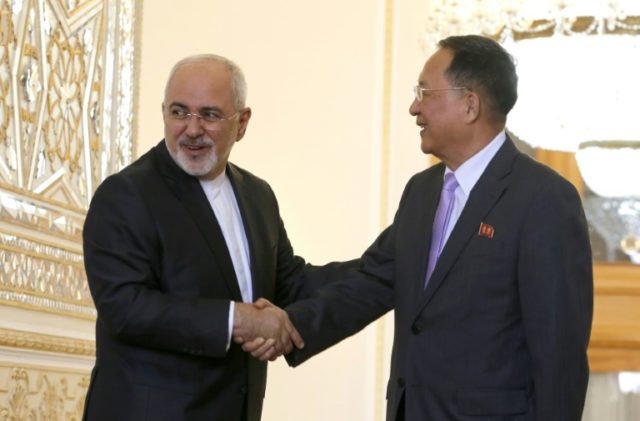

North Korean Foreign Minister Ri Yong-ho met with his Iranian counterpart Mohammad Javad Zarif in Tehran on Tuesday, hours after U.S. oil sanctions against the Iranian regime came into effect.
The state-run Islamic Republic News Agency (IRNA) reported the two officials met and “expressed satisfaction with existing bilateral relations and called for further expansion of ties.” It added, “They also discussed the latest regional and international developments, as well as issues of mutual interest.”
According to the IRNA, the meeting was requested by Ri Yong-ho and was the first between North Korean and Iranian officials since the beginning of Iranian President Hassan Rouhani’s second term.
The meeting came as the U.S. reimposed sanctions on Iran’s crucial oil industry after leaving the Iran nuclear deal signed under Barack Obama, with President Donald Trump cautioning countries against doing business with Iran.
“The Iran sanctions have officially been cast,” Trump wrote on Twitter. “These are the most biting sanctions ever imposed, and in November they ratchet up to yet another level. Anyone doing business with Iran will NOT be doing business with the United States. I am asking for WORLD PEACE, nothing less!”
However, an Iranian newspaper cited Zaraf as saying that U.S. oil sanctions will not succeed, with Rouhani suggesting last month that Iran could block the Strait of Hormuz, a prominent oil shipping route, should the U.S. continue to block their own shipments.
“If the Americans want to keep this simplistic and impossible idea in their minds they should also know its consequences,” Zarif told the Iranian newspaper. “They can’t think that Iran won’t export oil and others will export.”
“The Americans have assembled a war room against Iran,” Zarif said. “We can’t get drawn into a confrontation with America by falling into this war room trap and playing on a battlefield.”
The U.S. is currently also deep in negotiations with North Korea to scrap its nuclear program after communist dictator Kim Jong-un agreed to the complete “denuclearization of the Korean Peninsula” following a meeting with Trump in June.
Last year, a United Nations panel expressed concern over military collaboration between Iran and North Korea, noting the presence of designated North Korean weapons traffickers based in Tehran and the similarity of missile designs within the two country’s weaponry.
However, Rouhani previously outlined his opposition to the regime’s nuclear capabilities, stating that his “basic position is that nuclear weapons should be removed from the Korean Peninsula and the Middle East.”
Follow Ben Kew on Facebook, Twitter at @ben_kew, or email him at bkew@breitbart.com.
COMMENTS
Please let us know if you're having issues with commenting.