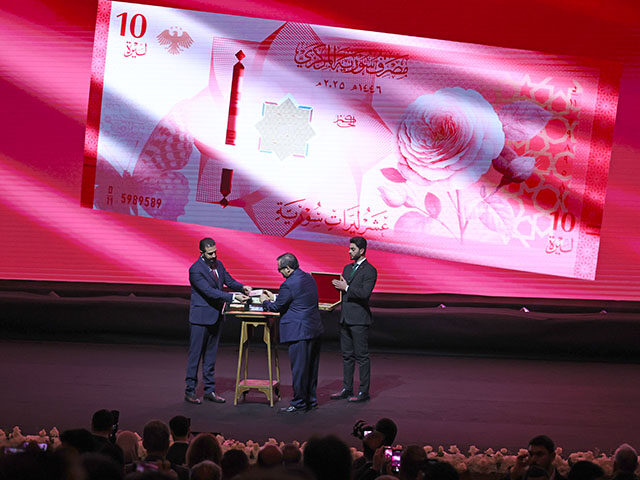
Syria’s interim President Ahmed al-Sharaa rolled out the country’s new currency at a ceremony in Damascus on Monday.
The redesigned banknotes have been redenominated, which means they have fewer zeroes in the amounts, and they no longer bear the visage of deposed dictator Bashar al-Assad, memorably condemned as a “gas-killing animal” by President Donald Trump in 2018.
Sharaa noted during the ceremony that changing the denominations on the Syrian pound was an accounting convenience and did not materially change their value or reverse the high inflation suffered during the long Syrian civil war.

Syria’s President Ahmed al-Sharaa (L) and Syria’s Central bank chief Abdulkader Husrieh (R) stand between the country’s new revamped currency notes at the Conference Palace in the Syrian capital Damascus on December 29, 2025. (Bakr ALkasem / AFP via Getty Images)
“Changing the zeros and removing two zeros from the old currency to the new currency does not mean improving the economy, but rather it is easier to deal with the currency,” he said.
“Improving the economy depends on increasing production rates and reducing unemployment rates in Syria, and one of the basics of achieving economic growth is improving the banking situation because banks are like arteries for the economy,” he added.
The new notes are available in denominations ranging from 10 to 500 pounds, while the old bills ran from 1,000 to 50,000 pounds. The new ten-pound note buys roughly the same amount of goods as the old 1000-pound note.
The new bills are quite colorful compared to the drab old bills, and they replace images of the brutal Assad dynasty with some plants native to Syria, including roses, wheat, olives, oranges, and mulberries – a fruit prized in Middle Eastern cuisine.
Sharaa said the new designs symbolize “the end of a previous, unlamented phase and the beginning of a new phase that the Syrian people, and the peoples of the region who are hopeful about the modern Syrian reality, aspire to.”
“The new currency design is an expression of the new national identity and a move away from the veneration of individuals,” he said.
Some Syrian online commentators were not thrilled with the new design, feeling that the cheerful bright colors and crop displays did not accurately reflect Syria’s long history, or the grim realities of the civil war.
“Syria is not just a few trees and crops. It’s about civilizations and history and cultures,” one critic wrote on Instagram.
“Honestly, whoever designed the new Syrian currency should have their hands broken. It’s like they went to a vegetable market and said: this one’s for the five, this one’s for the 10 and this one’s for the 100,” said an even more trenchant critic of the new bills.
“Not a fan of the new Syria banknotes. Even Assad put the Umayyad Mosque on his currency. Come on, guys,” grumbled a third.
The Umayyad Mosque is a historic structure in Damascus. It was a Christian basilica before it was converted into a mosque centuries ago, and some believe that John the Baptist (or at least part of him) is interred there.
Sharaa said one objective of the currency relaunch is to make Syria less dependent on foreign currency and restore their trust in the pound. The Syrian pound was trading at about 50 to the U.S. dollar when the civil war began in 2011 – and about 11,000 to the dollar when it ended with Assad’s ouster in December 2024. Syria’s currency lost so much of its value that citizens grew accustomed to lugging heavy bags of cash around to make even the smallest market purchases.
Sharaa and Syrian central bank governor Abdulkader Husrieh asked the public to be patient during the currency transition.
“Everyone who has old currency will have it replaced with the new one, so there is no need to insist on changing it because that may harm the exchange rate of the Syrian pound. We need a calm approach to currency replacement, and the central bank has made it clear that this will be done according to a specific timetable,” Sharaa said.
Husriyeh said the exchange was expected to take about 90 days, with extensions possible if needed.
“This will help stabilize prices, and we confirm that pricing during this phase will be in both the old and new currencies. There will be a media campaign to accompany the currency change and explain the details in the coming days,” he said.
Possibly for security reasons, Husriyeh declined to answer questions from reporters about where the new bills would be printed. Before the fall of the Assad regime, Syria’s currency was printed in Russia.
COMMENTS
Please let us know if you're having issues with commenting.