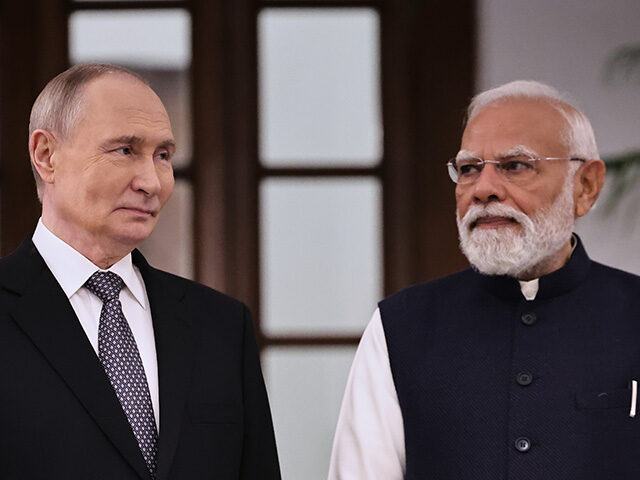
Kremlin spokesman Dmitry Peskov said on Tuesday that India has not indicated it will stop buying Russian oil, as claimed by President Donald Trump on Monday.
“So far, we have not heard any statements from Delhi on this issue,” Peskov told reporters on Tuesday.
“We respect bilateral U.S.-Indian relations, but we attach no less importance to the development of an advanced strategic partnership between Russia and India,” he said.
“This is the most important thing for us, and we intend to further develop our bilateral relations with Delhi,” he said, signaling that Russia would not lash out at India for whatever agreement it has made with the United States.
Russian Deputy Prime Minister Alexander Novak said on Tuesday that “we’re only seeing public statements” about the U.S.-India agreement, and “we’ll see how the situation develops.”
“Overall, our energy resources are in demand. Supply will always find demand, because the balance remains,” he predicted.
President Trump announced a sweeping trade agreement on Monday with Indian Prime Minister Narendra Modi, who he described as a “powerful and respected leader” and one of his “greatest friends.”
“We spoke about many things, including Trade, and ending the War with Russia and Ukraine. He agreed to stop buying Russian Oil, and to buy much more from the United States and, potentially, Venezuela,” Trump said of his most recent conversation with Modi, writing on his preferred social media platform, Truth Social.
“This will help END THE WAR in Ukraine, which is taking place right now, with thousands of people dying each and every week!” Trump said, restating his long-held goal of getting India to stop financing Russia’s invasion of Ukraine by purchasing billions of dollars in Russian oil.
Trump imposed a 25-percent punitive tariff on India for buying Russian oil in August, stacked on top of his 25-percent general tariff on Indian goods. The combined 50 percent rate was one of the highest Trump had imposed against any country in the world.
Trump said on Monday that in exchange for Modi agreeing to halt Russian oil purchases, making his own tariff concessions on imports from the United States, and agreeing to buy more American goods – including energy products – he would lower India’s tariff rate to 18 percent.
Modi wrote his own social media post thanking his “dear friend” Trump for his “wonderful announcement” of a trade deal, but he did not specifically mention any change in India’s oil imports.
The White House confirmed on Tuesday that the 25 percent punitive tariff on India for buying Russian oil will be lifted – provided India “will cease, not just reduce, Russian oil purchases.”
India bought very little oil from Russia until the Russians lost most of their old oil customers by invading Ukraine in 2022. Russia became India’s top oil provider overnight by offering huge discounts.
India has occasionally reduced its Russian oil imports since President Trump returned to office in 2025 – in some combination of placating Trump, pressuring Russia, and losing interest in Russian crude as those fire-sale discounts dwindled – but has always stopped short of buying zero Russian oil. Indian officials have long insisted they have the right to buy oil from any source they want, and they have been reluctant to jeopardize their good relations with Moscow.
CNBC reported on Tuesday that tankers from Russia’s sanctions-evading “shadow fleet” are still unloading oil and Indian ports. It might have been unreasonable to expect India to turn away loaded Russian tankers that were already docked at its oil terminals, but the coming week or two should clarify whether India is truly cutting off shipments from the massive shadow fleet or not.
CNBC quoted Bimco chief shipping analyst Niels Rasmussen noting that India obtained 33 percent of its oil from Russia in 2025, while Russia sent 25 percent of its seaborne oil exports to India, so zeroing out that trade would have a massive impact on both countries.
Rasmussen and other analysts expected Russia would find other buyers for its lost Indian trade, possibly by offering even steeper discounts – but India was simply too big of a customer to be swiftly replaced, and the hit to Moscow’s bottom line will be considerable, especially when factoring the logistical costs of shifting oil flows.
“The only major country left to purchase Russian oil is China, and they may already have all the Russian oil that they want,” noted Lipow Oil Associates President Andy Lipow.
If Trump really wants to twist the oil screws on Russian President Vladimir Putin, his next move would be cracking down on the shadow fleet.
CNBC noted that the number of “stateless tankers” orbiting around Malaysia has been steadily increasing, even though Malaysia’s trade agreement with the United States ostensibly forbids it from dealing with sanctioned entities. Trump could apply pressure on Malaysia and other states to make shadow fleet operations more difficult – and potentially more dangerous, as these ships tend to be old, poorly-maintained, prone to accidents, and a hazard to legitimate navigation.
“The dark fleet isn’t disappearing, it’s becoming more offshore, more fragmented, and more behaviorally extreme,” observed Kpler vice president of maritime and logistics Jean-Charles Gordon.
COMMENTS
Please let us know if you're having issues with commenting.