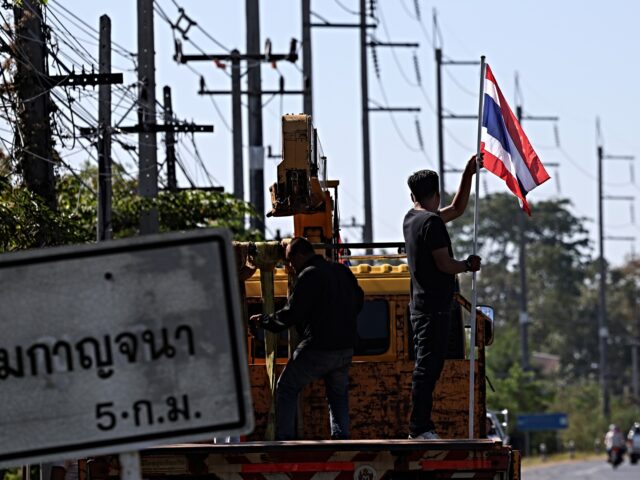

Cambodian Prime Minister Hun Manet said on Thursday that Thai forces are holding disputed territory by force, and even occupying Cambodian land beyond the disputed area, putting intense strain on the ceasefire agreement brokered by President Donald Trump.
President Trump announced a ceasefire in December after weeks of escalating clashes between Cambodia and Thailand, precipitated by a landmine explosion that Thailand blamed on Cambodia.
The landmine was a remnant of the last round of fighting between the two Southeast Asian nations over their border, which has been contested for more than a century. The latest round of fighting displaced hundreds of thousands of civilians on both sides of the border.
Manet told Fox News Digital on Thursday that Thai forces have sealed off the areas under their occupation with barricades made from barbed wire and shipping containers, stranding some 80,000 displaced Cambodians.
“The occupation is beyond even Thailand’s unilateral claim. Many of the villagers cannot go back to their hometowns,” he said, referring to Thailand’s notion of where the border should be drawn.
Manet, who was in Washington for the inaugural meeting of President Trump’s Board of Peace, suggested the board could “play an active role in promoting peace, stability, and normalcy between Cambodia and Thailand.”
“Our position is to always stick to peaceful resolutions. We don’t believe that using war to stop a war is sustainable or practical,” he said.
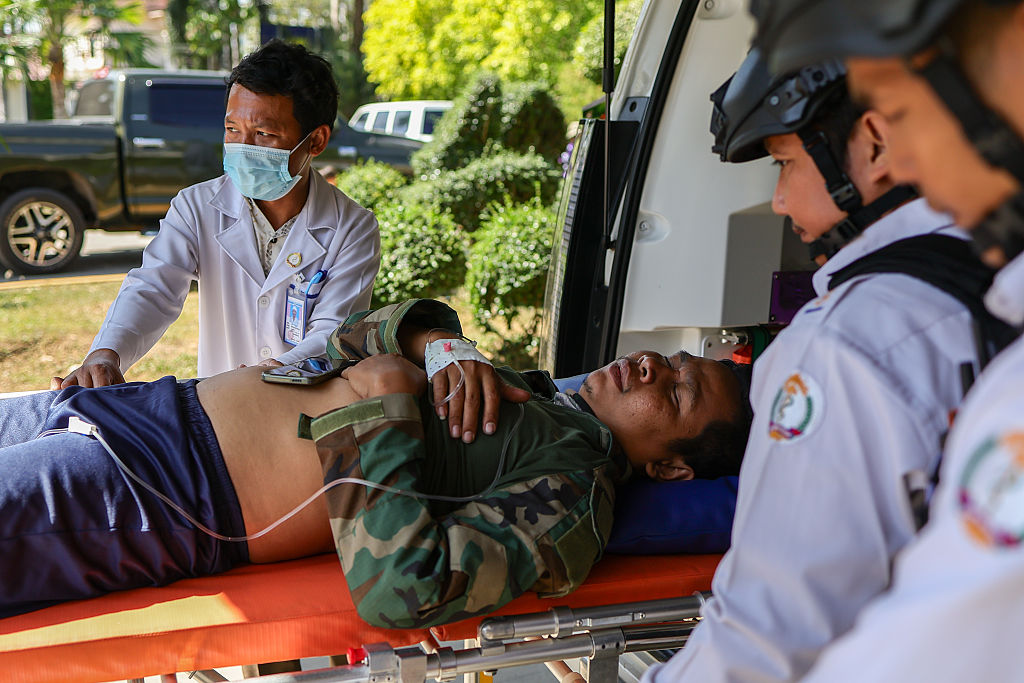
File/An injured Cambodian soldier is taken to a hospital at an undisclosed location, as Cambodia accuses Thailand of launching multiple strikes on Cambodian border areas, in Banteay Meanchey province, Cambodia, on December 26, 2025. (Daniel Ceng/Anadolu via Getty Images)
Manet urged Thailand to “allow the Joint Boundary Commission (JBC) to work as early as possible.” The JBC is a bilateral committee that has met sporadically since it was established in 2000 to resolve the border dispute. Hun Manet is a strong believer in the JBC as the ideal mechanism for drawing mutually acceptable borders between Thailand and Cambodia.
Manet said on Thursday that he believes Thailand’s February 8 elections delayed the JBC’s work, but “now the election is done, we hope that Thailand can start, at least on a technical level, to start measuring, start demarcating in the hot zone, so that we can go back to life.”
The Thai election seemed like a grim omen for the border dispute, as new prime minister Anutin Charnvirakul is an avowed nationalist who took a tough stance on Cambodia in his campaign.
Manet is probably hoping that his efforts to rebuild relations with the United States will be helpful in resolving the dispute with Thailand. Ties between the two countries have warmed considerably over the past year, helped along by Manet’s nomination of Trump for the Nobel Peace Prize in August to commemorate his work on the Thai-Cambodian peace treaty.
The Trump administration would still like to see a bit more distance between Cambodia and China, particularly in matters like the Ream Naval Base, which was renovated between 2022 and 2025 with extensive assistance from Beijing. Manet repeated his insistence that the base does not belong to the Chinese military, or any other foreign power, even though Chinese warships are allowed to dock there.
Manet insisted that Cambodia will not choose between the U.S. and China, but will insist on its right as a “sovereign country” to “pursue the policy of friends” with both.
Trump did mention Cambodia and Thailand in his inaugural remarks to the Board of Peace on Thursday, but mostly to congratulate them for working out a ceasefire to halt the “nasty war” they had been fighting. The Cambodian government took even this cursory mention as a positive sign that the dispute with Thailand is on the Board of Peace agenda.
Thailand said on Thursday that it is holding all of its troops in position, in accordance with the ceasefire agreement, and is not attempting to occupy any Cambodian territory.
“We are adhering to the joint statement, which agreed to maintain existing troop deployments. There has been no reinforcement,” insisted Thai Defense Ministry spokesman Rear Adm. Surasant Kongsiri.
In a further sign of deteriorating relations, Thailand on Friday announced that work permits for some 100,000 Cambodian migrant workers have been put on hold, ostensibly to evaluate any “security risks” that might be posed by the Cambodians. Most of those workers are currently unable to return to Cambodia due to the border situation.
“For our ministry, such decisions are an internal matter of the Thai side, but I want to clarify that Cambodia has prepared all the necessary mechanisms to assist our workers in case they are sent back, so that they have jobs,” a spokesman for Cambodia’s labor ministry responded.
“The Ministry of Labour wishes to inform all workers that in cases of discrimination or abuse there, and if you want to return to work in Cambodia, we welcome you, because we have many jobs that are more secure and have comparable income,” the ministry said.
COMMENTS
Please let us know if you're having issues with commenting.