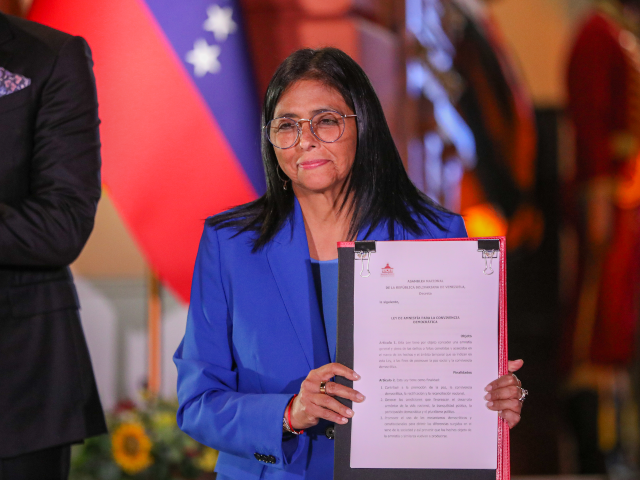
“Acting president” of Venezuela Delcy Rodríguez on Thursday evening signed an “amnesty law” criticized by local human rights organizations over its limited reach for all of the socialist regime’s remaining political prisoners.
Rodríguez signed the bill into law moments after it was approved by the National Assembly — a parliamentary body entirely controlled by the ruling United Socialist Party of Venezuela (PSUV) and led by Delcy’s brother Jorge Rodríguez.
“This law opens an extraordinary door for Venezuela to rediscover itself and learn to live democratically and rid itself of hatred; for understanding and recognition to prevail. The Amnesty Law goes even further,” Rodríguez said on Thursday.
The Venezuelan outlet Runrunes explained that, rather than a full amnesty, the 16-article law limits the the scope of the new amnesty provisions to events that occurred across 13 specific moments in Venezuela’s 27-year political crisis, such as the events surrounding the sham July 2024 presidential election and moments of intense anti-regime protests against the Venezuelan regime between 2002 and 2025.
Persons who “are or may be prosecuted or convicted for promoting, instigating, soliciting, invoking, favoring, facilitating, financing, or participating in armed or forceful actions against the people, sovereignty, and territorial integrity of the Bolivarian Republic of Venezuela by foreign states, corporations, or individuals” are excluded from the amnesty, as per Runrunes.
The Venezuelan newspaper El Nacional reported that discussions over the law’s Article 7 prompted the socialist lawmakers to postpone the bill’s deliberations on February 12 before it was modified. According to the newspaper, the article’s final version states that the amnesty covers: “Any person who is or may be prosecuted or convicted for crimes or offenses committed” and who “is in compliance with the law or comes into compliance with the law.” El Nacional stressed that as such, individuals must be in “compliance” with Venezuelan courts, all of which are presently controlled by the socialist regime. The text includes that those in exile may send a representative before a judge.
“After submitting the request for amnesty, the person may not be deprived of liberty for the acts provided for in this law and must appear in person before the competent court for the purpose of granting amnesty,” the law’s article 7 reportedly reads in part.
Reuters noted that the law does not detail what “crimes’ would be eligible for amnesty nor does it contain provisions for the return of assets seized from individuals detained. It does not revoke public office bans imposed on politicians , nor does it remove sanctions that the regime has imposed against local media outlets.
Rodríguez, during the signing ceremony, called to execute the law with “maximum celerity” and called upon Venezuelan authorities to review cases of individuals not covered by the law in order to “heal wounds, restore democratic coexistence, and justice.”
“I ask all of Venezuela to devote ourselves to this fundamental task as one of the great virtues of our republic, which must be justice,” she reportedly said.
Alfredo Romero, President of the non-government organization Foro Penal detailed in a brief social media video that although the law will include a group of politically persecuted persons, it is “quite restrictive and excludes a significant sector” of politically persecuted persons, many of whom are still arbitrarily detained.
Moments after Rodríguez signed the law, opposition politician Juan Pablo Guanipa announced through social media that he had been given full freedom. He criticized the amnesty law, describing it as a “bogus document that seeks to blackmail many innocent Venezuelans and excludes several brothers who remain unjustly behind bars.”
“I agree with reconciliation among Venezuelans, but with the truth at the forefront. Reconciliation based on lies is like a giant with feet of clay; it collapses at the first sign of trouble,” Guanipa’s message read in part.
“The release of political prisoners is not an act of clemency. None of them should have been imprisoned. The dictatorship kidnapped them in an attempt to break the spirit of the Venezuelan people, but they failed,” he continued. “Despite the terror, they failed in their mission to turn us into a submissive people.”
Guanipa is a close ally of ally of anti-socialist opposition leader María Corina Machado that spent ten months in hiding after the Venezuelan regime accused him of being involved in a purported “terrorist” plot.
He was captured on May 2025 and spent ten months unjustly detained until mid-February 2026. Hours after his release, he was re-arrested and placed into house arrest days later at his son’s house in the city of Maracaibo, Zulia.
COMMENTS
Please let us know if you're having issues with commenting.