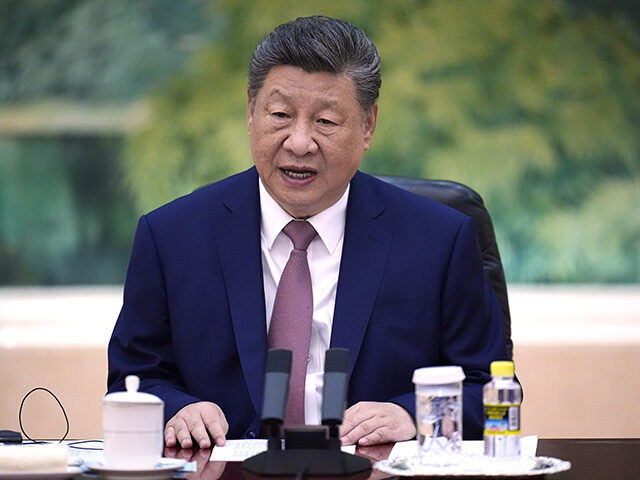

China’s communist dictator Xi Jinping received a coveted position on this year’s edition of Time magazine’s list of 100 most influential people, receiving a profile crediting him with “rewriting how the world works” that omits any mention of the ongoing Uyghur genocide.
Xi, widely considered China’s most powerful dictator since Mao Zedong, has been engaging in the erasure of indigenous communities in occupied East Turkistan – via the use of slavery, forced sterilization, and the wholesale destruction of historic and religious sites – for nearly a decade. The evidence of widespread imprisonment of Uyghurs, Kazakhs, and other Turkic groups in concentration camps in East Turkistan has diminished since China claimed that the camps, dubbed “vocational training” centers, had “graduated” its victims. But as recently as this Thursday, evidence from human rights groups and defecting officers indicates that the subjugation has simply been made less visible, rather than eliminated.
In addition to the asphyxiating persecution policies in East Turkistan, non-Han ethnic groups in Tibet and Inner Mongolia have denounced similar measures in which locals are forced out of speaking their native language, have their children taken away to communist indoctrination “boarding schools,” and, in many cases, are forced into slavery.
Time publishes its list of 100 most influential people every year, typically choosing the world’s most prominent political and religious leaders, technology moguls, entertainment artists, athletes, and other notables. The magazine’s editor-at-large, Charlie Campbell, wrote a profile of Xi that hints at his brutality – noting that Xi has been “purging generals, bridling tech oligarchs, and entrenching the Chinese Communist Party as the paramount state organ” – but omits the Uyghur genocide.
The magazine noted that Xi is working on “rewriting how the world works,” crediting him for having “leveraged China’s dominance of rare earths to cow geopolitical rivals” and “exploited U.S. tariff anarchy to ink new trade agreements,” as well as promoting the use of the national currency, the yuan, over the U.S. dollar.
Xi has not appeared in the Time 100 list since 2022. At the time, his profile, written by Jeffrey Wasserstrom, did mention the Uyghur genocide, though only in passing. Wasserstrom listed some of Xi’s most egregious actions in an inverted way, mentioning actions he did not take to elevate what he did: “Reconsidered the zero-COVID strategy that has been criticized by the World Health Organization chief as ‘not sustainable’; reversed course on Xinjiang, the site of horrific human-rights abuses; distanced himself from a warmongering Vladimir Putin; and, of course, named a successor.”
“Xinjiang” is the Mandarin colonialist name for East Turkistan, and the “horrific human-rights abuses” in question are, according to a widespread segment of the global human rights community, a genocide. Genocide is defined in international law as taking actions “with intent to destroy, in whole or in part, a national, ethnical, racial or religious group.” International law lists a series of actions that the accused must take to be guilty of genocide; engaging in only one of these actions alone satisfies the elements of the crime. On the list are killing those in the targeted group, “imposing measures intended to prevent births,” and “forcibly transferring children of the group to another group.” Evidence from East Turkistan suggests the Communist Party is guilty of all three, in addition to enslaving thousands of people – potentially millions – and destroying critical cultural sites such as cemeteries and mosques.
In 2021, the Uyghur Tribunal, a group of international legal experts tasked with examining the situation, found China guilty of genocide in the case of East Turkistan, highlighting the particular brutality of the “vocational” centers imprisoning as many as 3 million Uyghurs.
“Women detainees have had their vaginas and rectums penetrated by electric shock rods and iron bars. Women were raped by men paying to be allowed into the detention centre for the purpose,” the Tribunal found. “One young woman of twenty or twenty-one was gang raped by policemen in front of an audience of a hundred people all forced to watch.”
“Pregnant women, in detention centres and outside, were forced to have abortions even at the very last stages of pregnancy. In the course of attempted abortions babies were sometimes born alive but then killed,” it continued.
China has claimed for years that the concentration camps no longer exist, but evidence indicates that the persecution continues. In an article published on Thursday, the UK Spectator highlighted the testimony of Chinese former police officer Zhang Yabo, offered to one of the world’s most preeminent experts on the Uyghur genocide, researcher Adrian Zenz. Zhang reportedly testified that, rather than keeping concentration camp victims in large prison complexes visible through satellite imaging, Chinese authorities began to “destroy every single file related to the re-education camps” and rotate local populations into short-term, brutal imprisonment.
“By keeping the lockups brief but systematic, the state maintains pervasive fear while projecting an illusion of normalcy … programs actually operate as a vast mechanism for state-imposed forced labour and demographic engineering,” Zenz explained in his latest report.
COMMENTS
Please let us know if you're having issues with commenting.