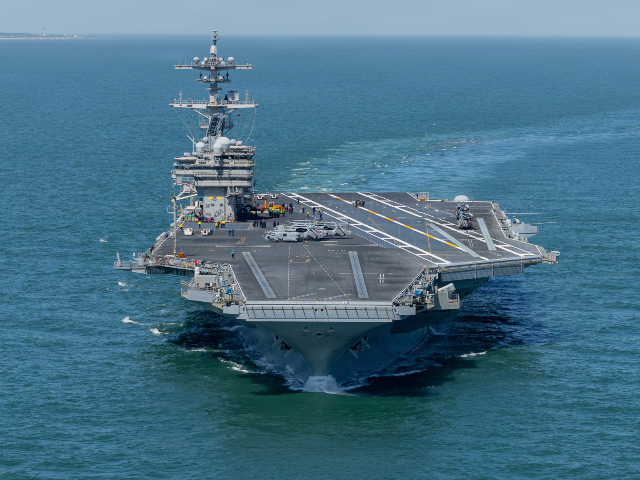

President Donald Trump’s blockade of Iranian ports brings a tremendous amount of air and sea power to bear against the difficult task of ensuring that no ships enter or leave Iranian ports.
The blockade force currently includes three carrier battle groups, two Marine amphibious assault ships (which are essentially small aircraft carriers) and ten guided missile destroyers, plus space and undersea assets.
The aircraft carrier Gerald R. Ford, the largest and longest-deployed carrier of the modern era, is on its way back into service after undergoing repairs from a non-combat-related fire that broke out on March 12. The carrier was obliged to withdraw to Croatia for repairs, but has now returned to the Mediterranean.
The other two carriers in the area are the USS Abraham Lincoln and USS George H.W. Bush. The Navy is reportedly still considering whether to keep all three near Iran, or use the Bush to relieve the Ford so it can return home for more extensive repairs.
The National on Wednesday envisioned the carrier groups providing air surveillance of the waters around Iran’s ports so that the fast and sophisticated Arleigh Burke-class destroyers can intercept ships which challenge the blockade — and the amphibious assault ships can put Marines aboard any vessel that refuses to turn away.
No such aggressive measures have been necessary thus far. U.S. Central Command (CENTCOM) said on Thursday that “after 72 hours of enforcement, 14 vessels have turned around to comply with the blockade at the direction of American forces.”
CENTCOM said U.S. forces remain “focused, vigilant, and highly motivated” as they patrol the sky and water around Iran. The U.S. Marines have been keeping themselves busy with “live hoist training on the flight deck of America-class amphibious assault ship USS Tripoli,” which will help to keep them in top shape if boarding actions become necessary.
The National quoted analysts who warned of dangers yet to come if Iran eventually decides to try breaking the blockade.
One obvious tactic would involve putting troops from Iran’s terrorist Islamic Revolutionary Guard Corps (IRGC) aboard merchant ships armed with shoulder-launched missiles. Merely brandishing such weapons beneath watching American planes, helicopters, and destroyers could make intercepts much more perilous.
Iran might also be in possession of Chinese-made anti-ship missiles, which range in capability up to the CM-302 “carrier killers” with supersonic speed and 175-mile range.
Even without weapons that can threaten American ships and aircraft, Iran could push the blockade into an awkward new phase by simply refusing to stop when commanded. The U.S. Navy would have to escalate to warning shots, and then boarding actions.
CENTCOM has so far documented only one Iranian cargo ship making an aggressive effort to evade the blockade, sailing from the port of Bandar Abbas on Tuesday and hugging the Iranian coastline to exit from the Strait of Hormuz. The ship was intercepted by the guided missile destroyer USS Spruance and “redirected” back to Iran, without any shots being fired.
Iranian Maj. Gen. Ali Abdollahi said on Wednesday that Iran could create a “blockade” of its own in retaliation for the American action.
“If the aggressive and terrorist America continues its unlawful actions of maritime blockade in the region and creates insecurity for Iranian commercial ships and oil tankers, this action will be considered a prelude to violating the ceasefire, and the powerful Armed Forces of Iran will not allow any kind of export and import to continue in the Persian Gulf, the Sea of Oman, and the Red Sea,” he huffed.
Abdollahi did not explain how Iran would enforce such a gigantic blockade when most of its navy is currently resting on the bottom of the ocean. According to President Donald Trump on Monday, Iran’s navy has been “completely obliterated” except for small “fast attack ships,” which could pose a threat to unprotected civilian vessels but would be unlikely to get past American destroyers and patrolling aircraft.
Iran would most likely need to work with its Houthi proxies in Yemen to threaten missile and drone attacks against commercial vessels, a tactic the Houthis used successfully during the 2024 Gaza war. The “Houthi card” has not been played against the blockade yet, but U.S. and Israeli forces are reportedly on guard for renewed piracy.
COMMENTS
Please let us know if you're having issues with commenting.