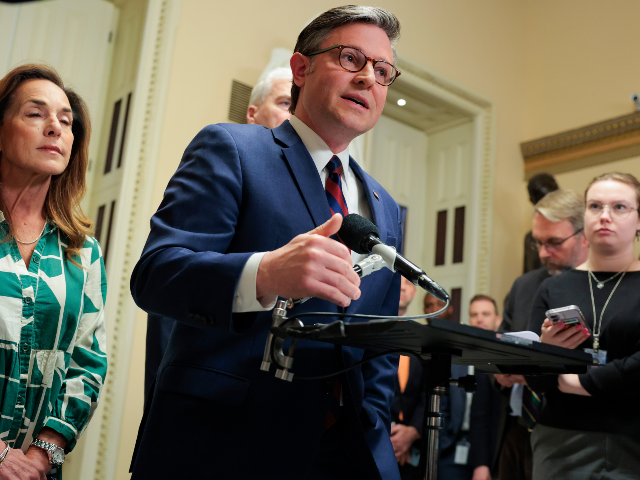

Congress passed a short-term extension of a key government surveillance authority after House Speaker Mike Johnson (R-LA) failed to ram through a clean extension of Section 702 of FISA over the interests of bipartisan lawmakers who want to reform the spy power.
The Senate on Friday passed the short-term extension of Section 702 of the Foreign Intelligence Surveillance Act (FISA) after a long-term renewal failed amidst bipartisan opposition to a clean extension of the spy power in the House.
Section 702 is a surveillance authority meant to be used to spy on foreign adversaries. However, Americans’ private communications incidentally get surveilled without a warrant — contrary to the Fourth Amendment protections against warrantless surveillance.
The House had agreed by unanimous consent to extend Section 702 until April 30 after tanking multiple attempts to extend the authority by five years and 18 months.
The failure of Section 702 to pass through the House without reforms proves that congressional leadership and the White House may have to agree to reform the law to secure the GOP votes necessary for a longer-term extension.
Twenty conservatives had voted against a longer extension early Friday morning because it would not protect the privacy of American citizens. Reformers want a warrant requirement for searches of Americans’ communications as well as a warrant for purchasing Americans’ data through third-party data brokers. Those who wish for privacy reform for months have made it clear that they would need to see consideration of a warrant requirement to vote to reauthorize the surveillance tool.
Reps. Tim Burchett, Eric Burlison, Michael Cloud, Andrew Clyde, Andy Harris, Mark Harris, Scott Perry, Ralph Norman, Thomas Massie, Keith Self, Andy Ogles, Warren Davidson, Diana Harshbarger, Mary Miller, Paul Gosar, John Rose, Lauren Boebert, Victoria Spartz, Sheri Biggs, and Eli Crane voted against advancing the 18-month extension of Section 702.
On the other side, four Democrats voted to extend Section 702, including Reps. Jared Golden (D-ME), Josh Gottheimer (D-NJ), Thomas Suozzi (D-NY), and Marie Gluesenkamp Perez (D-WA).
Rep. Warren Davidson (R-OH), a chief privacy proponent in the House, made it clear that a warrant requirement is needed to reauthorize Section 702.
He wrote, “Without a suitable warrant requirement, FISA will not be reauthorized. The foreign part of the foreign intelligence surveillance act is an essential tool for national security. It should be reauthorized. We are very close to making both happen.”
Rep. Lauren Boebert (R-CO) on Monday wrote to National Security Agency (NSA) Director Joshua Rudd about many instances of “deeply troubling abuses of power” by NSA analysts who have misused the spy tool to search private communications for personal reasons, including a person met through a dating service and a potential tenant.
“As a Member of Congress who takes both national security and the constitutional rights of every American seriously, I find it unacceptable that nearly three years after this abuse was disclosed, the public has received no accounting of what consequences, if any, were imposed on the individuals responsible,” she wrote about the lack of accountability.
Boebert continued, “I also insist on a warrant requirement for any queries of an American so that a judge decides whether a search of an American’s private communications is justified.”
COMMENTS
Please let us know if you're having issues with commenting.