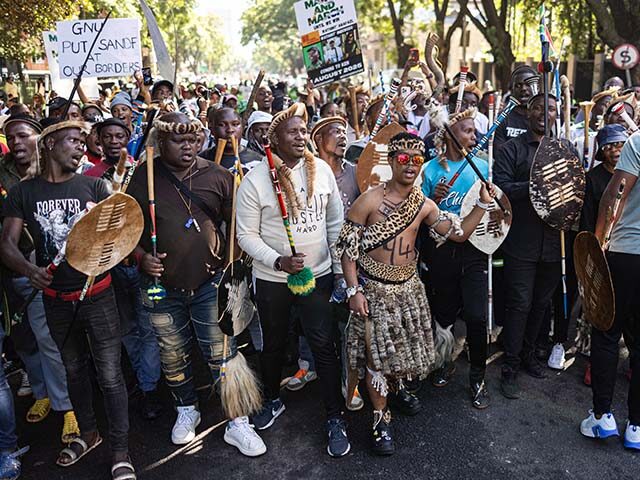

Over 300 people marched against mass migration and undocumented immigrants in Pretoria, South Africa, on Tuesday.
Police stepped in to prevent physical confrontations when the marchers entered a district of the city with a heavy immigrant population.
The demonstration was organized by a civic group called March and March, which has accused the South African government of not doing enough to enforce immigration and citizenship laws. The group demanded mass deportations at a previous rally in March.
Most of the same allied groups attended both the March and April demonstrations, including the ActionSA political party and Operation Dudula, an anti-immigration vigilante group whose name is taken from a Zulu phrase that means “to force out.”
As with the previous event, March and March’s demonstration on Tuesday largely consisted of black Africans speaking out against other black Africans. South African anti-migration activists are particularly critical of migrants from Nigeria, who they accuse of burdening South Africa’s welfare and law enforcement agencies.
March and March founder Jacinta Ngobese-Zuma – a 39-year-old black radio personality who established the organization last year to protect the impact of mass migration upon employment, education, and public safety – said on Tuesday that many of the migrants flooding into South Africa are criminals fleeing prosecution in other countries.
“They are not victims. If you walk down the roads, you will find that they take buildings. There are drugs. There is prostitution. There are cartels. There are mafias. So, everything in this country is a fertile ground for criminals to thrive,” she said.
Ngobese-Zuma said her organization has been unfairly attacked for simply insisting on proper enforcement of South Africa’s laws.
“The only thing that they do is to label us as xenophobic. There is nothing xenophobic about wanting law and order in your country,” she said.
“This is not normal migration. I say this all the time. What we’re currently facing in South Africa is not normal migration,” she insisted.
Another speaker at Tuesday’s rally, March and March treasurer Sanele Nkambule, complained that many of the small spaza shops across the country – essentially bodegas, named with a Zulu word that means “hidden” because they had to do business in secret during apartheid – are “owned or run by foreign nationals without proper trading rights.”
Since these shops pay no taxes, Nkambule said their operations placed “an unfair burden on citizens who pay taxes.” March for March’s platform includes a thorough audit of all spaza shops to ensure they are run by legal citizens and pay taxes.
March and March held a similar demonstration in Johannesburg on Wednesday, at which ActionSA member Themba Mabunda also pushed back against charges of mindless xenophobia.
“We are not xenophobic, we just want the right thing to be done in South Africa, to put the South African first. We do want to live with foreigners in our country, but those foreigners must be legally in the country,” Mabunda said.
South African President Cyril Ramaphosa did not seem sympathetic to these arguments in his address on Monday, which was “Freedom Day” in South Africa, an annual public holiday commemorating the first elections after the end of the apartheid racial system in 1994.
Ramaphosa’s Freedom Day speech condemned attacks on foreigners, celebrated the contributions made by other African nations to end apartheid, and warned citizens not to allow their concerns about mass migration to “breed prejudices and hatred toward our fellow Africans.”
Officials and civic activists in neighboring countries advised their nationals in South Africa to take shelter during the March for March rallies.
Ghana’s diplomatic mission in South Africa told Ghanaians to “place the highest priority on personal safety” and “take precautionary measures,” while the Nigerian Union in South Africa advised Nigerians to “close their shops” and “not go outside.”
“I’ve been harassed,” Nigerian Union chairman Olaniyi Abodedele told the BBC on Tuesday.
“For us, it’s not about whether you are legal or not, and that is why everyone is very careful right now. As long as you are a Nigerian, you are profiled and you are stereotyped immediately,” Abodedele said.
A heavy police presence was deployed for the march on Tuesday, watching nervously as the demonstrators and onlookers shouted insults at each other. The anti-migration demonstrators frequently used the insult amakwerekewere, a nonsensical pejorative intended to mock the sound of unintelligible foreign dialects.
COMMENTS
Please let us know if you're having issues with commenting.