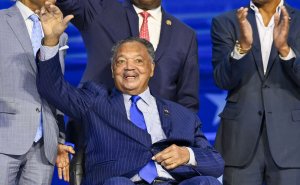

Feb. 17 (UPI) — The Rev. Jesse Jackson, a Baptist minister and civil rights leader who twice sought to be the Democratic Party’s nominee for U.S. president, died Tuesday, his family announced. He was 84.
The Rainbow PUSH Coalition shared the announcement of Jackson’s death, saying he was surrounded by family as he “died peacefully” on Tuesday morning, but did not state a cause of death.
“Our father was a servant leader — not only to our family, but to the oppressed, the voiceless and the overlooked around the world,” the Jackson family said in a statement. “We shared him with the world and in return, the world became part of our extended family. His unwavering belief in justice, equality and love uplifted millions and we ask you to honor his memory by continuing the fight for the values he lived by.”
Jackson had recently been hospitalized because of a rare neurodegenerative condition called progressive supranuclear palsy. He was diagnosed in 2017 with Parkinson’s disease, but doctors later determined he was suffering from the more rare condition.
Jackson was born as Jessie Louis Burns on Oct. 8, 1941, in Greenville, S.C., to a 16-year-old mother. His stepfather, whom his mother married a year later, adopted him and officially gave him the last name Jackson.
He attended the University of Illinois on a football scholarship but later transferred to the Agricultural and Technical College of North Carolina, a predominantly Black school, where he studied sociology. He later studied at the Chicago Theological Seminary and was ordained a Baptist minister in 1968.
As a student during the height of the 1960s civil rights movement, Jackson became inspired by the activism he saw around him. He was present at the 1965 Selma to Montgomery march in Alabama, which was led in part by the Rev. Martin Luther King Jr.
Jackson also worked with the Southern Christian Leadership Conference in Atlanta. He founded the SCLC’s Operation Breadbasket, which helped to improve the economic status of Black Americans, and was named the national director of the group from 1967 to 1971.
Facing controversy over whether he was using the SCLC for personal gain, the group suspended Jackson, and he went on to found the Chicago-based Operation PUSH, which stood for People United to Save Humanity. In 1984, he founded the National Rainbow Coalition — which also sought equal rights for LGBTQIA+ communities — and later merged the two groups to form Rainbow/PUSH Coalition.
As Jackson’s image as a civil rights leader grew, he became more prominent on the national and global stage, speaking against apartheid in South Africa, campaigning for statehood for Palestine, and negotiating the release of hostages in Beirut, Cuba, Syria and Iraq.
In the 1980s, Jackson turned his attention toward a political career. He ran for the Democratic presidential nomination in 1984, in which he placed third in primary voting and in 1988, when he placed second to Michael Dukakis. At the time, he had the strongest showing ever for a Black American running for president, but negative comments he made about Jewish communities and his association with Nation of Islam leader Louis Farrakhan impacted his public standing for many.
Jackson never ran for president again, but in 1991, he was elected as a delegate and so-called shadow senator representing the District of Columbia in the U.S. Congress. He held the position through 1997 and used the platform to campaign for statehood for the capital city.
Then-President Bill Clinton awarded Jackson the Presidential Medal of Freedom in 2000, and in 2021, French President Emmanuel Macron appointed him as a commander of the Legion of Honor for his civil rights work.
He also authored two books — Straight from the Heart in 1987 and Legal Lynching: Racism, Injustice, and the Death Penalty in 1995.
Jackson married Jacqueline Brown in 1962, with whom he had five children: singer Santita Jackson; former U.S. Rep. Jesse Jackson Jr., U.S. Rep. Jonathan Jackson; businessman Yusef Jackson; and academic Jacqueline Jackson. Jesse Jackson also had a child — writer/producer Ashley Jackson — in 1999 after an affair with a staffer, which lost him his job hosting Both Sides with Jesse Jackson on CNN and prompted him to step away from activism for a time.
COMMENTS
Please let us know if you're having issues with commenting.