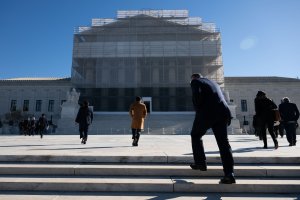

Jan. 14 (UPI) — Political candidates have legal standing to sue states that count mail-in ballots received after election day, the Supreme Court ruled Wednesday.
The court voted 7-2 to allow lead plaintiff Rep. Mike Bost, R-Ill., to continue his lawsuit against the Illinois State Board of Elections and its executive director for counting mail-in ballots that are received after a designated voting day.
Also suing are presidential elector nominees Laura Pollastrini and Susan Sweeney.
Article III of the Constitution requires plaintiffs to have a “personal stake” in a case in order to have legal standing to sue, and an unlawful election rule can cause injury in many ways, the court ruled.
A candidate might lose an election, expend more resources, lose a share of the vote or suffer a damaged reputation, Chief Justice John Roberts said in the majority opinion.
Candidates also have an interest in a fair process, but “rules that undermine the integrity of the electoral process also undermine the winner’s political legitimacy,” Roberts wrote.
Illinois law allows for the counting of mail-in ballots that are mailed through election day and received up to two weeks after voting ends.
Bost says the late counting of ballots forces him to “organize, fundraise and run [his] campaign for 14 more days,” which costs “time, money, volunteers and other resources” by forcing campaigns to send poll watchers to monitor the arrival.
It also raises the potential for illegal and untimely ballots to be counted and cause a candidate to lose an election.
“Candidates, in short, are not ‘mere bystanders’ in their own elections,” Roberts said. “They have an obvious personal stake in how the result is determined and regarded.”
When the process “departs from the law,” Roberts said “the long-shot and shoo-in alike would suffer harm if a state chose to conduct its election by, say, flipping a coin.”
He said harm occurs when public confidence in elections erodes when illegal votes are counted or when legally cast votes are discarded.
Justices Sonia Sotomayor and Ketanji Brown Jackson dissented, saying plaintiffs must establish some harm or “injury in fact” that occurred to challenge Illinois’ mail-in ballot law, and Bost has not done that.
“A majority of the court nevertheless concludes that Bost has standing to sue based solely on his status as a candidate for office,” Brown wrote in her 20-page dissent.
“The court thereby subtly shifts from our longstanding actual-injury rule to a presumption that certain kinds of plaintiffs are sufficiently aggrieved to satisfy Article III standing, regardless of whether they will experience any particularized harm,” she said.
“This dubious departure from settled law disregards both the equal treatment of litigants and judicial restraint.”
Bost, Pollastrini and Sweeney challenged Illinois’ mail-in ballot counting procedure.
The court did not rule on the legality of mail-in ballots or how they are counted and instead ruled on whether or not Bost, Pollastrini and Sweeney have standing to sue in the matter.
A federal district court ruled against the plaintiffs, saying they lacked standing to sue over the matter, which the Seventh Circuit affirmed upon appeal.
The matter now goes back to the district court for litigation, which could result in further appeals that put it before the Supreme Court to rule on the legality of late-counting of mail-in ballots.
COMMENTS
Please let us know if you're having issues with commenting.