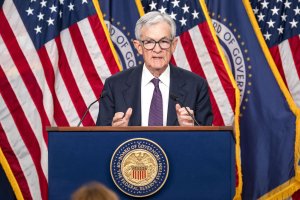

April 22 (UPI) — Federal Reserve Chairman Jerome Powell’s term is nearing its end and President Donald Trump is pushing for his replacement but an investigation into Powell may hold up the appointment of a new chair.
The Justice Department opened an investigation into Powell over the renovation of the Marriner S. Eccles Federal Reserve Board Building in Washington, D.C., which Trump claims has exceeded $3 billion. The renovation was not the beginning of Trump’s feud with Powell but it has added to his effort to oust the chairman before the end of his term.
Powell’s term as chairman of the Federal Reserve will end in May but he will remain on the Board of Governors until January 2028.
Typically when a Fed chair’s term ends, they resign. However, Powell said he plans to stay put until a replacement is appointed.
At least one lawmaker, Sen. Thom Tillis, R-N.C., said he would not vote on a new chairman until the investigation into Powell is over.
The Justice Department alleges that Powell made false or misleading statements to Congress about the cost of the renovation project at the Federal Reserve headquarters during his testimony to the House Committee on Financial Services in June.
Powell’s testimony was part of his semiannual report to Congress on monetary policy.
Following the hearing, Rep. Anna Paulina Luna, R-Fla., submitted a request to then-Attorney General Pam Bondi for Powell to be investigated for perjury and making false statements. Luna said that Powell denied there would be “luxury features” included in the renovations, including a “VIP dining room, premium marble, water features and a roof terrace garden.”
Luna added that Powell “falsely claimed that the Eccles building ‘never had’ a serious renovation.” She notes that the building underwent renovations in 1999 and 2003.
“These are not minor misstatements,” Luna said. “Chairman Powell knowingly misled both Congress and executive branch officials about the true nature of a taxpayer-funded project. Lying under oath is a serious offense — especially from someone tasked with overseeing our monetary system and public trust.”
No charges have been formally filed against Powell. The challenge the Justice Department faces in convicting Powell of perjury or false statements is in proving that he willfully, knowingly made statements he knew to be false at the time.
Powell, who was Trump’s nominee for chairman in 2017, has said that the investigation into him and the Federal Reserve renovation is “pretext” to punish him for not following Trump’s direction to lower interest rates.
“No one, certainly not the chair of the Federal Reserve, is above the law, but this unprecedented action should be seen in the broader context of the administration’s threats and ongoing pressure,” Powell said in a video message in January. “This is about whether the Feed will be able to continue to set interest rates based on evidence and economic conditions — or whether instead monetary policy will be directed by political pressure or intimidation.”
Last month, federal prosecutor George A. Massucco-LaTaif told Chief U.S. District Judge James E. Boasberg that the Justice Department does not know of any evidence that a crime has been committed in the Federal Reserve renovation project.
“We do not know at this time,” Massucco-LaTaif said. “However, there are 1.2 billion reasons for us to look into it.”
The fissure between Powell and Trump began and has continued over the Federal Reserve’s decision to maintain elevated interest rates in response to inflation. Trump has repeatedly called on the Federal Reserve to lower interest rates, saying the United States should “have the lowest interest rate in the world.”
All along the Federal Reserve continues to hold an elevated interest rate, currently between 3.5% and 3.75%, in an effort to tame inflation. Its target rate of inflation is 2% on an annual basis.
Economic markers from the U.S. Bureau of Labor statistics show the rate of inflation remains at about 3%.
Trump has nominated Kevin Warsh to succeed Powell. Warsh served on the Fed’s board for five years after being appointed by President George W. Bush in 2006.
“I have known Kevin for a long period of time, and have no doubt that he will go down as one of the great Fed chairmen, maybe the best,” Trump posted on social media in January. “On top of everything else, he is ‘central casting,’ and he will never let you down.”
Warsh faced his first hearing on the path toward confirmation on Tuesday when he testified before the Senate Banking Committee. Questions by senators centered on the Federal Reserve’s independence, something Trump’s influence has called into question.
If appointed, Warsh would be the wealthiest person to lead the Federal Reserve.
Presidents have butted heads with the Federal Reserve throughout its history, as monetary policy can reflect on how the U.S. population views the president’s performance. A president has never tried to fire the chairman of the Federal Reserve.
The Federal Reserve is a non-partisan, independent agency made up of a board of governors posted in Washington, D.C., and 12 regional banks located across the United States.
Independence is key to the Federal Reserve’s function, keeping it from choosing policy based on the political goals of those occupying the White House and other branches of government.
Trump has not attempted to fire Powell yet but he did attempt to fire Fed board Gov. Lisa Cook. The attempt was unsuccessful as the U.S. Supreme Court intervened in October and ruled that she can remain at her post on an interim basis, at least for 2026.
The president does have some authority over choosing or designating a new Federal Reserve chair, Peter Shane, a constitutional law scholar in residence at NYU Law School, told UPI. However, a president must demonstrate a good reason for doing so.
There are two mechanisms in place that are meant to protect the independence of the Federal Reserve and its chair from political influence.
First, there is Supreme Court precedent. In 1935, the high court made a ruling in the landmark case Humphrey’s Executor vs. the United States. In this case, the court ruled that President Franklin D. Roosevelt could not fire the commissioner of the Federal Trade Commission, another independent agency, without cause.
The ruling affirmed that the authority to remove the head of any independent agency falls to Congress.
Second, there is the Federal Reserve Act. President Woodrow Wilson signed the Federal Reserve Act of 1913 to decentralize the control over monetary policy in the United States. This established the Federal Reserve and set its independence as a foundational feature of its existence.
The Federal Reserve Act makes the Federal Reserve independent in setting monetary policy without the influence of the president or Congress.
Congress has the ability to change the Federal Reserve Act. It did so in 1977 with the Federal Reserve Reform Act.
This amendment, signed into law by President Jimmy Carter, codified the objectives of the agency and established a requirement for the board of governors to report to Congress in hearings twice a year. It also added the requirement of Senate confirmation hearings for the chairman and vice chairman of the board of governors.
Last year, Rep. Thomas Massie, R-Ky., introduced the Federal Reserve Board Abolition Act, calling for the board of governors of the Federal Reserve and all Federal Reserve banks to be abolished.
“Americans have suffered under crippling inflation and the Federal Reserve is to blame,” Massie said in a statement.
Since being introduced in March 2025 the bill has not progressed beyond being referred to the House Committee on Financial Services.
COMMENTS
Please let us know if you're having issues with commenting.