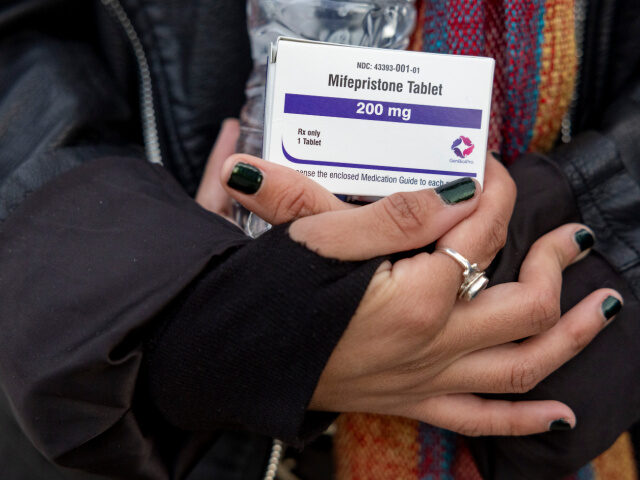

The U.S. Food and Drug Administration (FDA) approved a new generic version of the abortion pill on Tuesday, prompting outrage from conservatives and the pro-life movement.
The FDA’s approval of a generic form of mifepristone — the first drug used in a two-drug medication abortion regimen — comes as the agency, under the direction of the Department of Health and Human Services (HHS), is performing a safety review of the drug following a shocking study suggesting a much higher complication rate than previously reported.
The FDA specifically approved a generic form of the abortion pill produced by Evita Solutions LLC, a company that says its mission is to “normalize abortion” and make it “accessible to all.” In the FDA’s letter to Evita Solutions LLC, the agency said it concluded the drug is “bioequivalent and therapeutically equivalent” to the brand name mifepristone drug Mifeprex, which is made by Danco Laboratories, and has therefore met the requirements for approval.
Breitbart News reached out to the FDA for comment about the drug’s approval and asked whether the agency is still conducting a safety review of mifepristone.
HHS communications director Andrew Nixon told Breitbart News the FDA has “very limited discretion in deciding whether to approve a generic drug.”
“By law, the Secretary of Health and Human Services must approve an application if it demonstrates that the generic drug is identical to the brand-name drug,” Nixon said. “Generic applicants are not required to submit independent evidence proving safety and effectiveness.”
Nixon said HHS is still conducting a study on the reported adverse effects of mifepristone “to ensure the FDA’s risk mitigation program for the drug is sufficient to protect women from unstated risks.”
“The FDA does not endorse any drug product and directs prescribers to follow all labeling,” he added.
Sen. Josh Hawley (R-MO), who has been one of the main lawmakers pressuring the HHS to conduct a review of mifepristone, called the agency’s approval of the drug “shocking.”
“FDA has just approved ANOTHER chemical abortion drug, when the evidence shows chemical abortion drugs are dangerous and even deadly for the mother. And of course 100% lethal to the child,” Hawley said in a post to X on Thursday.
“FDA had promised to do a top-to-bottom safety review of the chemical abortion drug, but instead they’ve just greenlighted new versions of it for distribution. I have lost confidence in the leadership at FDA,” he added.
Leading pro-life groups also slammed the move, with Students for Life of America (SFLA) president Kristan Hawkins calling it a “true failure.”
“The Pro-Life Generation asked during the campaign and from day one in this new administration for one Republican President to undo the political manipulations of three Democratic Party Presidents who prioritized the business model of Chemical Abortion Pill pushers,” she said in part. “More babies will die; More women will be harmed; and More Americans exposed to Abortion Water Pollution as a direct result of this unfathomable decision. This is a stain on the Trump Presidency and another sign that the deep state at the FDA must go.”
Susan B. Anthony Pro-Life America President Marjorie Dannenfelser called it a “reckless decision” and “unconscionable.”
“These dangerous drugs take the lives of unborn children, place women and underage girls at serious risk, empower abusers, and trample the pro-life laws enacted by states across the nation,” Dannenfelser said in a statement:
In September, Secretary Kennedy said the Biden administration ‘twisted the data to bury one of the safety signals.’ Secretary Kennedy and FDA Commissioner Makary assured Congress and the American people they would conduct a thorough review given credible evidence of the harm inflicted by these drugs. The prompt completion of the review is made more urgent given this approval to flood the market with a cheap abortion drug.
The FDA must, at a minimum, immediately reinstate the commonsense safeguards that were in place during President Trump’s first term. In particular, the Biden-era policy of removing doctors by allowing mail-order abortion drugs without in-person medical oversight must be reversed without delay. Women are endangered by taking the drugs without a sonogram to check for ectopic pregnancy and confirm the gestational age of the child.
President Trump believes states have the right to pass and enforce pro-life protections. Yet every day this right is being trampled upon by the abortion industry.
A study from the Ethics and Public Policy Center (EPPC) found that 10.93 percent of women who had mifepristone abortions experienced severe complications including sepsis, infection, hemorrhaging, or another serious adverse event within 45 days following the abortion. This percentage is significantly higher than the less than 0.5 percent in clinical trials reported on the FDA-approved drug label. The study is based on analysis of data from an all-payer insurance claims database that includes 865,727 prescribed mifepristone abortions from 2017 to 2023.
HHS Secretary Robert F. Kennedy Jr. called the findings “alarming” during a Senate Health, Labor, Education and Pensions (HELP) Committee hearing in May and said he ordered the FDA to do a complete review of the drug. At another hearing in September, Kennedy accused the Biden administration of manipulating abortion pill safety data.
While the pro-life movement wants mifepristone to be eliminated altogether, it is pushing, at a minimum, for earlier safeguards to be reinstated after the Obama and Biden administrations chipped away at them.
Mifepristone was first fast-tracked for approval in 2000 during the Clinton administration under a process that required unwanted pregnancy to be classified as a “serious or life-threatening illness” and the drug had to be proved more effective than surgical abortion, the EPPC study details.
The original FDA-approved drug label for Mifeprex from September of 2000 said the drug should be used through approximately 7 weeks of pregnancy. Its use also required “several modest safeguards for women’s health,” the study notes. Safeguards included:
- Three office visits by the patient
- A prescription given only by physicians who have read and understand prescribing information
- Administration of the drug in a clinic, medical office, or hospital, by or under the supervision of a physician able to assess the gestational age of an embryo and to diagnose ectopic pregnancies
- The presence of a physician who is able to provide surgical intervention in cases of incomplete abortion or severe bleeding, or plans for such care through others
- Patient access to medical facilities equipped to provide blood transfusions and resuscitation, if necessary.
These safeguards have been eliminated over the past two decades since the drug’s approval.
Following actions by the Obama and Biden administrations, the drug’s current Risk Evaluation and Mitigation Strategy (REMS), which has been in effect since 2023, allows women to obtain mifepristone with one telehealth visit with any approved healthcare provider (not necessarily a physician), allows women to self-administer the drugs obtained from a mail-order pharmacy, and allows women to take the drugs up to ten weeks gestation instead of seven weeks.
The FDA also stopped requiring prescribers to report serious adverse events other than deaths in 2016.
Pro-abortion groups like Planned Parenthood and The American College of Obstetricians and Gynecologists (ACOG) have contended scrapping these regulations is necessary in order to increase access to abortions, especially in wake of the Supreme Court’s Dobbs decision overturning Roe v. Wade. Roe had created the constitutional “right” to abortion 50 years before before the high court released its Dobbs decision in 2022, sending the issue back to states and their elected representatives.
The American Association of Pro-Life OBGYNs (AAPLOG) counters that relaxing regulations around mifepristone puts women at risk. Specifically, they warn a lack of in-person evaluation could put women at risk of having undiagnosed ectopic pregnancies or miscalculating how far along they are.
In 2023, medication abortions accounted for 63 percent of all abortions within the formal U.S. healthcare system — meaning an estimated 642,700 unborn babies died in medication abortions, according to the pro-abortion Guttmacher Institute. The percentage was up from an estimated 53 percent in 2020 and 39 percent in 2017. The report did not account for abortion pills obtained through underground national and international networks, including those that send pills to women in states with abortion restrictions.
In a medication abortion, mifepristone blocks the action of progesterone, which the mother’s body produces to nourish the pregnancy. When progesterone is blocked, the lining of the mother’s uterus deteriorates, and blood and nourishment are cut off to the developing baby, who then dies inside the mother’s womb. The drug misoprostol (also called Cytotec) then causes contractions and bleeding to expel the baby from the mother’s uterus.
Katherine Hamilton is a political reporter for Breitbart News. You can follow her on X @thekat_hamilton.
COMMENTS
Please let us know if you're having issues with commenting.