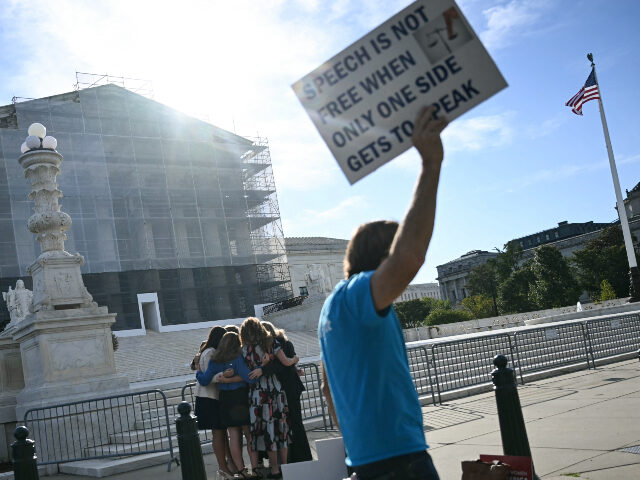

The Supreme Court overwhelmingly ruled against a Colorado “conversion therapy” law on Tuesday that bans therapists from helping minors align their “gender identity” with their biological reality.
The High Court ruled against the law 8-1, saying it likely violates the First Amendment by allowing some viewpoints but not others. Liberal-leaning Justice Ketanji Brown Jackson, who has repeatedly been unable to describe what a woman is, penned the lone dissent.
Colorado’s law was passed in 2019; more than 20 other states have laws banning “conversion therapy.” While Colorado’s law bans archaic and unethical aversion methods historically associated with conversion therapy, like electroshock therapy, it also more broadly outlaws “providing professional services for the purpose of attempting to change a person’s sexual orientation or gender identity, including attempting to change behaviors or expressions of self or to reduce sexual or romantic attractions or feelings toward individuals of the same gender.”
Kaley Chiles, a practicing Christian and a licensed counselor who, per court documents, “believes that people flourish when they live consistently with God’s design, including their biological sex,” sued the state over the law. She argued the law banned her from using talk therapy with clients who voluntarily come to her to help them align their sexuality or view of their identity with their biological reality, particularly with regard to minors.
Chiles contended Colorado banned consensual conversations based on the viewpoints expressed, in violation of the Free Speech Clause of the First Amendment, and only allows counselors to push minors toward “gender-affirming care,” which includes social transition, sex change drugs, and surgeries — methods which are experimental, steeped in ideology, and pushed by large medical associations. Colorado argued that licensed health professionals in the state are subject to professional discipline for providing treatment to patients that falls “below the accepted standard of care.”
RELATED: Supreme Court Appears Skeptical of Colorado’s ‘Conversion Therapy’ Ban
Justice Neil Gorsuch wrote the majority opinion, saying the question before the court was a “narrow one,” and noted that Chiles did not seek to overturn the Colorado law in its entirety but to insure talk therapy between her and her minor clients is protected.
He wrote:
We do not doubt that the question ‘how best to help minors’ struggling with issues of gender identity or sexual orientation is presently a subject of fierce public debate. But Colorado’s law addressing conversion therapy does not just ban physical interventions. In cases like this, it censors speech based on viewpoint.
Colorado may regard its policy as essential to public health and safety. Certainly, censorious governments throughout history have believed the same. But the First Amendment stands as a shield against any effort to enforce orthodoxy in thought or speech in this country. It reflects instead a judgment that every American possesses an inalienable right to think and speak freely, and a faith in the free marketplace of ideas as the best means for discovering truth.
“However well-intentioned, any law that suppresses speech based on viewpoint represents an egregious assault on both of those commitments. The judgment of the Tenth Circuit is reversed, and the case remanded for further proceedings consistent with this opinion,” he added.
Jackson conversely wrote in her dissent that the majority “plays with fire in this case” and said she is afraid “the people of this country will get burned.”
“Before now, licensed medical professionals had to adhere to standards when treating patients: They could neither do nor say whatever they want,” Jackson wrote. “Largely due to such State regulation, Americans have been privileged to enjoy a long and successful tradition of high-quality medical care.”
Nearly two dozen states and Washington, DC, have similar laws, which could be impacted by the Supreme Court’s decision.
Jim Campbell, the Alliance Defending Freedom (ADF) attorney who argued the case on behalf of Chiles before the High Court, called the decision a “significant win.”
“Kids deserve real help affirming that their bodies are not a mistake and that they are wonderfully made. The U.S. Supreme Court’s decision today is a significant win for free speech, common sense, and families desperate to help their children,” Campbell said in a statement. “States cannot silence voluntary conversations that help young people seeking to grow comfortable with their bodies.”
Chiles called the ruling a major win for counselors and families across the United States.
She said in a statement:
When my young clients come to me for counsel, they often want to discuss issues of gender and sexuality. I look forward to being able to help them when they choose the goal of growing comfortable with their bodies. Counselors walking alongside these young people shouldn’t be limited to promoting state-approved goals like gender transition, which often leads to harmful drugs and surgeries. The Supreme Court’s ruling is a victory for counselors and, more importantly, kids and families everywhere.
The ruling is the latest example of the 6-3 majority conservative Supreme Court slapping down overreach from transgender activists who have worked for more than a decade to elevate gender identity over biological reality in all spheres. Last year, the court dealt major blows to transgender activists pushing for sex changes for minors and LGTBQ+ propaganda in schools. The Supreme Court is expected to rule soon on the whether transgender-identifying males (biological boys and men) should be allowed to dominate female sports and spaces.
The case is Chiles v. Salazar, No. 24-539 in the Supreme Court of the United States.
Katherine Hamilton is a political reporter for Breitbart News. You can follow her on X @thekat_hamilton.
COMMENTS
Please let us know if you're having issues with commenting.