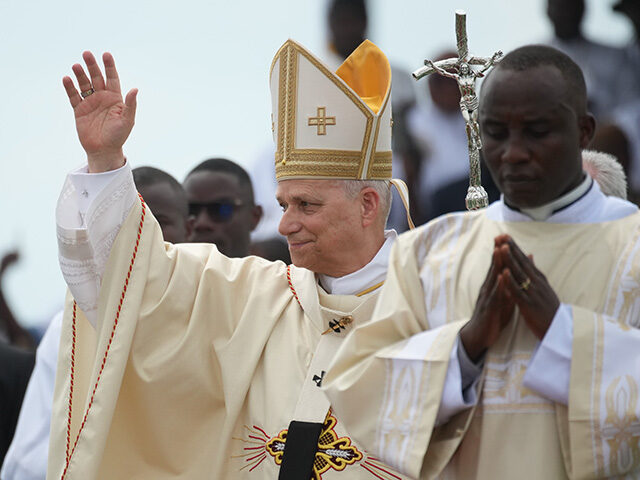

Pope Leo XIV urged young men in Cameroon not to take the dangerous migration route to Europe and instead develop their own country.
“In the face of the understandable tendency to migrate — which may lead one to believe that elsewhere a better future may be more easily found — I invite you, first and foremost, to respond with an ardent desire to serve your country and to apply the knowledge you are acquiring here to the benefit of your fellow citizens,” Leo told French-speaking Cameroonian attendees at a mass on April 19. He added:
This is the raison d’être of your university, founded thirty-five years ago to form pastors of souls and lay people committed to society: these are the witnesses of wisdom and justice, of which the African continent needs.
The message reflects the Pope’s zig-zag strategy on migration politics.
He argues that young people should develop their own countries through work and study, but also argues that young people who migrate should be protected.
He also argues that the Catholic Church should welcome migrants, but also that national governments have the right to block migrants and the duty to help their young people not to migrate.
He directs his deputies in many countries to manage their bishoprics, but the many pro-migration bishops also push him to endorse more migration into their parishes.
The church’s pro-migration lobbies tout any statements that seem to support migrants or migration, but populist politicians slam him when he seems to endorse migration into Europe or the United States.
The inevitable result is that his universalist and inspiring messages can be seen as clashing with the practical problems — such as migration — facing national politicians, including President Donald Trump and Vice-President JD Vance.
Yet those papal religious messages are usually broad enough to avoid direct conflict with governing populists, including those who are supported by the many Catholic populists who oppose the church’s pro-migration hierarchy.
“The Pope has said, on numerous occasions, that he is not a politician and that his role is not the determination of any nation’s foreign policy,” Minnesota Bishop Robert Barron said in an April 20 X message. He added:
But he has just as clearly said that he will continue to speak for peace and for moral constraint. In making both of these claims, he is operating perfectly within the framework of paragraph 2309 of the [Catholic] Catechism. If we understand that the Pope and the President have qualitatively different roles to play in the determination of moral action … we can, I hope, extricate ourselves from the completely unhelpful narrative of “Pope vs. President.”
This complementary role for popes amid hard-nosed politicians was displayed when Leo talked about the many dilemmas of migration during a December 2025 visit to Lebanon:
A challenge, not only for Lebanon but for the entire Levant, is what can be done to ensure that young people in particular do not feel compelled to leave their homeland and emigrate? How can we encourage them not to seek peace elsewhere, but to find guarantees of peace and become protagonists in their own native land?
…
There are times when it is easier to flee, or simply more convenient to move elsewhere. It takes real courage and foresight to stay or return to one’s own country, and to consider even somewhat difficult situations worthy of love and dedication. We know that here, as in other parts of the world, uncertainty, violence, poverty and many other threats are leading to an exodus of young people and families seeking a future elsewhere, even though it is very painful to leave one’s homeland.
It is certainly necessary to recognize that much good can come to all of you from having Lebanese people spread throughout the world. However, we must not forget that remaining in our homeland and working day by day to develop a civilization of love and peace remains something very valuable.
Amid the Pope’s idealism and broad perspective, many Western progressives, church leaders, and employers ruthlessly try to extract yet more migrants to fill jobs, apartments, welfare rolls, voting booths, or church pews in developed countries.
This demand for more migrants often disregards the economic harm to citizens, the damage to the migrants’ poor home countries, and the massive danger for migrants. “At least 7,667 people died or went missing on migration routes worldwide in 2025,” the United Nations (UN) reported in February 2026:
Sea crossings remained among the deadliest routes. In 2025, at least 2,185 people died or went missing in the Mediterranean, while 1,214 were recorded on the Western Africa/Atlantic route [including Cameroonians] toward the Canary Islands. Despite year-on-year declines, the real toll is likely higher, as at least 1,500 additional people were reported missing at sea but could not be verified due to limited access to search-and-rescue information.
Many migrants from Cameroon die as they use boats to reach Spain, Italy, and European islands in the Atlantic.
But fewer migrants are dying in the Americas, likely because of President Trump’s policies, the UN admitted in February.
“In the Americas, 409 deaths were recorded in 2025, the lowest annual total since [the UN] began collecting data in 2014 … likely due to fewer people taking dangerous irregular pathways, such as crossing the Darien Jungle or the US-Mexico border,” the UN said.
COMMENTS
Please let us know if you're having issues with commenting.