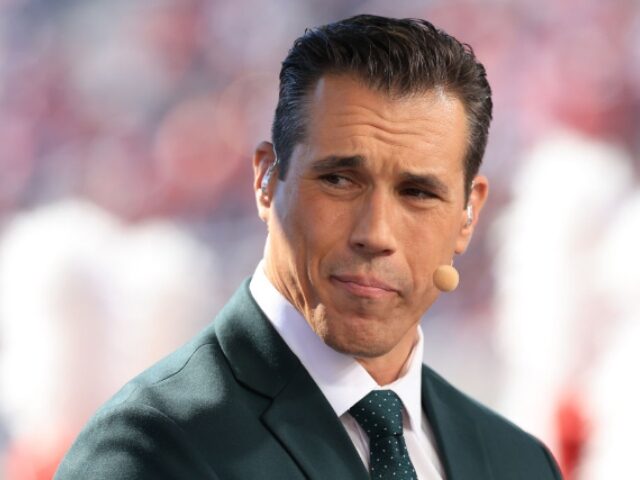

Fox Sports analyst Brady Quinn sees a controlling mechanism behind the chaos and confusion sown by the College Football Playoff (CFP) Committee: ESPN.
The former Notre Dame QB and current member of the Fox Big Noon Saturday pregame show blasted his rival network, accusing it of manipulating the committee’s selection process to benefit ESPN and the teams and conferences with which it has broadcast agreements.
“This entire process is controlled by ESPN and Disney,” Quinn said on the podcast Stugotz and Company. “And just to compare it to the NFL — because that’s where college football is going, it’s more of a professionalized model — what you have is an NFL that controls all of it. And they kind of say, ‘Hey, we decide who gets access on this and who doesn’t,’ it’s entirely different with college football. This is all an ESPN creation, a Disney creation, so I think that’s where they think there’s a big sense of bias.”
ESPN’s influence over college football is indeed something wholly different from that of its or any other broadcast partner over the NFL. The NFL, by and large, tells its broadcast partners what it’s going to do, and the networks comply. However, with no central governing body for college football and its broadcast rights deal with the Southeastern Conference (SEC), and given that it owns the broadcast rights to all CFP selection show broadcasts, ESPN wields immense influence over the sport.
“I mean, let’s just go back before the season. [ESPN] talked about the committee changing the criteria in how they evaluate schedules, because what did we have last year in the playoff? Only three SEC teams and they all got stomped for the most part, besides Texas, that at least made its way to the semifinal round. And, by the way, barely made it there,” Quinn said.
The change in criteria worked to the benefit of ESPN and the SEC. The 2025 committee – headed up by Hunter Yurachek, an SEC athletics administrator – increased the number of SEC teams in the 12-team bracket to five. As Awful Announcing reports, the committee “decided to place more emphasis on the exact criteria that would benefit SEC teams: strength of schedule, conference depth, and quality losses within a tough league.”
“So, when you look at the landscape, I think the SEC was watching the Big Ten now win the last two national championships, there’s a lot more money in some of these Big Ten programs that are starting to distance themselves,” Quinn said. “And you look at their media rights deal, same thing, they keep kind of distancing themselves. I think there’s a concern for the products that ESPN has and the SEC and ACC.”
Given the change in criteria and the completely different result the committee engineered, a key question in the future will be whether separate committees should be able to change their grading criteria at will, or should they be required to stick to a set of grading criteria that doesn’t change from year to year.
“As much as you know, I sit there and say, is there separation between the committee and ESPN? Sure,” Quinn continued. “But it also lends itself to the conspiracy theories that are out there because it’s hard to make a case for a team that went 2-2 in its last four, got absolutely drummed in the SEC championship game, and watched every other team conference championship weekend dropped that lost but them.”
Quinn also aimed at the Group of Five automatic bids, claiming that the two spots reserved for those teams also help ESPN manipulate the field.
“When we talk about the ACC’s criteria, which is obviously primarily owned and distributed by ESPN, we talked about their conference championship, playoff criteria, look at the criteria for the teams that get the auto bids in that are conference champions,” Quinn added. “Like, this whole JMU, Tulane, with the AAC, that’s also part of the issue that I have with how we’ve constructed which five conference champions get in. You could also put in language there that kind of protects some of those power four teams, but you didn’t, right? So, you know, I realize it’s only because they’re making it up as they go along.”
“That’s exactly what it is,” Stugotz chimed in. “It’s a made-for-TV event throughout the course of the season. Otherwise, why would you tune in?”
A wholesale review of the committee process is certainly needed after this year’s debacle. Though one of the solutions to he problem, an expansion to 16 teams, seems to already be in the offing. However, a serious examination of the committee’s criteria is needed to ensure that rogue committees led by SEC administrators don’t use an expanded playoff merely to cram more undeserving SEC teams into it.
COMMENTS
Please let us know if you're having issues with commenting.