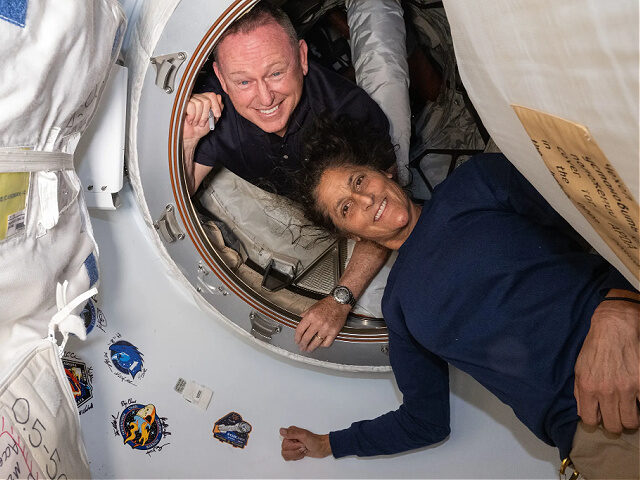
NASA announced that Boeing stranding astronauts in space due to the Starliner spacecraft’s failure has been officially reclassified as a Type A mishap, the agency’s most serious safety designation, nearly eight months after the troubled mission concluded.
Space.com reports that NASA revealed the reclassification on February 19, placing the Boeing Crew Flight Test that stranded astronauts in space in the same category as the space shuttle Challenger and Columbia disasters. The announcement came during a press conference that detailed findings from an investigation into the mission’s numerous technical problems.
“This was a really challenging event in our recent history,” NASA Associate Administrator Amit Kshatriya said during the briefing. “We almost did have a really terrible day.”
The Boeing Crew Flight Test launched on June 5, 2024, carrying NASA astronauts Suni Williams and Butch Wilmore to the International Space Station (ISS) for what was intended to be a 10-day mission. While the spacecraft successfully reached the orbiting laboratory, it encountered multiple critical failures during the journey that threatened the safety of the crew.
During the approach to the space station, Starliner experienced multiple thruster failures and temporarily lost what mission controllers call six degree of freedom control, which is the ability to precisely maintain the spacecraft’s desired orientation and trajectory in space. NASA Administrator Jared Isaacman, reading from a letter sent to all NASA employees, acknowledged the gravity of the situation.
“Flight rules were appropriately challenged, control was recovered and docking was achieved,” Isaacman stated. “But it is worth restating what should be obvious: At that moment, had different decisions been made, had thrusters not been recovered, or had docking been unsuccessful, the outcome of this mission could have been very, very different.”
The problems continued throughout the mission. NASA extended Williams and Wilmore’s stay aboard the space station multiple times to study the thruster issues. After careful evaluation, the agency ultimately decided the spacecraft was too risky to bring the astronauts home and returned Starliner to Earth uncrewed on September 6. Even during that autonomous return, the capsule experienced an unexpected crew module propulsion failure and lacked fault tolerance in its thrusters throughout reentry.
Williams and Wilmore remained aboard the ISS and returned to Earth on a SpaceX Crew Dragon capsule in March 2025, having spent approximately nine months in space rather than the planned 10 days. Both astronauts have since retired from the agency.
NASA recognizes five categories of mishaps, ranging from Type A (the most serious) to Type D, plus close calls. Any incident causing at least two million dollars in damages or unplanned mission costs, or involving unexpected departure from controlled flight, qualifies as a Type A mishap. The Crew Flight Test clearly met these criteria, according to Isaacman.
The administrator revealed that NASA failed to properly classify the mission during and immediately after the flight because officials were too focused on certifying Starliner for operational missions. “Concern for the Starliner program’s reputation influenced that decision,” Isaacman said. “Programmatic advocacy exceeded reasonable balance and placed the mission, the crew and America’s space program at risk in ways that were not fully understood at the time decisions were being contemplated. This created a culture of mistrust that can never happen again, and there will be leadership accountability.”
The investigation continues as NASA and Boeing work to identify the root cause of the thruster problems. Isaacman emphasized that Starliner will not carry astronauts again until these issues are resolved. The spacecraft is currently scheduled to fly an uncrewed cargo mission to the space station no earlier than April, though no official launch date has been established.
Read more at Space.com here.
Lucas Nolan is a reporter for Breitbart News covering issues of free speech and online censorship.
COMMENTS
Please let us know if you're having issues with commenting.