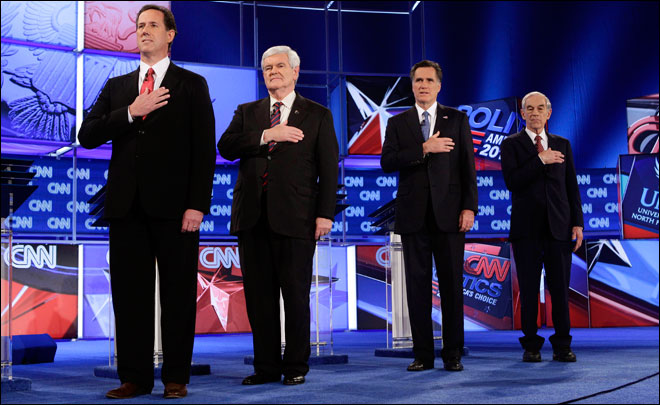
With 10 states and over 400 delegates at stake on March 6th, Super Tuesday,
Ohio will be a key state to watch for how Santorum performs versus Mitt Romney. Still, each contest will have it's own winner and losers, as most expect a mixed result. For more information, you can click on the link for each state mentioned below.
As for the possibility of a brokered convention, the odds have been increasing, with
reports having them as high as 20% for now.
We're finally close enough to Super Tuesday to get a sense of how the overall delegate count might work out in the GOP primary. The end result: Assuming that none of the four candidates drops out of the race, it looks increasingly as if no one will be able to claim a majority of the delegates. The candidate with the best chance is Mitt Romney, but he probably wouldn't be able to wrap up the nomination until May or even June. The other candidates will probably have to hope for a brokered convention.
Georgia is a must win for Gingrich, while at a bare minimum, he'll need to show well in other Southern states if he wants to appear resurgent. The former Speaker is up from 16 - 20 percent in
his home state right now, after being in a three way tie just a week ago.
There are
76 delegates available. Check the Georgia Secretary of State’s
website for additional details. In 2008, Huckabee won with 34%, McCain ended with 32% and Romney won 30%.
Romney's best hopes are addressed in another
solid analysis available here.
Mitt Romney must lock down Virginia, where only he and Paul are on the ballot, as well as Massachusetts, where he served as governor, and Vermont. And Rick Santorum must close the deal in the ultraconservative states of Tennessee and Oklahoma, where he already enjoys big leads in the polls.
Representative Ron Paul has his work cut out for him.
Texas Rep. Ron Paul not only must pile up delegates in the caucus states of Alaska, Idaho, and North Dakota--where his tight-knit and enthusiastic organization provides advantages--he needs to finally win one outright.
The odds are in favor of Ohio being the make it or break it state in the battle between Mitt Romney and Rick Santorum.
But there is one must-win--or close to it--on the docket: Ohio. It’s not so much about the state’s 66 delegates, although winning delegates is important. It’s about momentum, media narrative, and general election viability.
Ohio is America’s preeminent bellwether state. It has picked the winner in 25 of the last 27 presidential elections. It provided the margin of victory in both of President George W. Bush’s campaigns. And electoral experts agree it provides a near-perfect microcosm of the general election landscape.
Click this link and scroll down for a formatted state-by-state listing of the details, represented by this example.
GEORGIA PRIMARY
Delegates at stake: 76
How it works: 34 delegates will be awarded proportionally to any candidate receiving more than 20% of the statewide vote. The winner in each of the state's 14 congressional districts will earn another two delegates, and the second-place finisher will win one, unless one candidate wins more than 50% in a district.
2008 result: In a close three-way race, Mike Huckabee won 34% of the vote, followed by John McCain with 32% and Romney with 30%.
2012 advantage: An automated SurveyUSA poll has Gingrich ahead by 15 points, 39% to 24%, over Santorum.
All the latest in
polling is available via Real Clear Politics here.