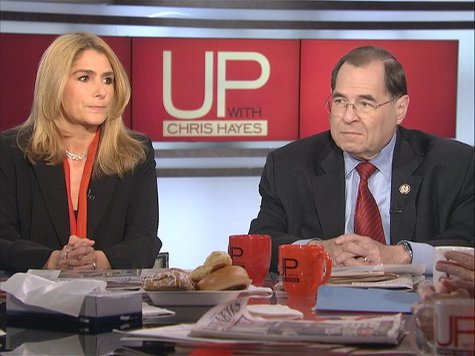


This weekend, Marina Sitrin of the Occupy Legal Working Group appeared onMSNBC’s “Up with Chris Hayes.” Hayes introduced Sitrin as someonewith a “radical perspective outside” the world of Washington politics. Trueto her billing, Sitrin offered a vision so far outside themainstream of American politics that even left-wing Rep. Jerrold Nadlerpushed back on it:
Marina Sitrin: People who’ve been involvedin the Occupy movements around the US, the movement’s around the world butthere’s a similarity, but we’re talking about tens of thousands, hundreds ofthousands of people who are in a different conversation, which is nothostile, it’s just a different conversation all together which is thegovernment is not meeting people’s needs it’s not going to meet people’sneeds, is kind of the expectation I think of a lot of people, so we need tocome together and figure something else out entirely. So it’s a differentconversation about kind of what the government even can do. I think there’sa total rejection of the kind of politics that come from representation.People believing that actually we’re not represented.
Lack of representation was one of the major grievances that led to theRevolutionary War. Sitrin seems to be suggesting the Occupy movement sees usat a similar point in history. Even Rep. Jerrold Nadler (0% ACU, 99% AFL-CIOrating) felt forced to push back:
Rep. Nadler: Well, it’s interesting ifpeople reject the concept of representation but there is no other conceptunless your back to the small Greek city-state you have to have arepresentative government. Hopefully it’s a democratic government with asmall ‘d’ because otherwise what have you got? So you have to work throughrepresentative government and the question is how do you make representativegovernment work? How do you eliminate or reduce the power of money which isdestroying our democratic system? Those are the relevant questions. Youcan’t just reject democratic government because there’s no alternative.
Sitrin: I actually think we need to open theconversation about what democracy means. And I think that’s what the Occupymovements in the US, the movements in Greece and Spain and all over theworld have been doing. If we have no say in our lives, we regular people,around economics, war, social questions–all questions, economic, social,political, then what kind of democracy…it’s a question?
In case it wasn’t clear enough that Sitrin sees Occupy as a revolutionaryforce that seeks to replace our system with something quite different, shehad this to sayabout the kickoff of tomorrow’s May Day general strike:
Hayes: Just tell me a little bit about howthe movement is envisioning it.
Sitrin: I’m gonna, yeah, I will talk about how themovement’s envisioning it and to help give a sense of both kind of OccupyMay Day and the concept of general strike I want use actuallythere’s this phrase by Walter Benjamin who is this thinker anddecades he wrote–actually paraphrasing something by Karl Marx–about, um, you think about revolution as being this locomotive in historyand Benjamin said maybe we need to rethink that and maybe actually we needto think of revolution as this concept of when people pull the emergencybrake who are on the train. And I think in a lot of way you know with whatwe were talking about with inequality and you know rising inequality andlower union density and everything else. I think as a population we’vepulled the emergency brake. I think that’s what the Occupy movement is aboutis just saying stop. And we’re going to create something different. And MayDay and a general strike is another kind of stop. Stopping in the senseof…you know, will we shut down all production, no I don’t think so.
Hayes: [Laughter] I think that’s a safe bet.
Sitrin: That’s not out of the question at other times inthe future. People around the world do it regularly.
Walter Benjamin was a Marxist critic and philosopher with ties to theFrankfurt School. Whether you prefer his take on revolution (pulling thebrake on the train) or Marx’s original one (revolution as the locomotive ofhistory), the fact remains that we no longer seem to be talking aboutreforming the system via the mechanisms specified in the Constitution. AsSitrin said initially, this is “a different conversation.”
Given the reaction of Chris Hayes and Rep. Nadler, it’s safe to say thatOWS remains well outside the bounds of conventional, even far-left, Americanpolitics. This is not a side issue but a central one, because OWS has alwaysbeen about generating sympathetic media buzz. They simply don’t have thenumbers to achieve anything much without from the force-multiplier of thenational media. Last fall, it took weeks before the national media beganreporting on the unseemly aspects of OWS. There’s no excuse for anotherhoneymoon phase this time around.
Starting tomorrow, OWS is back and more radical than ever. Will the mediareport on the radical goals espoused by their own spokespeople or will theyinsulate the public from this reality? You can bet that if Tea Party memberswere talking about ending representative democracy and starting over, itwould be the lede, not a fact omitted for brevity. It’s time for the USmedia to apply the same standard to OWS. It’s time, in other words, for therevolution to be televised.
COMMENTS
Please let us know if you're having issues with commenting.