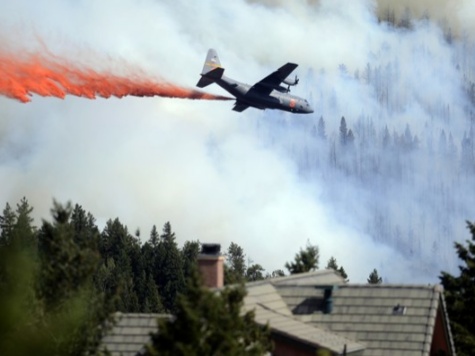

Wildfires in Colorado have now burned over 180,000 acres.Unfortunately, these fires come at a time when the federal governmenthas a historically low number of air tankers to fight suchblazes. By the government’s own estimates, it currently has undercontract just one-half to one-third of the firefighting planes itneeds.
The U.S. Forest Service contracts with private companies around thecountry to provide air tankers to respond to wildfires like the ones nowraging in Colorado. Many of these air tankers are aging planes, some ofwhich first saw service in the 1950s. ABC reportsthat tanker “crashes in 2002 and 2004 led to stricter safety standardsthat eliminated dozens of aging air tankers from the fleet.” As aresult, the number of fire-fighting planes dropped from 44 in 2006 to 11at the beginning of this fire season. That decline has not been withoutcontroversy.
In April 2011, the FAA questioned the certification of three airtankers operated by a California firm called Aero Union. At the time,Aero Union maintained and operated 8 of the remaining 19 planesavailable for fire-fighting work. A report in a Lubbock, Texas paper,where three of the Aero Union planes were fighting wildfires at thetime, suggested that the issue was one of completing agreed upon inspections:
Britt Gourley, president and CEO of the Aero Union, said his companystopped flying its three aircraft because of an ongoing conflict withthe U.S. Forest Service and the Federal Aviation Administrationconcerning the company’s certification.
Gourley said his company initially was given certification by the FAAand U.S. Forest Service in 2007, with the understanding Aero Unionwould put its fleet of eight P3 air tankers through a gauntlet ofinspections as part of the FAA’s phase-in program.
He said the planes already have gone through and passed the mostcrucial inspections at a cost of more than $11 million…But additionalinspections remain, which he estimates would cost more than $20 million.Gourley said his company had planned to finish those inspections andpart replacements by 2013.
An emergency meeting between the company and the U.S. Forest Service led to the resolution of the problem less than a week later. However, two months after that the Forest Service abruptly cancelled its entire contract with Aero Union in the middle of the fire season. The company was forced to lay off the majority of its work force.
Asa result of cancelling the contract with Aero Union, the Forest Servicewas left with just 11 large tankers under contract at the beginning ofthis year’s wildfire season. That number dropped to nine planes aftertwo tankers owned by two different companies crashed earlier this month.One of the crashes killed two pilots.
The Forest Service initiated a modernization strategy in February which called forunder contract. As a result, the Forest Service has been forced toborrow planes from state fire-fighting agencies and from the Canadiangovernment.
Two weeks ago, the Forest Service announcedthat new contracts had been signed with four air tanker companies,including two that owned the two planes which crashed this month.Eventually, these contracts will add another seven planes to theavailable tanker fleet, but those will not be available until later thisyear or 2013.
COMMENTS
Please let us know if you're having issues with commenting.