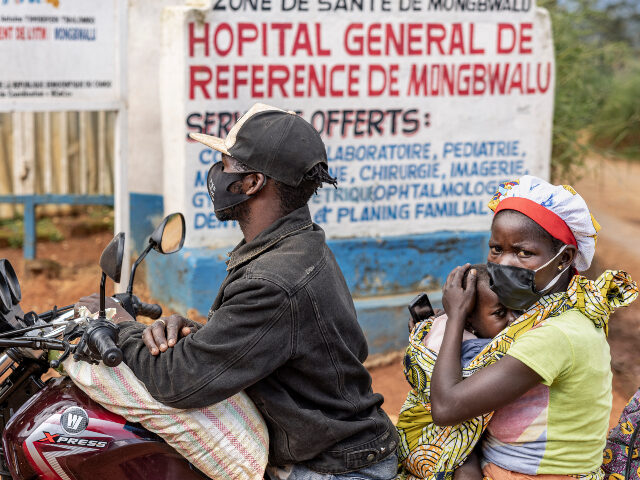

Health officials in the Democratic Republic of the Congo (DRC) have reported a disturbing new trend of patients fleeing from treatment centers when they come under attack from angry mobs – something that is happening with increasing frequency, as youths in the eastern Congo demand the remains of friends and family be handed over for funerals, in defiance of outbreak protocols.
There were at least three documented attacks on Ebola clinics in the eastern Ituri province, the epicenter of the Ebola Bundibugyo outbreak, and in each case some patients fled during the chaos and did not return. Two of those attacks targeted the same hospital in the town of Mongbwalu.
“There is denial of the disease within the population, with some members wanting to claim the bodies of suspected and/or confirmed cases,” warned Dr. Richard Lokodu, medical director of the Mongbwalu General Referral Hospital.
Lokodu recalled similar attacks on clinics during the deadly Ebola outbreaks of 2013-2016 and 2018-2020, which also saw angry crowds demanding the return of their loved ones for funerals, even though the bodies of Ebola victims are highly contagious.
Many residents of the eastern Congo do not believe Ebola is a real disease. Some believe it is a hoax concocted by foreigners to exploit the population, a belief ironically reinforced by the flood of money and resources into the war-torn outbreak region when international health agencies join forces with the central DRC government to combat Ebola outbreaks.
Violence in the 2018 outbreak was much worse because the political situation in the eastern Congo was more unstable, with insurgents and jihadi groups linked to the Islamic State and al-Qaeda seeking to take advantage of the confusion. Those groups are even more influential today, and have outright control of Goma, a major city that has been affected by the current outbreak.
According to Dr. Lokodu, 18 Ebola patients fled when a treatment center constructed by the international charity Doctors Without Borders (MSF) was burned by an angry mob on Saturday. Only four of the lab tests for those patients have come back with results – and one of them was positive.
“So we have one confirmed case of Ebola that continues to circulate in the community and evade the response,” Lokodu sighed.
The Mongbwalu General Hospital was attacked again on Sunday by four consecutive waves of angry local youths. During the brawl with police, seven more Ebola patients fled. One of them was in critical condition due to the hemorrhaging typical of Ebola infections, and died while attempting to leave the clinic.
On Saturday, the town of Rwampara – where another Ebola clinic was attacked two days earlier – held a communal burial for Ebola victims under heavy security.
“Armed soldiers and police monitored the burials as Red Cross workers clad in white protective suits lowered sealed coffins into the ground. Crying family members stood at a distance,” the Associated Press (AP) reported.
Officials like Dr. Lokodu worried that mob attacks on Ebola clinics are making an already difficult, and dangerous, job for healthcare workers even harder. The International Federation of Red Cross and Red Crescent Societies said on Saturday that three of its volunteers have died from Ebola while fighting the outbreak in Mongbwalu. All three are believed to have contracted the disease while handling dead bodies, over a week before the Ebola outbreak was detected and officially declared.
The official timeline of the Ebola Bundibugyo outbreak has been pushed back several times, as older infections are discovered. The disease apparently spread for several harrowing weeks before the outbreak was declared because the rare Buindibugyo strain is genetically distinct and can evade detection by test kits designed for the more common strains.
“We are now playing catch-up with a very fast-moving epidemic. At the moment, the epidemic is outpacing us,” World Health Organization (W.H.O.) Director-General Tedros Adhanom Ghebreyesus warned on Monday.
COMMENTS
Please let us know if you're having issues with commenting.