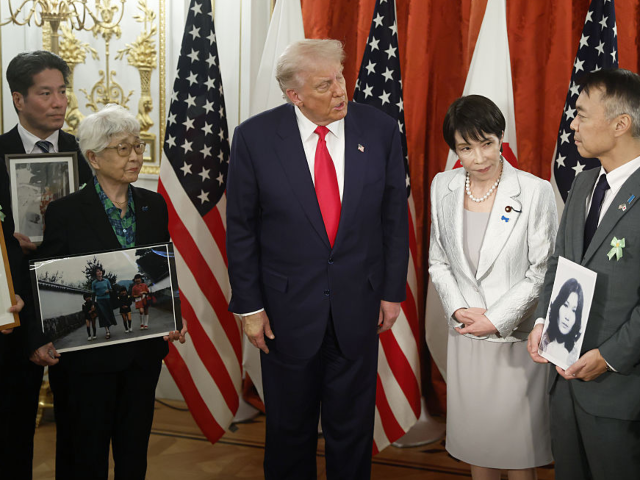
President Donald Trump and Japanese Prime Minister Takaichi Sanae met on Tuesday with the families of Japanese nationals believed to have been abducted by North Korea.
Takaichi said in a statement following the meeting that Trump told the abductees’ loved ones he would “do everything possible” to bring their relatives back. The meeting was one of several high-profile engagements Trump is holding in Japan alongside Takaichi, including policy discussions, a visit with U.S. troops stationed in the country, and watching World Series baseball.
Trump making time in his high-stakes schedule to meet with victims of North Korean abductions marks a notable political move given multiple comments the president made this week en route to and traveling within Asia in which he expressed a desire to meet with North Korean dictator Kim Jong-un. Trump met with the communist tyrant on three occasions during his first term in office and became the first American president to set foot in North Korea in 2019. While Pyongyang remains technically in a state of war with South Korea and America, and has retained a belligerent and menacing foreign policy towards Washington, North Korean state media has emphasized that Kim personally values his friendship with Trump. Kim notably sent a “warm” message wishing Trump well following a failed assassination attempt against the latter last year.
According to Takaichi, Trump offered “strong words” of commitment to helping return the abducted from North Korea to their families.
“Under the close cooperation between Japan and the United States, and in coordination with the international community, this has once again strengthened my determination to ‘ultimately and completely resolve’ the abduction issue,” Takaichi asserted. “I take the families’ wishes as my own mission, and I will devote all my efforts to ensuring the return of the abduction victims.”
Takaichi, a hardline conservative, became Japan’s first woman prime minister last week after a prolonged struggle to form a coalition within the Japanese legislature, the Diet. A protege of late former Prime Minister Abe Shinzo, a close friend of President Trump’s, Takaichi has proposed the adoption of similar conservative policies for the country, including limitations on immigration, an expansion of Japan’s defense apparatus, and closer ties to the United States.
Takaichi has also been vocal throughout her career in condemning communist North Korea and calling for Japan to prepare for any potential attack, particularly nuclear attacks. Takaichi has called North Korea’s illegal nuclear program “totally unacceptable” and suggested in the past that, to protect itself, Japan should consider nuclear-sharing agreements with America.
North Korea has for decades maintained a vitriolic and threatening position against Japan in response to the atrocities committed by Imperial Japan during its longtime occupation of the Korean Peninsula, which ended after World War II and the collapse of the empire. As part of its efforts against Japan, Pyongyang is believed to have kidnapped hundreds, if not thousands, of Japanese people since its founding after World War II; abductions are believed to have begun in earnest in the 1970s. Survivors who escaped North Korean captivity described being forced to train North Korean spies on Japanese language, culture, and mannerisms to help them seamlessly fit into Japanese society. North Korea first admitted to the abductions in 2002.
In 2016, the Japanese government completed an extensive study that identified 886 people who went missing in the 40 years prior whom it concluded had been abducted by North Korea. Due to the limited information available, Tokyo noted that only 17 of those 886 were confirmed North Korean abduction cases.
President Trump may be a unique potential mediator to resolve the issue of the missing citizens, as a world leader with a personal relationship with Kim — who seized power in 2011 after the death of father Kim Jong-il, and thus does not have direct ties to most of the abductions. Trump himself has mused publicly this week about wanting to meet Kim. The American president first traveled to Malaysia this weekend for meetings with local leaders on the sidelines of the Association of Southeast Asian Nations (ASEAN) summit, then traveled to Japan on Monday and is expected to travel to South Korea this week to attend a summit of leaders of the Asia-Pacific Economic Cooperation (APEC) organization.
“I haven’t mentioned it, I haven’t said anything, but I’d love to meet with him if he’d like to meet,” Trump said while on Air Force One on Monday.
“I just have a good relationship with him, I would love to see him,” Trump said of Kim. “It’s [South Korea] our last stop, so it’s pretty easy to do.”
Prior to landing in Malaysia, on Friday, Trump similarly said that he was “open” to meeting Kim in Korea.
“He probably knows I’m coming, right? If you want to put out the word, I’m open to it,” the president said.
COMMENTS
Please let us know if you're having issues with commenting.