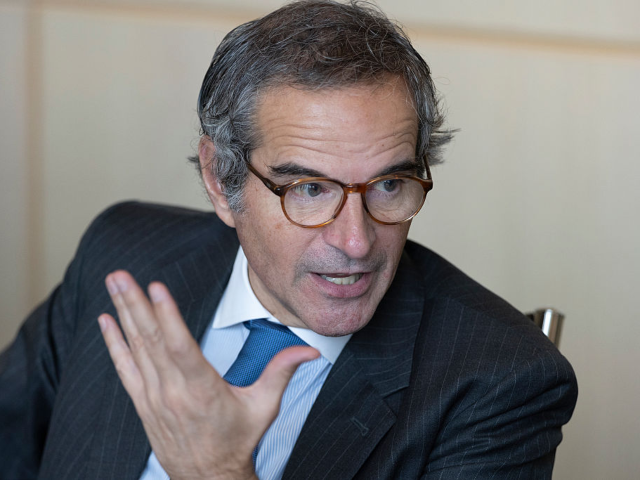

The head of the United Nations nuclear body, the International Atomic Energy Agency (IAEA), warned on Wednesday that he had reason to believe communist North Korea had engaged in a “very serious increase” in activity to make nuclear weapons.
Rafael Grossi made the comments during a visit to South Korea this week in which he addressed several nuclear crises around the world, including ongoing negotiations to end hostilities in Iran. In addition to running the IAEA and meeting with senior South Korean leaders, Grossi is also campaigning to become the next U.N. secretary-general and used his time in South Korea to meet with former U.N. head Ban Ki-moon.
North Korea’s dictator Kim Jong-un has regularly, throughout the past five years, called for an “exponential” increase in his country’s illicit nuclear weapons arsenal, describing it as necessary to prevent an invasion by South Korea or the United States. North Korea is technically in a state of war with both, as the armistice agreement that ended Korean War hostilities in 1953 was not a peace treaty and did not formally end the war.
Speaking to reporters on Wednesday, Grossi noted that North Korea has not allowed the IAEA to inspect any of its nuclear facilities since 2009, defying international law, but that the agency nonetheless has attempted to keep track of its nuclear development using outside evidence such as satellite images. Based on its efforts, Grossi warned that the IAEA had reason to believe North Korea was experiencing “a very serious increase in the area of nuclear weapons production, which is estimated at a few dozen warheads.” He came to this conclusion via observing a “rapid increase in the operations” at the country’s Yongbyun nuclear complex, which is believed to produce fissile material used in weapons.
In addition to activity at Yongbyon, Grossi said that the IAEA had detected action to build a “new facility similar to the enrichment facility in Yongbyon.”
In a meeting with South Korean Foreign Minister Cho Hyun, Grossi said he and his team “discussed our deep concerns about the DPRK’s [North Korea’s] nuclear program and the IAEA’s indispensable verification role in support of much-needed renewed diplomatic efforts on this issue, in line with relevant U.N. Security Council resolutions.”
To push for better diplomacy between North Korea and free states, Grossi also visited the Demilitarized Zone (DMZ), the border between the two Koreans as defined by the Korean War armistice agreement. The visit, he emphasized, “reminds us of the importance of diplomatic efforts to ease tensions, promote peaceful co-existence on the Korean Peninsula, and resolve the DPRK nuclear issue in a peaceful manner.”
The most recent estimates of the size of the North Korean nuclear arsenal suggest the country possesses about 50 nuclear weapons. A report published by the Congressional Research Service (CRS) in May 2025 found evidence that Kim Jong-un had ordered a significant increase in the development of material for new weapons that resulted in the country possessing enough fissile material to build another 90 nuclear warheads.
“The country’s ballistic missile testing, military parades, and policy statements suggest that North Korea is continuing to build a nuclear warfighting capability designed to evade regional ballistic missile defenses,” the report read.
Shortly before the publication of that report, Grossi similarly warned that the IAEA’s evidence suggested that North Korea’s nuclear development is “completely off the charts.”
“It has spawned exponentially. The program is no longer, you know, the complex at Yongbyon. It’s Kangson. It’s other places also in the country,” he explained. “It’s a light water reactor. It’s a second and perhaps a third enrichment facility being built at the moment. It’s a reprocessing campaign, which is ongoing as we speak. And there’s, you know, a nuclear arsenal that exists.”
“I mean, you cannot have a country like this, which is completely off the charts with this nuclear arsenal,” he continued. “With such a big program, nuclear program, with all these facilities, without us having any clue of any safety or security measure which is being applied to it.”
At the time, Grossi called for more international diplomatic efforts to convince the North Korean regime to stop its illicit nuclear development.
Kim Jong-un has been transparent in his ambitions to elevate North Korea into a top-tier global nuclear threat, repeatedly using the word “exponential” to describe how rapidly he wants his military to build more bombs.
“The security environment around the DPRK is getting more serious day by day and the prevailing situation requires us to make a radical and swift change in the existing military theory and practice and rapid expansion of nuclearization,” he urged in August.
In March of this year, he attended a rocket launch in which he insisted on the need for North Korea’s enemies to be threatened with nuclear annihilation, stating that the launch was “making a signaling wave stronger than the aimed, and give them a deep understanding of the destructive power of tactical nuclear weapon.”
COMMENTS
Please let us know if you're having issues with commenting.