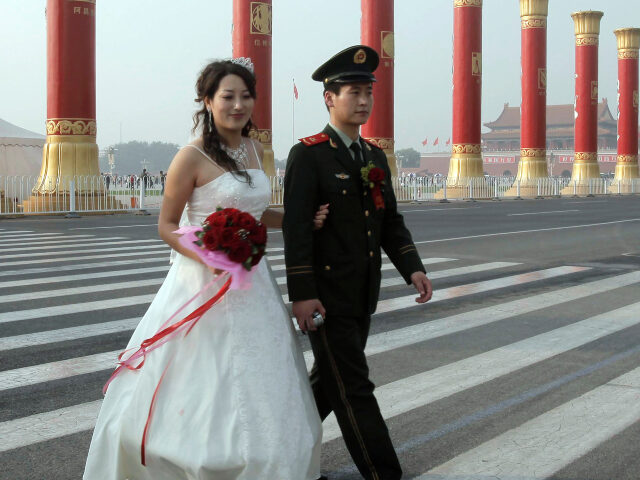

China’s Ministry of Civil Affairs released a dismaying report Saturday on marriage registrations, finding them down by 6.2 percent year-on-year for the first quarter of 2026 – and down by almost 50 percent compared to a decade ago.
The first-quarter report was particularly gloomy because January through March is usually the busiest time of the year for weddings in China, thanks to the Lunar New Year and Spring Festival holidays that bring families together.
The marriage bust was the latest bit of bad demographic news for China, which has experienced record-low birthrates and population decline for the past four years.
The Communist dictatorship seems baffled, and increasingly anxious, about its inability to reverse the demographic decline. A panoply of incentives for getting married and having children has been introduced, to no avail.
China, like many Asian cultures, has very low rates of pregnancy outside of marriage, so the decline in brides will probably translate fairly directly into a further decline in children.
The South China Morning Post (SCMP) noted that new marriages are down to their lowest level since the Wuhan coronavirus pandemic, which was thought to have postponed or ruined a great many marriages by making people afraid to hold wedding ceremonies. The Chinese government hoped for post-pandemic marriage boom after the coronavirus danger passed, but the modest increase in weddings after 2022 appears to have sputtered out.
In March, Chinese officials rolled out their latest plan to “build a fertility-friendly society,” including more support for child care, more subsidies for maternity costs, more social services benefits for people living in rural areas, and more jobs programs.
In 2025, the Chinese government tried handing out cash subsidies for the first three years of a child’s life, expanded insurance coverage for pregnancy, and a streamlined process for marriage registrations. Chinese state media boasted these measures were producing a “nuptial uptick” – right up until the depressing marriage numbers came out on Monday.
Prior to the 2025 reforms, a common complaint from Chinese couples was excessive paperwork for getting married, long waits for appointments to get those papers finalized, and requirements for married couples to return to their home provinces to obtain a marriage license. The latter was thought to be especially inconvenient for high-mobility young people who moved from rural areas to China’s swelling cities to seek their fortunes, and met their would-be spouses in their new homes.
The Chinese government sought to address that problem by allowing people to get married anywhere, instead of requiring them to return to either the bride or groom’s home province. The 2025 reform also provided funding for a large number of new marriage registration offices, located in venues where young couples might like to hold their weddings, like scenic parks and tourist hot spots.
China’s state-run Global Times boasted on Sunday that the 2025 marriage reform plan created 1,330 new outdoor marriage certificate issuance sites, making it more convenient than ever for couples to tie the knot. The marriage data released the next day showed that not enough knots were being tied, even with faster and more convenient services available.
Another state media outlet, China Daily, claimed there is “overwhelming demand” at marriage offices across the country for weddings to be held on May 20 and 21, because when the numbers “520” and “521” are spoken out loud in Mandarin Chinese, they sound very similar to the words “I love you.”
COMMENTS
Please let us know if you're having issues with commenting.