
The World Health Organization (W.H.O.) and Spanish health officials on Monday updated their tally of hantavirus cases linked to the cruise ship MV Hondius to seven confirmed cases and two reported infections under investigation.
This count did not include an American passenger who tested “mildly positive” after returning to the United States.
The MV Hondius had 17 Americans aboard when the hantavirus outbreak was reported. The ship departed from Argentina with 147 people aboard on April 1. The first illness was reported on April 6 and the first of three fatalities occurred on April 11. About two dozen passengers left the ship on the island of St. Helena and one of them flew to South Africa while visibly ill, dying of respiratory failure the day after arriving in Johannesburg. A few of the most seriously ill passengers have been medically evacuated from the ship.
These details have complicated the task of “contact tracing,” or finding and testing everyone who might have come into close contact with Hondius passengers. The version of the deadly hantavirus in play is the Andes strain, the only variant known to pass between humans. Hantaviruses kill about a third of their victims, usually through respiratory failure, and normally spread through vermin droppings.
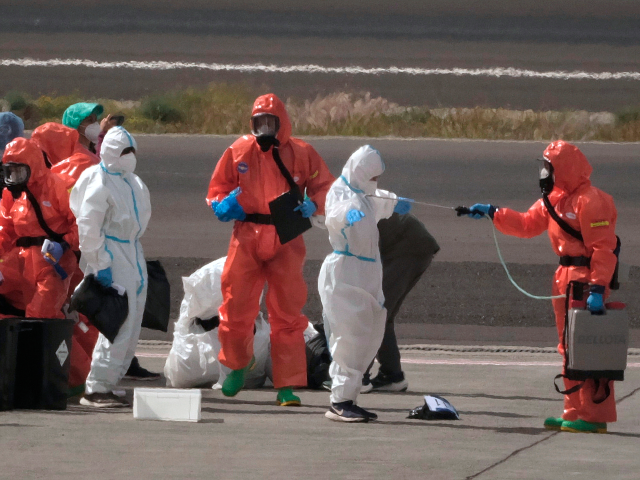
After remaining in offshore isolation for weeks, with various nearby ports refusing to allow it to dock, the Hondius arrived early Sunday at the island of Tenerife in the Canary Islands off the west coast of Africa. The process of moving passengers off the ship, which has been ordered to remain off the coast of Tenerife, is expected to be complete by Monday night.
The 17 Americans aboard the ship were able to come ashore at Tenerife and fly back to the United States, arriving at Omaha Eppley Airfield early Monday morning. Two of the passengers traveled in biocontainment units “out of an abundance of caution,” according to the State Department. A British national with dual U.S. citizenship was also aboard the plane.
The dispute between U.S. and Spanish health officials concerns a passenger who was tested by an epidemiologist from the European Center for Disease Prevention and Control while in the Canary Islands before returning to the United States. The passenger is reportedly showing no symptoms of illness, but hantaviruses have long incubation periods, so tests were performed and sent to two different laboratories as a precaution.
One of the labs said the individual tested negative, while the other was ambiguous.
“The result was considered by the U.S. authorities as a weak positive, although for us it was not conclusive,” the Spanish Health Ministry said, seemingly unhappy with the U.S. decision to “treat the case as positive.”
The second American who was handled as potentially infected complained of a mild cough on May 6, but the cough subsided within a day, so infection is seen as “possible” but not “probable.”
The American passengers were taken to the University of Nebraska Medical Center by bus after arriving in Omaha. The center has a federally-funded quarantine facility, plus an infectious disease unit that has been utilized for Ebola and Wuhan coronavirus patients.
“One passenger will be transported to the Nebraska Biocontainment Unit upon arrival, while other passengers will go to the National Quarantine Unit for assessment and monitoring. The passenger who is going to the Biocontainment Unit tested positive for the virus but does not have symptoms,” said Nebraska Medicine spokeswoman Kayla Thomas.
The U.S. Centers for Disease Control (CDC) noted in its latest bulletin on the hantavirus outbreak that “several U.S. passengers disembarked the cruise ship before the outbreak was identified, and some have returned to the United States.”
“CDC notified the state health departments where these passengers live and is actively providing timely updates, resources, and guidance on how to protect these passengers and their families and communities,” the bulletin said.
CDC Acting Director Jay Bhattacharya said on Sunday that the returning American passengers would be deemed “low risk” if they “weren’t in close contact with someone who was symptomatic,” while they would be classified as “medium or high risk” if they were.
Bhattacharya said the returnees would be offered “alternatives,” including an “offer to stay in Nebraska, if they’d like, or if they want to go back home, and their home situation allows it, to safely drive them home without exposing other people on the way.”
CDC protocols call for 42 days of monitoring after the last potential exposure to hantavirus, with instructions to “self-isolate immediately” if symptoms are displayed.
A female French passenger from the Hondius developed symptoms during her flight home to Paris, tested positive for hantavirus, and was hospitalized on Sunday. She was one of five French Hondius passengers on the flight to Paris.
French Health Minister Stephanie Rist said the woman is “isolating” in Paris and her health is “deteriorating.” Health officials have identified 22 people who came in contact with her.
The W.H.O. continues to classify the public health risk from the outbreak as “low.”
“We don’t anticipate a large epidemic. With public health measures, we can break the chain of transmission, and this will be a limited outbreak,” said Dr. Abdirahman Mahamud, director of the Response Coordination Department of W.H.O.’s Emergencies Health Program, at a press conference on Friday.
“Hantavirus is not COVID, and the risk to the people of Tenerife is low because of the nature of the disease and the actions of the Spanish government,” W.H.O. Director-General Tedros Adhanom Ghebreyesus said on Saturday.
Tedros took the unusual step of writing a letter to the people of Tenerife, acknowledging their concerns but stressing that “this is not another COVID” and “the current public health risk from hantavirus remains low.”
The W.H.O. director said he would underline his confidence in this analysis by traveling to Tenerife to “observe this operation firsthand, to stand alongside the health workers, port staff, and officials who are making it happen, and to personally pay my respects to an island that has responded to a difficult situation with grace, solidarity, and compassion.”
COMMENTS
Please let us know if you're having issues with commenting.