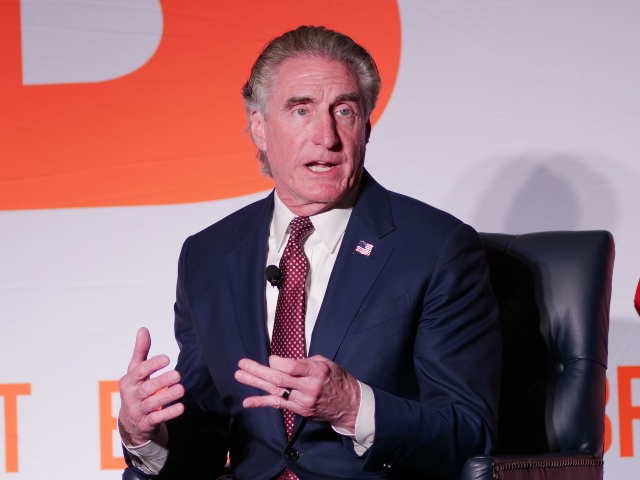

Breitbart News’s “Harnessing American Power” event with Interior Secretary and National Energy Dominance Council Chairman Doug Burgum featured a wide-ranging policy discussion on the Trump administration’s energy agenda, including how royalties from production on federal lands help support conservation, wildlife, and national parks.
During the discussion, Washington Bureau Chief Matthew Boyle asked Burgum to provide an update on the administration’s energy agenda since President Donald Trump returned to the White House, referring to what he called the “four babies” needed for energy dominance: “drill, baby, drill,” “map, baby, map,” “mine, baby, mine,” and “build, baby, build.”
“Well, on the drill, baby drill record oil production, that’s the best measure of that,” Burgum said.
Burgum then described the drilling permit backlog he said the administration faced on federal lands.
“But I do want to say that what we inherited in places, just like in one district in the Bureau of Land Management in New Mexico, the Carlsbad district had 5,600 unprocessed applications for permit to drill that we inherited,” Burgum said.
“The law says that on these public lands that we will hold quarterly lease sales, that the quarterly lease sales are available to the public to buy a lease that a private sector company writes a check to America for the opportunity to develop,” he added.
Burgum said energy production on public lands follows environmental rules while generating revenue for the country.
“And when they’re developing, they’re developing it in line, they have to follow all the EPA rules at the state and federal and local level. This is not like destruction. This is wealth-generating activity for America and for Americans,” Burgum said.
He then turned to the permitting process that follows a successful lease auction.
“And so once they have the lease, they’ve won the lease auction. Now they apply for a permit to drill, so they’ve written us a check. But now we’re going to slow roll the application [for a permit] to drill, 5600 those not being processed,” Burgum said. “We’ve knocked those down by 91 percent — record number processed, record number of new permits.”
Burgum said that effort reflects the administration’s focus on energy production, legal compliance, and customer service.
“And it’s like, ‘Oh, you guys must be really pro-energy.’ Yes, we are. We’re also pro-following the law, and we’re also pro-customer service, which is — if someone is writing us a check, they’re the customer. ‘Us’ is America the customer,” Burgum said.
He then linked production on federal lands to royalty payments for taxpayers.
“And then when they develop, when they actually start, when they start producing, and those wells, you know what they do? They pay royalties to all of you, to us. They pay royalties to us,” Burgum said.
Burgum said that revenue has helped change the Department of the Interior’s financial position.
“In one year, we’ve taken the Department of Interior to an organization after four years of declining revenue, it’s now this year we will produce more revenue than we expend,” Burgum said. “And what does that mean? That’s good things for our land. It’s good things for conservation, for wildlife, for our national parks.”
He said Interior’s lands and offshore areas should be used for the benefit of Americans, while some protected areas remain off-limits.
“Because if America — the 500 million acres of land, the 700 million acres of subsurface and the 3 billion of offshore that are all part of the Department of Interior… we’re doing what we should do,” Burgum said. “These lands were put away for the benefit and the use of the American people.”
“And there are things that we protect exclusively, wilderness areas, national parks, wildlife refuges, those are completely off-limits,” he added. “But the other piece, which is like 90 percent of it, was put away for the benefit and the use of the American people.”
Burgum then turned to the administration’s mapping push, arguing that exploration is central to energy dominance.
“And that means that we’ve got to not just drill baby drill, but we’ve also have to map baby map, because the mapping leads the exploration, and we’ve had some incredible mapping successes,” Burgum said.
He cited a lithium-related finding in Appalachia as one example.
“One that just got reported last week in Appalachia, there was a find that looks like we could have 300 years equivalent of the lithium that we import from foreign countries, right here in the United States, that could be easily accessible,” Burgum said.
“Didn’t even know it was there, because again, in past administrations, well, when you’re going to transition, part of the transition lie was, ‘Oh, we don’t need to do mining anymore. We don’t need to do anything anymore in America,’” Burgum said.
He said the U.S. Geological Survey (USGS), which is part of Interior, has resumed that mapping work.
“So, great progress getting the USGS, which is part of us, Geologic Survey, part of interior, back on track,” Burgum said. “They’re back mapping like crazy.”
COMMENTS
Please let us know if you're having issues with commenting.