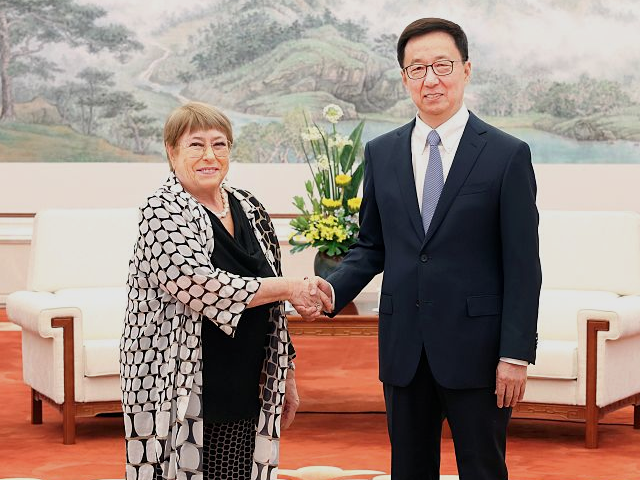

Former United Nations High Commissioner for Human Rights Michelle Bachelet met with Chinese Foreign Minister Wang Yi and Vice President Han Zheng on Wednesday, touring the country amid her campaign to become the next U.N. Secretary General.
Bachelet, a radical leftist, served as president of Chile before completing her term and taking over the Office of the High Commissioner for Human Rights (OHCHR). She served two terms as president in the country, from 2006 to 2010 and, later, from 2014 to 2018. Her time leading the OHCHR spanned from 2018, shortly after the end of her time as president, through 2022, when she chose not to run for a second term amid global disgust and calls for her resignation for her poor handling of the Chinese genocide of Uyghurs and other Turkic people in the country.
Bachelet notably visited China in 2022 shortly before stepping down and, far from condemning the ongoing genocide, praised China’s human rights record and claimed that the concentration camps the Chinese Communist Party had been caught using to imprison as many as 3 million people were no longer functional.
Bachelet is one of five official candidates running to replace Antonio Guterres as the secretary-general of the United Nations. The other candidates are former General Assembly leader María Fernanda Espinosa, former Costa Rican Vice President Rebeca Grynspan, former Senegalese President Macky Sall, and the head of the International Atomic Energy Agency (IAEA), Rafael Grossi. Bachelet initially enjoyed the endorsement of her country under leftist former President Gabriel Boric, but Chile withdrew its support after the inauguration of conservative current President José Antonio Kast.
Campaigning for the position is often less overt than a traditional political role, involving private meetings with the most powerful actors at the United Nations. Bachelet appears to have traveled to Beijing seeking support from China, though Chinese state media reports did not overtly describe her visit as a formal campaign stop.
Chinese government television networks published images of Bachelet receiving a warm welcome from Wang, the nation’s top diplomat.
The Chinese government, through its media arms, shared that Wang confirmed to Bachelet that China would be active in participating in the selection of the next secretary-general, but did not mention any endorsement.
“China will take part in the selection of the next UN secretary-general in a responsible and constructive manner, and will work to promote the United Nations to revitalize its authority and vitality, and to better adapt to the new circumstances and better cope with new challenges, said Wang,” according to the Global Times state newspaper.
The state news agency Xinhua reported that Bachelet also met with the vice president, Han Zheng, who similarly promised that China would seek a major role in the secretary-general selection.
“Han said China is willing to work with all parties and continue to firmly support the core role of the U.N. so as to promote the building of a more just and reasonable global governance system,” the outlet shared. “As a permanent member of the U.N. Security Council, China will earnestly fulfill its responsibilities, continue to uphold an impartial position, safeguard the authority of the U.N., and protect the common interests of the Global South.”
Xinhua shared that Bachelet used her time with Han to praise China specifically on human rights, despite its status as a repressive, genocidal communist state.
“Bachelet expressed her high appreciation for China’s long-term and firm commitment to promoting multilateralism and the cause of the U.N., supporting the balanced advancement of peace, development and human rights,” Xinhua claimed. “She expressed her readiness to work with China to follow the original aspiration and purpose of the U.N. and jointly strengthen the role of the U.N.”
Bachelet has not refuted the reporting of her comments by Xinhua at press time.
Bachelet’s relationship with China was the source of much controversy during her time leading the OHCHR. In 2022, Bachelet visited China, in part to investigate the documented evidence of genocidal behavior against Uyghurs, Kazakhs, Kyrgyz, and other non-Han ethnic groups in occupied East Turkistan. Rather than condemning the Chinese government to its face for its abuses, according to the Foreign Ministry, Bachelet “expressed admiration for China’s efforts and achievements in eliminating poverty, protecting human rights, and realizing economic and social development” in May 2022.
In comments later during her visit, Bachelet again celebrated China as a human rights leader, claiming, “poverty alleviation and the eradication of extreme poverty, 10 years ahead of its target date, are tremendous achievements of China.” Bachelet briefly addressed the large-scale construction of concentration camps in the country, describing them using the regime euphemism of Vocational Education and Training Centre (VETC) and claiming they had been “dismantled.”
While Bachelet lost support from her native Chile for her secretary-general bid, she retains endorsements from the Marxist governments of Mexico and Brazil and is considered a top candidate for the job, China scandal notwithstanding.
“Her experience, leadership, and commitment to multilateralism qualify her to lead the U.N. in an international context marked by conflict, inequality, and democratic setbacks,” socialist Brazilian President Luiz Inácio Lula da Silva wrote in an endorsement message on social media.
Competing against her is current IAEA Chief Grossi, who has attempted to court support from the United States and is formally endorsed by both his native Argentina and the conservative government of Paraguay. Grossi enters the competition as one of the few United Nations leaders to have taken action that has resulted in any real-world consequence. In 2025, Grossi testified before the IAEA that Iran was blocking proper nuclear inspectors and “sanitizing” nuclear activity sites, leading to the first IAEA resolution against Iran in two decades and President Donald Trump bombing Iran.
Rebeca Grynspan received the endorsement of her country, Costa Rica, and is campaigning on her strong economic record. María Fernanda Espinosa is running on her record of running the largest body of the U.N., the General Assembly, and is endorsed by the Antigua and Barbuda. Sall, the former Senegalese president, has received no official endorsements at press time but was nominated by the nation of Burundi.
All four other candidates have sat down for interviews with Chinese state television network CGTN. Espinosa, Grynspan, and Grossi have done so recently to discuss their campaign for secretary-general, while Sall has talked to the network in his capacity as the leader of Senegal.
COMMENTS
Please let us know if you're having issues with commenting.