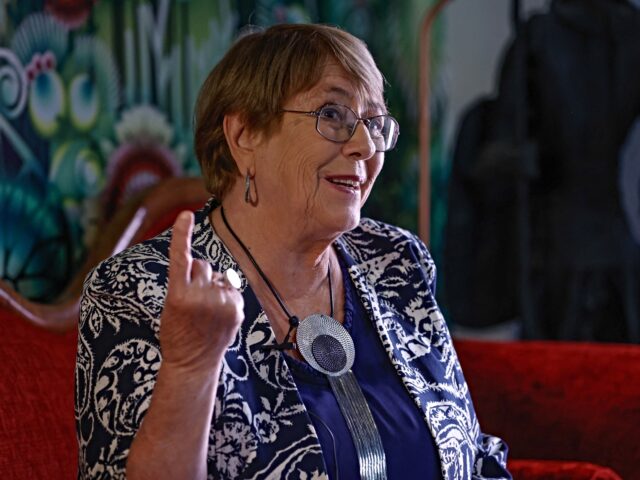

Chile’s outgoing far-left President Gabriel Boric on Monday formally presented the candidacy of socialist former President Michelle Bachelet to become the next U.N. Secretary-General — and announced that her bid is also backed by leftists governments of Brazil and Mexico.
The United Nations will choose a new secretary-general this year to succeed António Guterres, whose current tenure is slated to conclude at the end of 2026. The next Secretary-General will take office in 2017 and will see his or her tenure run through 2031.
President Boric, who will soon leave office on March 11, made the formal announcement of Bachelet’s candidacy speaking alongside her at the presidential palace of La Moneda. Boric also confirmed that both Brazil and Mexico are endorsing Bachelet’s bid to become the next U.N. chief.
“As you can see, we are not alone in this nomination. The candidacy of President Bachelet, which we will register, and which has already been registered with the United Nations, will be presented jointly with our sister countries Brazil and Mexico. The two most populous countries in Latin America,” Boric reportedly said, thanking both Presidents Luiz Inácio Lula da Silva and Claudia Sheinbaum for the “months-long” talks towards supporting Bachelet’s bid.
“I am deeply honored to be a candidate for Secretary General, not only for Chile, but also for Brazil and Mexico. I am grateful for the support for this candidacy from the State, and I accept the tremendous responsibility that it entails,” Bachelet said.
Michelle Bachelet served as president of Chile for two non-consecutive terms for 2006 to 2010 and from 2014 to 2018. Months after leaving office, she became the U.N. High Commissioner for Human Rights for a four year-term until 2022.
Her passage through the U.N. human rights office was defined by her appeasement of China’s communist regime during investigations of China’s genocide of Turkic peoples in occupied East Turkistan — publicly praising China for its purported “achievements” in human rights and for the alleged “dismantlement” of the well-documented concentration camps for Uyghurs and other Turkic people. Bachelet was also criticized for holding “amiable” conversations with Venezuela’s now-deposed socialist dictator Nicolás Maduro despite her office having condemned the Maduro regime for its extensive list of human rights atrocities against its own people.
Brazilian President Lula da Silva expressed his country’s honor in supporting Bachelet’s candidacy and claimed that, during her past tenure as U.N. High Commissioner for Human Rights, she “worked to protect the most vulnerable, advance the recognition of the human right to a clean, healthy, and sustainable environment, and give a voice to those who most need to be heard.”
“Her experience, leadership, and commitment to multilateralism qualify her to lead the U.N. in an international context marked by conflict, inequality, and democratic setbacks,” Lula wrote on social media.
At press time, Bachelet is the second official high-profile Latin American candidate for the U.N. Secretary-General chairmanship. In December, the government of Argentine President Javier Milei presented the candidacy of current International Atomic Energy Agency (IAEA) chief Rafael Grossi to become the next U.N. Secretary-General. Grossi is widely known for his extensive work exposing Iran’s violations of the 2015 nuclear deal, which has earned him recurrent death threats from the rogue Islamic regime.
Grossi has also been highly critical of the current state of the United Nations. In December, he told CNN en Español that he is hoping to occupy the U.N. chief position “because it is very important to restore the role of the organization in a world affected by fragmentation, wars, conflicts, and serious dangers.”
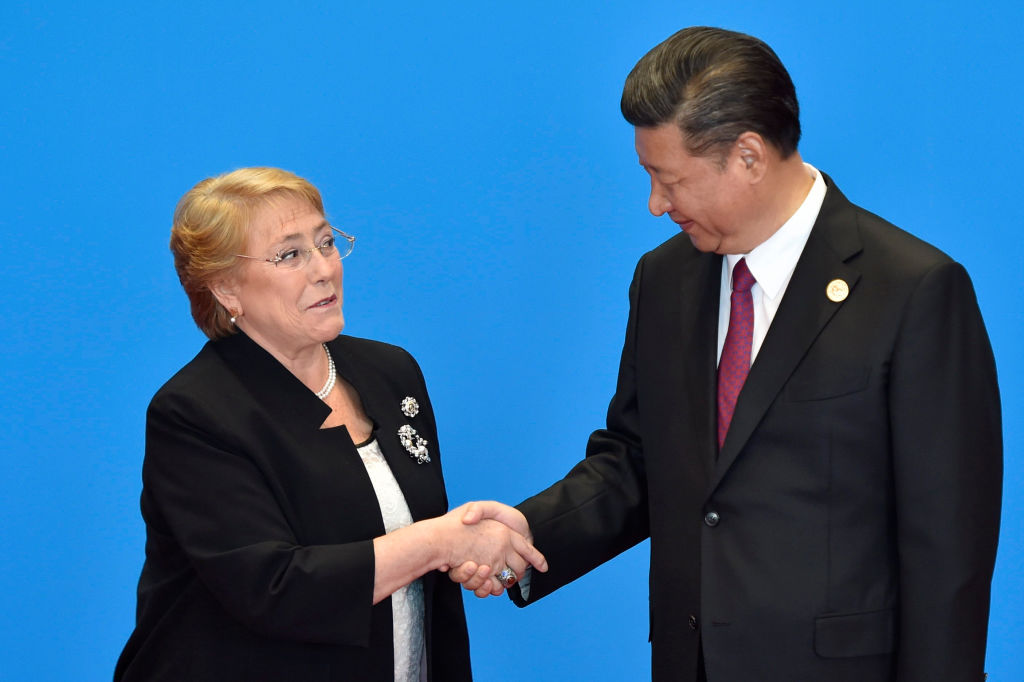
File/Chile’s President Michelle Bachelet (L) shakes hands with Chinese President Xi Jinping during the welcome ceremony for the Belt and Road Forum, at the International Conference Center on May 15, 2017 in Yanqi Lake, north of Beijing, China. (Kenzaburo Fukuhara-Pool/Getty Images)
“I believe that the U.N. has somehow forgotten the initial premise on which it was created: to ensure international peace and security. There are other very important areas — humanitarian work, development — all of which are important, but this central task of preventing people from fighting each other, of trying to prevent and, if possible, resolve wars, is no longer present,” Grossi said at the time.
“When you look at the current conflicts in the world — in Africa, Europe, or anywhere else — you see one thing: the U.N. is not there. And I don’t think it has to be that way,” he continued.
President Boric first announced Bachelet’s U.N. chief bid during his final speech at the United Nations General Assembly in September, claiming at the time that a prospective chairmanship for Bachelet would help the U.N. recover “credibility, effectiveness, and purpose in relation to the challenges of our time.”
Boric will leave office next month and will be succeeded by conservative José Antonio Kast, who won a landslide victory in December. At press time, the Chilean president-elect has not publicly disclosed his stance on Bachelet’s candidacy.
Kast met with Bachelet days after the election but told reporters that he would not issue any comment on the matter until he takes office on March 11. At the time, Kast said that although one addresses “all issues” at a meeting, he deemed it appropriate to respect Chile’s institutions, stressing, “today there is a president in office, who is President Gabriel Boric.”
On Monday, speaking to reporters at a press conference, Chile’s outgoing Minister General Secretariat of Government criticized Kast for not addressing Bachelet’s bid, calling for him to “walk and chew gum at the same time” after the president-elect once again refused to comment on Bachelet’s candidacy — stating that he currently prefers to focus on visiting families affected by the 2024 wave of deadly fires.
“I have pointed out, in relation to the other issue that concerns the President [Boric], that on March 11 I will take office as President of the Republic, and I have already stated, and I reiterate, that until I am President, I will not comment on any other issue,” Kast said this week.
Christian K. Caruzo is a Venezuelan writer and documents life under socialism. You can follow him on Twitter here.
COMMENTS
Please let us know if you're having issues with commenting.