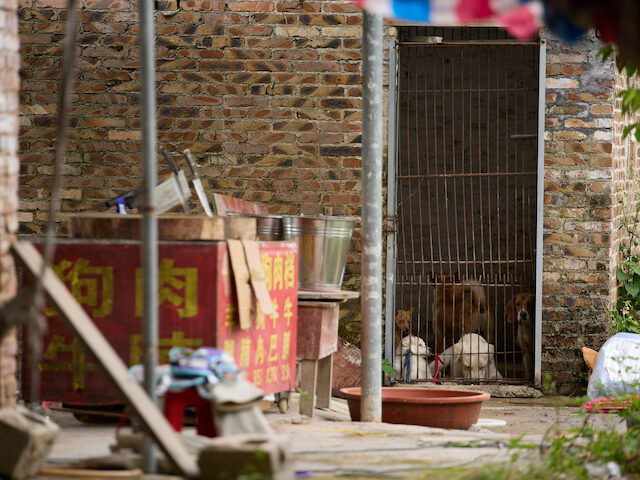

Animal rights activists documented the beginning of the Yulin Lychee and Dog Meat Festival on the summer solstice Sunday – a gory sight in which the Chinese city is taken over by rows of tables featuring the open-air slaughter and butchering of thousands of animals.
Yulin, a city located in far-south Guangxi province, has hosted an annual event beginning on the first day of summer since 2010, meant to boost local sales of dog meat. In the past decade, the horrific spectacle has attracted international attention, particularly from celebrities tied to animal rights causes, prompting the Chinese Communist Party to outlaw the raising of dogs as livestock in 2020 and reduce publicity for the event.
The more low-key approach has worked to keep the festival out of the spotlight in mainstream Western media, but has not eliminated the consumption of dog and cat meat at the event. Similarly, the banning of dogs as a livestock animal coincides with changing attitudes in China about dogs, now viewed more commonly as beloved pets than potential meals, but has resulted in an increase in reports of dog slaughterers abducting family pets for consumption.
Unlike in past years, when Chinese regime outlets have acknowledged and even defended the existence of the festival, Breitbart News could not find at press time any coverage of the Yulin event in the pages of English-language Chinese state newspapers such as the Global Times and China Daily.
Humane World for Animals, in conjunction with its Chinese partner organization Vshine, confirmed to Breitbart News this weekend that on-the-ground activists documented the launch of the festival. Vshine volunteers filmed videos of two markets, the Dongkou and Nan Qiao Markets, on Saturday and Sunday preparing for the event by installing rows of butchering tables. Graphic videos observed by Breitbart News showed the tables covered in the bodies of dead dogs, which workers appeared to be cutting up into pieces for consumption.
“The stench and sight of dog flesh at Dongkou and Nan Qiao Markets was so unpleasant and disturbing,” Vshine’s Chen Xiaolei said in a statement about the experience in Yulin, “particularly knowing that the corpses we were witnessing being sliced up were once someone’s beloved best friend.”
“Inside the covered market all you could hear was the continual thud of meat cleavers on the chopping board as dogs were dismembered,” Chen added. While describing the sales as “relatively slow” at the moment, and the area lacking any major indication of a “festival atmosphere,” Chen noted that the killing nonetheless continued on a massive scale.
The Yulin festival began facing international pushback in 2014, led by celebrities such as Paris Hilton, Simon Cowell, and Ricky Gervais. The Chinese government responded initially by complaining that Chinese people had been eating dogs “since ancient times” and foreigners should accept cultural differences. At the same time, the Global Times in 2014 pressured local authorities to hold the festival in a way that is not embarrassing to the country.
“Local authorities should conduct strict and detailed regulations of the whole dog slaughter process,” the Global Times claimed that year. “They need to impose stricter hygiene standards on dog meat producers, which on the one hand will squeeze small vendors, whose hygiene conditions cannot meet standards, out of the market, and on the other hand, make sure dogs are killed in a more humane manner making the meat safe and certified.”
The evidence collected by Humane World for Animals and Vshine does not indicate that any significant progress has been made on “hygiene standards” in public dog butchering. The slow sales do, however, reflect the point animal rights activists have repeatedly made about the event: contrary to Chinese government claims, eating dogs is not a popular practice rooted in Chinese culture.
“Yulin is arguably China’s most infamous dog and cat meat hotspot but even here we know that most ordinary people don’t eat dog meat and nor are they associated with the trade. It’s the same picture across the country,” Dr Peter Li, China Policy consultant for Humane World for Animals, said in a statement shared Sunday with Breitbart News. “Dog and cat meat falls outside of mainstream culinary food culture in China. And yet, every year millions of dogs and cats, including people’s beloved pets, continue to be stolen, trafficked, traumatised and slaughtered for this brutal trade.”
A poll published last year by Humane World for Animals found that 87.5 percent of Chinese respondents “never or rarely” eat dog or cat meat. Another 88 percent said that banning the consumption of dogs and cats would have “no impact” on their lives, meaning no significant resistance exists in the popular consciousness to banning the dog or cat meat trade.
The two animal rights groups marked a milestone earlier in June: the first dog slaughterhouse in Yulin shutting its doors right before the festival began. As a result, nine dogs, most of them bearing indications that they were stolen pets, were rescued from the slaughterhouse facility, as was the owner himself, who expressed in comments to the animal rights groups that he was excited to no longer participate in the butchering of dogs.
“I have been killing dogs for almost 20 years. It’s a dirty business and I don’t feel good about it,” the butcher, whose identity is being kept private, said. “Also, as fewer people are eating dog meat these days it’s hard for me to provide for my family. I am relieved to be leaving it behind me and having a more stable living.”
COMMENTS
Please let us know if you're having issues with commenting.