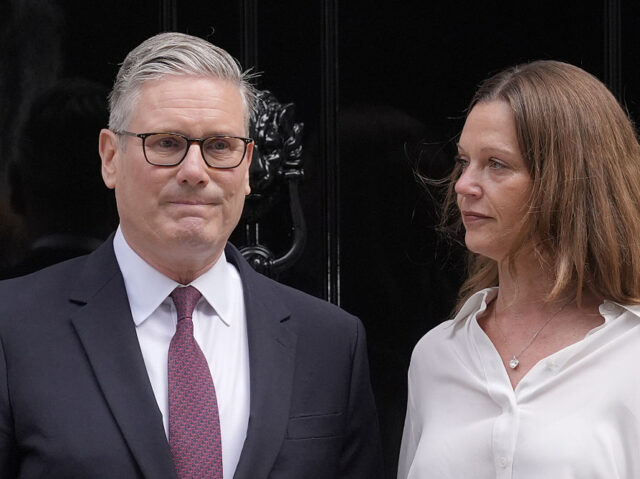

British Prime Minister Sir Keir Starmer at times appeared on the verge of tears as he announced that he’d lost the confidence of the governing Labour Party and would resign, but nevertheless set a months-long departure period that will see him through to the end of the summer.
The resignation of British Prime Minister Sir Keir Starmer could barely be heard in Downing Street as protesters outside the gate blasted Beethoven’s ‘Ode to Joy’ — the anthem of the European Union — as he spoke on Monday morning. Sir Keir boasted of the achievements he perceived he had made in office before setting out his timetable for departure, confirming he would remain on as caretaker Prime Minister during a summer-long leadership challenge.
The leadership process wouldn’t even begin for another three weeks on July 9th, he said, and would only conclude in time for Parliament to return after the summer recess in September to a newly installed Prime Minister.
These long good-byes are becoming more common in British politics, and it is easy to see why; after the intense pressure on leaders to resign from within their own parties and the country at large, by setting a long date to go, the embattled leaders are suddenly freed from party politics — leaving that bickering to would-be successors — while they buy themselves months of legacy-building time.
This is essentially against the much longer-established British norm of election-time changes of Prime Minister, where vote results and the new Prime Minister taking office occur on the same day, leaving outgoing administrations no time to set traps.
Sir Keir was met by rapturous applause from colleagues and staff as he walked out of his official residence, 10 Downing Street, on Monday morning to approach the lectern to announce his long-anticipated resignation. But the applause quickly gave way to loud, amplified music from outside the secure zone, almost drowning out the Prime Minister when he began by listing — at length — what he believed were his achievements.
Sir Keir began by purging the Labour Party of the hard-left Corbynite faction that had led it before him. Although he did not speak of the exiled former leader by name, oblique references to antisemitism in the party made it clear, and Starmer said: “Six years ago, I inherited a Labour Party that was politically, financially, and morally bankrupt. I was told time and time again that my party was finished, that we were consigned to history”.
Setting out his own idea of history, Starmer asserted that he had definitely been the right man for the job, but now, having single-handedly saved Labour from the dustbin of history, the Party was looking for whom to lead it into the next General Election. He said: “I have heard the answer of my Parliamentary party to that question and I accept that answer with good grace. Every decision I have taken has been about putting the country I love first. That is why I will resign as leader of the Labour Party.”
Starmer made clear that he wouldn’t stand in the coming challenge, something he’d very forcefully asserted he would do in other remarks on a potential leadership challenge in recent months. Instead, he said he would now stand above the fray and support an orderly transition of power. He said: “I will remain in place as Prime Minister until the contest is complete, and I will do everything I can to ensure an orderly handover of power. I will also give my successor my full and unequivocal support, knowing they will inherit a Britain that is far stronger and fairer than the one I inherited two years ago.”
The Prime Minister said he looked forward to spending more time with his family, at which point his voice broke, and Sir Keir appeared close to tears.
Monday’s resignation announcement follows months of speculation about when the unpopular Prime Minister would go. It was once reckoned that Starmer’s tenure in office was being artificially prolonged by party insiders so he could take the reputational hit for Labour’s historically poor election results in the nationwide local elections in May, leaving a blank slate for whoever followed. Yet even after that, he clung on.
Next, the delay appeared to be down to the Labour Party’s internally anointed candidate to be the next leader — and, consequently, as leader of the largest party in Parliament, Prime Minister with it — not being technically eligible to run for the leadership. Having spent the Starmer era out of Westminster politics and serving as Mayor of Manchester, Andy Burnham — already a twice-failed leadership candidate, but one who has now apparently captured the Labour zeitgeist — needed to get a Parliamentary seat in order to run.
That happened last week, on his second attempt to become a Parliamentarian again this year, essentially signing Starmer’s doom. It was stated that his taking the temperature of Parliamentary colleagues over the weekend persuaded the outgoing Prime Minister that he simply didn’t have the support to carry on.
What happens next remains up in the air. While at this moment it seems overwhelmingly likely that Burnham will see off any other internal challenges to become party leader over the summer, it has become a truism in British politics over recent years of continual Conservative Party leadership battles that he who wields the knife rarely wears the crown.
And there is the question of the legitimacy of the incoming government. There is no constitutional reason for the new Prime Minister, whoever it should be, to call fresh elections. In theory, the government’s legitimacy comes from having the most Members of Parliament, and leaders do not have personal mandates.
Yet a de facto belief that British politics, which is heavily personality-driven, does actually oblige new leaders to seek a personal mandate is emerging.
In the lead-up to today, would-be Prime Minister Andy Burnham has said he would stick to the promises in the 2024 Labour Manifesto, removing the implied obligation to return to the country for a fresh election. But this leaves him in a bind: Sir Keir Starmer was deeply unpopular, at least in part because of his policies. If Burnham believes the route to salvation for Britain is yet higher taxes and spending, it would be politically difficult to push this through a House of MPs elected on a solemn vow not to raise income tax on workers.
The logic for an early election — a theoretical Prime Minister Burnham wouldn’t be legally obliged to have fresh elections until 2029 — may seem appealing to the Labour leader.
Labour’s polling has been demolished by Reform leader Nigel Farage, who has been riding high in election forecasts for over a year, and Burnham might calculate that his personal poll rating may never be as high again as it is now. Once the crushing reality of the tax hikes Burnham allegedly dreams of, and that ungovernable Britain simply can’t be fixed within the constraints of Labour managerialism dogma, sets in, he will quite likely be on the same terminal velocity Sir Keir Starmer was on from practically the moment he took power in 2024.
Can anyone be more excited about this than Nigel Farage himself? He’s long cautioned Reform UK activists to be ready for an early general election, saying it was more likely in 2027 than 2029. The rate things are going, that day may yet come very much sooner.
COMMENTS
Please let us know if you're having issues with commenting.