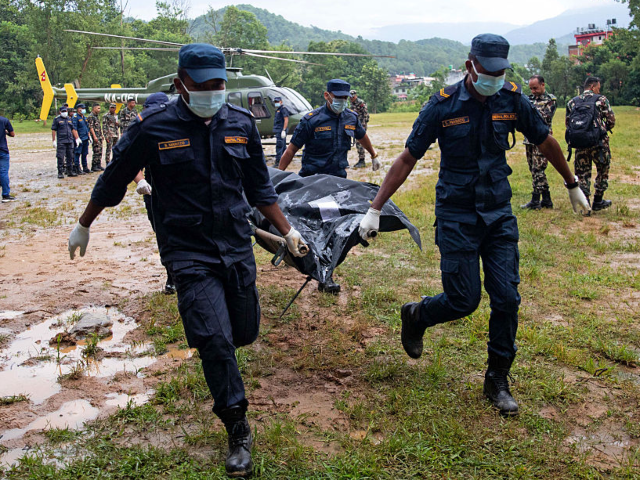

A lake that formed along the border between China and Nepal during Wednesday’s terrifying flash floods overflowed on Thursday, prompting a temporary suspension of rescue efforts due to fears of another flood cascade.
The newly formed body of water is known as a “barrier lake” because its perimeter was formed by debris from the earlier floods. The debris effectively dammed the junction of the Tsogyal and Purupqiangzangbu Rivers, turning the intersection into an unsteady reservoir of water.
The barrier lake held about 50 million cubic feet of water when it formed during Wednesday’s floods and was up to 90 million cubic feet by Friday morning. Surveyors noted water from the lake was beginning to spill into the nearby Lhende Khola and Trishuli rivers.
News of the overflow sparked a brief panic. Nepal suspended all rescue operations for several hours, while China withdrew its rescue personnel to higher ground. By noon local time on Friday, the rise in water levels proved to be less than feared, and the barriers around the lake appeared to be holding, so Chinese state media reported rescue operations had resumed.
China’s state-run Global Times reported on Thursday that China’s Ministry of Water Resources is “closely monitoring the lake’s developments and conducting flood simulations and analyses to prepare for a potential breach and provide support for emergency rescue efforts.”
The Global Times said the rescue effort included “emergency responders, the People’s Liberation Army, engineering teams, telecom operators, and relief organizations,” all of which are working against “difficult terrain, continued rainfall, and mounting risks of secondary disasters.” A team of disaster specialists arrived at the barrier lake on Friday to monitor its integrity with drones and water level sensors.
Chinese dictator Xi Jinping chaired a meeting of the Politburo in Beijing on Friday to coordinate the disaster response. The meeting concluded that “stronger monitoring of glacier lakes, landslide risks, and barrier lakes, emergency aid to affected areas in Nepal, and closer international disaster cooperation” were needed.
Stimson Center senior fellow Austin Lord told CNN on Friday that disaster experts are worried about a second barrier lake that appears to have formed just below the glacial fracture that has been blamed for triggering Wednesday’s floods. Chinese officials are referring to this second barrier lake as an “impact crater” from the glacier fall.
Lord noted that if either of the known barrier lakes overflows, or their barriers are breached, another flood could be triggered along the same path as the first one.
“There is a concern for those doing search and rescue who are operating in the river corridor itself,” he said, pointing to forecasts of more rain in the region.
The terrain’s features and risks of further flooding have made it very difficult for rescue workers to access Gyirong, the border crossing that was destroyed by torrents of debris-laden muddy water in a matter of minutes on Wednesday.
Nepalese rescue workers have reported finding dozens of dead bodies in the plains where flood waters emptied out. Many of the corpses were hideously mangled by repeated debris impacts as they were swept along by the fast-moving tide.
“All of our people have gone. They are dead. I have no one left waiting for me. Everything and everyone is gone. The end,” said a man who was rescued from the devastated village of Rasuwa and evacuated to a Nepalese army camp.
The evacuation camp was crowded with people looking for information on missing loved ones, including tourists from the United States and other countries. One group of ten women said they were looking for their husbands, who disappeared while climbing Mount Kailash in southwestern Tibet.
“Everybody is taking turns in shedding their tears, wiping it off and getting back to work,” said one of the women.
The Times of India identified two of the 90 missing U.S. citizens as 60-year-old Deepak Ahuja and his wife Madhu, 57, both residents of Texas. Their family said the couple was part of a group pilgrimage to Mount Kailash when the floods struck.
Nepalese authorities said about 500 tourists from 28 different countries are among the missing, while Chinese officials said hundreds more are missing in Tibet. Many of the missing were on or near Mount Kailash, which is revered by Hindus, Buddhists, and the less well-known Jain and Bon faiths.
The Indian government runs an official pilgrimage tour of the mountain every summer. The tour involves walking around the base of the mountain and bathing in the nearby Lake Manasarovar rather than climbing it, so the pilgrims were at relatively low altitudes when the flash floods struck.
The government of Nepal declined foreign assistance with disaster relief on Friday despite the large number of missing foreign nationals. Assistance has thus far been offered by the United States, India, China, the United Kingdom, Japan, South Korea, Sri Lanka, and Bangladesh.
“The offer for help is natural. Our security agencies are doing the search and rescue operation. For now we don’t require such help,” said Nepalese Foreign Ministry spokesperson Lok Bahadur Chhetri.
South Korea already has a rapid response team on the ground in Nepal, dispatched when about two dozen South Korean workers were killed or trapped in a flooded hydropower plant, but Nepalese authorities will not allow them to operate the six helicopters they have leased for search and rescue efforts, ostensibly due to fears of a “second major flood.”
“The rapid response team is in the process of requesting cooperation from Nepalese authorities to obtain permission to operate helicopters. We are continuing our efforts,” the South Korean Foreign Ministry said on Friday.
South Korea hastily reassigned its ambassador to Zimbabwe, Park Jae-kyung, to fill the vacant post of ambassador to Nepal on Friday. The foreign ministry said Park was “scheduled to move over the weekend and assume the position promptly.”
President Donald Trump on Thursday described the flood as “a terrible thing” and said the United States has offered Nepal “any help they need.”
“We’re sending aid, and we’ve spoken to the leadership and we let them know anything they want, we’ll have,” Trump said.
Confirmed deaths from the flood were somewhere between 553 and 579 on Friday, according to various reports, plus at least five dead acknowledged by China. 1,924 people have been reported missing in Nepal, plus 558 in China.
COMMENTS
Please let us know if you're having issues with commenting.