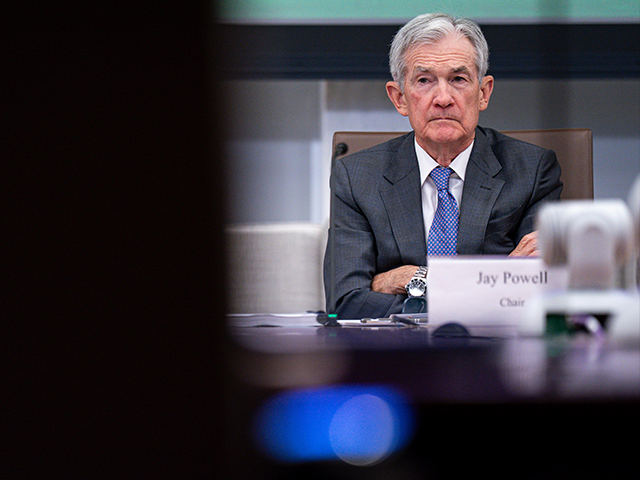

Pretty Vacant: The End of Powell’s Term Is Three Weeks Away
It is not clear who will run the Fed after the expiration of Powell’s term if the Senate has not confirmed Kevin Warsh.
As we explained yesterday, Senator Thom Tillis, the Republican of North Carolina, is sticking to his script about holding back Warsh’s confirmation so long as U.S. Attorney Jeanine Pirro’s investigation of the Fed continues. And Pirro says she’s not dropping the investigation. So, the end of Powell’s term without a confirmed successor is looking more and more like a real possibility.
Time is running out. Powell’s term as governor expires on May 15, just 22 days from now. That’s 15 business days. Pirro is still appealing a federal judge’s ruling that her investigation of the Fed is illegitimate. The odds of that appeal being decided in the next couple of weeks are extremely low. Three weeks is hardly enough time for the Senate to schedule a vote on the nomination, much less actually hold one.
What happens if that date passes prior to a confirmation of a new chairman is, at best, legally ambiguous. We may even end up without a chair of the Fed for a period of time.
The Law Doesn’t Explicitly Say Who Serves as Chair After May 15
While the law explicitly allows governors of the Fed to remain in their positions until a successor is confirmed, no such provision covers the chairman of the Fed. Similarly, while governors are explicitly protected from being fired without “cause,” that provision does not apply to the chairmanship. Despite this lack of statutory protection, U.S. presidents have not attempted to fire Fed chairs even when they disagreed on policy. Legal scholars describe this as a convention or norm against firing the Fed chair, pointing out that a president would risk political and public backlash if he were to attempt to do so without good cause.
Powell has said, without citing any statutory basis, that he can remain chairman if no successor is confirmed and that he intends to do so. But the text of the Federal Reserve Act points the other way. The Act provides that Board members continue to serve after their terms expire until their successors are appointed and qualified. It separately provides that the president shall designate one of those members to serve as chairman for a term of four years. What the statute does not say is that the chairmanship itself continues beyond that four-year term absent a new confirmation.
When this question arose in both the Carter and Reagan administrations, executive-branch lawyers concluded that a Fed chair could not automatically hold over after the expiration of the four-year chair term. A January 31, 1978, Office of Legal Counsel opinion reached that conclusion during the Carter administration, and a 1983 memorandum from Reagan White House Counsel Fred Fielding, echoing the Justice Department, said the same. Only a sitting governor is eligible to serve as chair, but the White House lawyers who examined the matter determined that the president’s duty to ensure the smooth operation of government created an inherent power to appoint one as a temporary chair.
So, the best reading of the law is likely that President Trump would get to appoint one of the current governors as acting chair. Most likely, this would be one of his appointees currently on the board: Christopher Waller, Michelle Bowman, or Steven Miran. Waller and Bowman are more likely, as Miran is still relatively new to the Fed and is in a temporary seat whose term expired months ago. Still, there would be a logic to appointing Miran: having a placeholder governor serve as chair might speed up the Senate confirmation process for Warsh. And despite his short tenure at the Fed, Miran quite obviously has the intellectual capacity to run monetary policy.
The statute’s pro tempore provision is also better read as covering a temporary absence, not a vacancy. It says that at Board meetings the chairman shall preside and that, “in his absence,” the vice chairman shall preside. If both are absent, the Board elects a member to act as chairman pro tempore. That language naturally describes a confirmed chair who is not present, not a vacancy created when a chair’s four-year term expires before a successor is confirmed. Philip N. Jefferson, an economist appointed by Joe Biden, is currently the vice chair.
That reading is reinforced by later legislative history. In 1983, Congress considered legislation that would have expressly provided that, upon the expiration of the term of the chairman or vice chairman, the incumbent would continue in that capacity until a successor was appointed and qualified. The same proposal separately addressed a “vacancy in the office of the chairman” and would have directed the vice chairman to perform the chair’s duties until a successor qualified. Congress’s consideration of those additions suggests the existing statute did not clearly provide either rule on its own.
An Empty Fed Chair Is a Reasonable Possibility
One plausible reading, then, is that the chairmanship simply becomes vacant until a new chair is confirmed. That would be unusual, but it would not be alien to federal law. Federal judgeships remain vacant pending confirmation, as the judiciary’s own vacancy tracker reflects. Ambassadorships can also remain vacant, with a chargé d’affaires ad interim taking charge when the position is vacant. Many of the federal agencies or commissions run by multi-member panels also allow seats to remain vacant pending confirmation. More generally, federal vacancy law itself contemplates that, when no lawful acting officer is in place, “the office shall remain vacant,” even though GAO says the Vacancies Reform Act does not apply to members of multimember boards and commissions.
This may even be part of the design. The Fed Board is a multimember body, and the statute elsewhere assumes that the Board can continue functioning when the chair is not present. A temporary vacancy in the chairmanship would also put pressure on the Senate to confirm the president’s nominee rather than leave the office unfilled.
What seems untenable is the notion that Powell can appoint his replacement or that the Fed Board gets to appoint its own chairman if there is a vacancy. That would be highly unusual and would leave the Fed essentially in charge of its own boss. This would make the Fed less accountable to Congress and put it beyond the control of the president, something the law and the U.S. constitution typically tries to avoid.
But Powell Might Then Become the Fed’s De Facto Leader
Complicating matters further, although Powell’s term as chair of the Fed board expires in May, his governor seat extends to January 2028. Traditionally, Fed chairs step down as governor when their term ends and a new chairman takes over, but this is not a legal requirement. Powell has indicated that he will not step down as long as Pirro’s investigation is ongoing and has not said whether he will step down once it ends. So, Powell might remain on the board as a governor and even the de facto head even if he is not officially the chair. In that position, however, he would not be able to exercise the authority of the chair
In another wrinkle, the Federal Open Market Committee (FOMC)—the Fed’s official monetary policy-setting body—elects its own chairman for a one-year term. It has always elected the chair of the Fed board to this position; but, in theory, it could elect any of its 12 members. Those members include the seven governors of the Fed, the president of the New York Fed, and a rotating group of four members of the remaining 12 Fed district banks. The FOMC could allow Powell to continue serving as its chair through the end of the year or could nominate another member who is not the chair of the Fed board.
The FOMC, however, does not directly control the most important lever of monetary policy. Although the Fed still focuses the public’s attention on the federal funds rate, the interest rate that banks would pay to borrow reserves from each other, this has been superseded when it comes to the operations of monetary policy. Because of the Fed’s large-scale asset purchases, the banking system is awash in reserves, and U.S. banks rarely borrow federal funds. Under the current regime, the rate the Fed pays banks for their reserves is what influences bank lending and interest rates in the broader economy. This is set by the Fed board. Traditionally, the Fed board sets the rate in lockstep with the FOMC’s rate changes, but this is not mandatory. In theory, the board could set the interest on reserves rate independently from the FOMC’s view on monetary policy—although that kind of explicit disunity seems unlikely.
It’s hard to believe that Senator Tillis wants to invite this kind of chaos. Perhaps someone on his staff would be so kind as to brief him on just how uncertain the outcome of allowing May 15 to come and go without a confirmation would be.
COMMENTS
Please let us know if you're having issues with commenting.