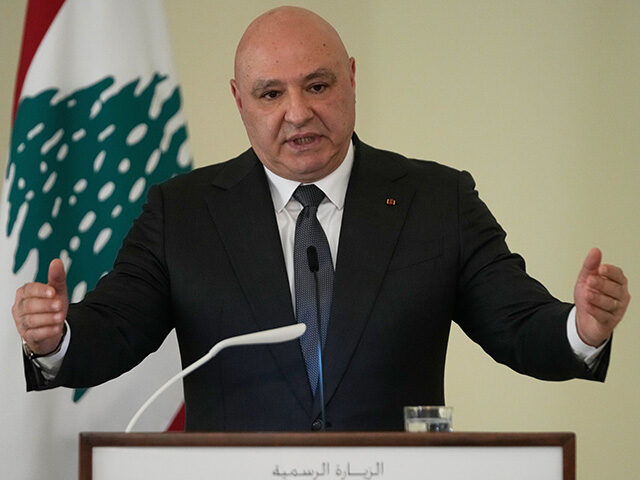

Ambassadors from Lebanon and Israel were scheduled to meet for a second round of talks in Washington on Thursday, with the Lebanese hoping to enlist the Trump administration’s assistance in ending the massive Israeli offensive against Hezbollah.
“For the first time, the Lebanon file is returning to the American table,” Lebanese President Joseph Aoun said on Thursday.
Aoun was hopeful that the new round of talks would lead to “economic recovery, reconstruction, and more.” He is not present for the talks himself, but said he hopes to meet with President Donald Trump soon to discuss the impact of the war in Lebanon.
Lebanon will be represented at the negotiations by Nada Moawad, the Lebanese ambassador to the United States, while Israel will be represented by its own ambassador to America, Yechiel Leiter. U.S. Ambassador to Lebanon Michel Issa will also attend the meetings. Hezbollah, the actual belligerent force that attacked Israel, is not sending a representative and has publicly disdained the peace process.
The U.S. State Department, which is hosting the Israel-Lebanon talks, hoped an extended ceasefire could be established if progress is made, a “mutual agreement” between the parties is reached, and the government of Lebanon “effectively demonstrates its ability to assert is sovereignty.”
This was a polite, if not very subtle, way of saying that Lebanon needs to get control of Hezbollah, the Iran-backed terrorist gang and political party that unilaterally dragged Lebanon into war by attacking Israel on Iran’s behalf last month.
“The time has come to treat Lebanon as a sovereign state and to finally empower it to act like one, rather than letting an Iran-backed terrorist organization have a veto on its future or block peace,” a State Department official told The National on Thursday.
“We are encouraged by a Lebanese leadership that is realistic about its challenges and willing to work toward a sovereign, stable Lebanon,” the official said.
Aoun’s government has expressed deep frustration with Hezbollah for bringing destruction on Lebanon by attacking Israel, but has also been strongly critical of Israel’s response, which included airstrikes, a ground invasion of southern Lebanon, and the destruction of villages where Hezbollah hides its drones and missiles.
Lebanon has been charged with disarming Hezbollah several times, first by United Nations resolutions and then by the Gaza War ceasefire in 2024, but Hezbollah continues to launch rocket and drone attacks at Israel. The Israeli government has said the current counter-offensive is intended to create a buffer area along the Israel-Lebanon border to nullify the threat of Hezbollah once and for all.
Aoun said his objectives for the negotiations included a “complete halt to Israeli aggressions,” the withdrawal of all Israeli forces from southern Lebanon, a return of prisoners, permission for displaced Lebanese civilians to return to their homes, and “the commencement of reconstruction for all that has been destroyed during this war.”
Aoun also demanded a halt to “Israel’s demolition operations in southern villages and towns.” The Israeli military has reportedly been using bulldozers, jackhammers, and other equipment to level structures that could be used as Hezbollah firing positions.
Israeli Defense Minister Israel Katz said last week that the area occupied by the Israeli Defense Forces (IDF) has been “cleared of terrorists and weapons and is empty of citizens, and will continue to be cleared of terrorists’ infrastructure.”
Katz said this clearing operation will continue, and will include “the destruction of houses in Lebanese villages” that have “become terrorist outposts in every sense.”
The IDF said its demolition operations are conducted “in accordance with international law and does not destroy civilian property unless required by imperative military necessity.”
Even with these obstacles to overcome, Aoun called Thursday’s talks “a rare opportunity that we must not squander, as it may not arise again.”
Israeli Foreign Minister Gideon Saar was less optimistic, calling Lebanon a “failed state” that is manipulated by Iran through its proxy Hezbollah.
“I call on the government of Lebanon: Let’s work together against the terror state that Hezbollah built in your territory. This co-operation is needed by you even more than by us,” Saar said.
“We don’t have any serious disagreements with Lebanon. There are a few minor border disputes that can be solved,” Saar said. “The obstacle to peace and normalization between the countries is one: Hezbollah.”
Hezbollah representatives slammed Aoun for talking to Israel at all, insisted on their “right to resist” with an arsenal of missiles, and said they would not abide by any agreements made in Washington.
Hassan Fadlallah, a Lebanese lawmaker from Hezbollah, said the group is willing to extend the current ceasefire “on the basis of full compliance by the Israeli enemy.” He essentially said there was nothing else to discuss by calling on Aoun to terminate all direct talks with Israel.
Lebanon’s Christian population continues to feel trapped in the conflict between Hezbollah and Israel, and remains outraged by last week’s destruction of a statue of Jesus Christ by an Israeli soldier, despite the IDF’s apologies, swift investigation of the incident, and efforts to make restitution.
“Their apology isn’t enough. It feels like an insult. This is a symbol of love and peace, and they broke it,” said Joseph Attieh, a local official from the village of Debel, where the incident took place.
“We couldn’t understand why an army would act like this. War is one thing. Religion is another. Every country at the UN agrees that religious symbols should be protected,” Attieh told The National on Wednesday.
“This will remain a wound in our hearts for a long time. It’s a red line. There is no respect left for humanity,” he said.
Israel’s apology for the destruction of the Christ statue apparently included quiet delivery of a sizable amount of humanitarian supplies to Christian villages in the conflict zone, but the residents were not mollified by the offering.
“We don’t want herbs, we want to live in dignity and for them to establish a humanitarian corridor so we can get our own supplies,” said an official from the Christian village of Rmeish in southern Lebanon, although he went on to say that assistance was urgently needed by civilians iin the conflict zone.
Lebanese Prime Minister Nawaf Salam told the Washington Post on Thursday that his government rejects the Israeli idea of a “buffer zone,” and will accept no agreement unless it includes “full withdrawal” of Israeli forces.
“We cannot live with a so-called buffer zone – an Israeli presence where Lebanese displaced people are not allowed to return, where destroyed villages and towns cannot be rebuilt,” he said.
Salam said he believed an agreement could be reached with help from the United States.
“We are entering these negotiations convened by the U.S. convinced that the U.S. is the party that can have leverage over Israel. Their role was critical in reaching the ceasefire, and we hope they will continue exercising their leverage over Israel,” he said.
“I don’t know what we can achieve through negotiation, but I know what we want. And whether it’s an avenue we should pursue? My answer is indeed yes. Because we don’t want to leave any stone unturned to reach our objectives,” he said.
Salam accused Israel of war crimes on Wednesday for an airstrike in southern Lebanon that killed journalist Amal Khalil and injured a freelance photographer. The Lebanese government accused the IDF of deliberately targeting Khalil.
“Targeting journalists, obstructing access to them by relief teams, and even targeting their locations again after these teams arrive constitutes described war crimes,” Salam said.
The Lebanese health ministry further accused Israeli forces of using gunfire and a stun grenade to prevent a Lebanese Red Cross ambulance from reaching the wounded journalist.
The IDF responded that it “does not target journalists and acts to mitigate harm to them while maintaining the safety and security of its troops,” and said the vehicles targeted by the airstrike became an “immediate threat” to Israeli forces after departing from a “military structure used by Hezbollah.”
COMMENTS
Please let us know if you're having issues with commenting.