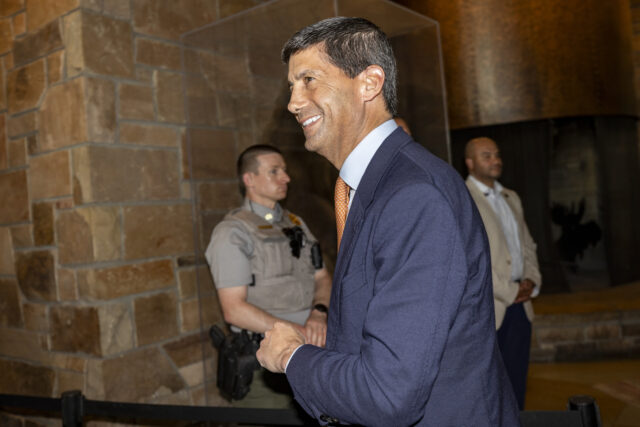

Federal Reserve Chairman Kevin Warsh used his Jackson Hole speech Friday to expand on a longstanding critique of forward guidance, arguing that the central bank should rely less on efforts to tell markets where policy is headed and more on a set of principles that leave officials free to respond to changing economic conditions.
Warsh has argued for years that central banks can damage decision-making by saying too much about future policy. On Friday, marking his 100th day as Fed chairman, he made clear that view will shape how he intends to run the central bank.
“You might know about my long-time discomfort with early pronouncements of future policy decisions,” Warsh said. “I much prefer another path.”
Forward guidance became an important part of Fed policy during the 2008 financial crisis, when Warsh himself was a governor. He said Friday that it had been useful in that emergency but had since “overstayed its welcome.”
“In normal times, the role of forward guidance should be limited and circumscribed,” Warsh said. Oversharing internal deliberations and making quasi-commitments about future interest-rate decisions, he argued, can mislead businesses and investors while restricting the Fed’s freedom to change course when circumstances shift.
The argument builds on concerns Warsh has raised since leaving the Fed, including in a 2014 review of communications practices at the Bank of England. What is different now is that Warsh is in a position to put those ideas into practice at the world’s most influential central bank.
His critique challenges one of the defining features of modern central banking. Since the financial crisis, Fed officials have increasingly used speeches, policy statements and economic projections to steer expectations about the future path of interest rates. Investors, in turn, have devoted growing attention to predicting the Fed’s next move.
Warsh said that relationship can become self-reinforcing. The Fed needs market prices to provide independent information about the economy, including signals from Treasury securities, credit markets, currencies, commodities and other asset prices. But those signals become less useful if investors are mainly trying to anticipate what the Fed itself will do.
“If markets rely materially on the Fed’s guidance and the Fed relies on market prices, we are all more likely to be blinded to new developments,” Warsh said, describing the problem as a “hall-of-mirrors” effect.
He pointed to the inflation surge of 2021 as an example of how forward guidance may delay a needed change in policy. Commitments about future rates can leave officials reluctant to abandon an earlier course even after the economic facts have changed, he said.
Warsh also pushed back against demands that the Fed replace forward guidance with an explicit “reaction function”—a formula describing how policymakers would change interest rates in response to different economic outcomes.
Such an approach might seem to offer predictability without requiring officials to promise a particular path for rates. Warsh argued that it assumes a degree of precision about the economy that policymakers do not possess.
“I wish our understanding of the economy were so precise as to provide a mechanical, tried-and-true answer—that some simple function like a Taylor rule could be rigorously relied upon,” Warsh said. “But our knowledge just doesn’t extend that far.”
The factors most important to monetary policy can change over time, Warsh said, particularly amid shifts in technology, geopolitics and global supply chains. Attempts to illustrate a reaction function with economic forecasts work better “in theory than in practice, better in the lab than in the field,” he said.
Warsh’s alternative is not to leave markets guessing about how he thinks. Instead of promising future decisions or supplying a formula from which investors can calculate them, he laid out seven principles he said should guide monetary policy.
The first is that policymakers should distinguish between what is happening now and what happened recently. Warsh warned against making forward-looking decisions based on stale data or reacting too heavily to individual releases. Trends, he said, matter more than isolated data points, and the information guiding decisions should be timely, accurate and relevant.
Second, the Fed should think of monetary policy as keeping aggregate demand broadly aligned with aggregate supply. The difficulty, Warsh said, is that policymakers can observe economic activity but cannot directly observe the economy’s underlying supply capacity. That makes estimates of whether policy is too loose or too tight inherently uncertain.
Third, Warsh said the Fed’s two percent inflation target is “firm” and “fixed.” Inflation, he added, should not be assumed to fade on its own. Maintaining price stability is the central bank’s responsibility.
Fourth, he argued that the two sides of the Fed’s congressional mandate—stable prices and maximum employment—should not be viewed as inherently conflicting. High inflation itself damages economic prosperity, he said.
His fifth principle would put short-term interest rates back at the center of monetary policy. Unconventional measures designed to stimulate the economy may be appropriate during genuine crises, Warsh said, but should otherwise be used “sparingly, if at all.”
That language points toward a more limited role for balance-sheet policies such as large-scale bond purchases, which became a regular part of the Fed’s toolkit after the financial crisis and pandemic.
Sixth, Warsh said “money matters.” Policymakers should pay attention both to money created by the central bank and to money generated through the banking and financial system, he said. Financial innovation may change the mechanics linking money, credit and prices, but that is not a reason to ignore money’s effects on financial conditions and inflation.
His final principle concerns the Fed itself. Warsh said a “quieter Fed, more purposeful in its communications,” would be better positioned to meet its objectives and should ultimately be judged by its results.
“At the moment of truth, there are either reasons or results,” Warsh said, quoting test pilot Chuck Yeager.
Taken together, the speech offered a fuller account of an approach Warsh has advocated for years: fewer promises about future policy, less dependence on mechanical rules,and more room for officials to exercise judgment as the economy changes.
That distinction ran throughout his remarks. Warsh offered a firm assessment of inflation and said the Fed’s “predominant focus” should currently be on price stability. But he stopped short of promising any particular decision at the next meeting.
“I stand here today committed to a discipline, not to a decision,” Warsh said.
COMMENTS
Please let us know if you're having issues with commenting.