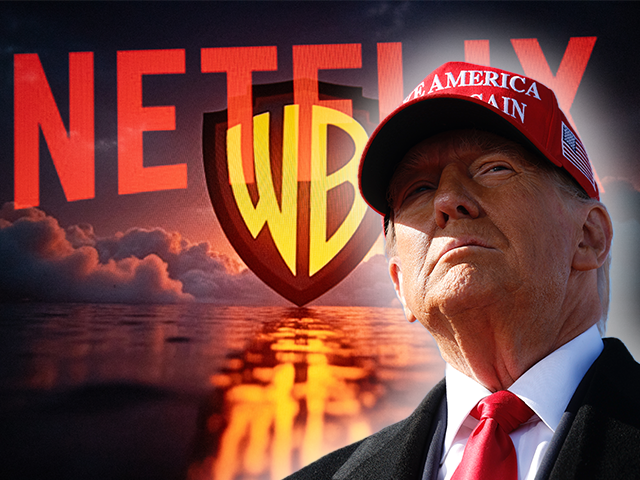

A few hours before Hollywood liberals started parading down the red carpet at Sunday’s Golden Globe awards, President Trump came out against the Netflix acquisition of Warner Brothers. He was right to do so, because as conservative journalist Andrew Breitbart pithily observed before his untimely death in 2012, “politics is downstream from culture.”
Breitbart recognized what has often been under-appreciated on the right: the immense power of the media to shape America’s narrative. For decades, that narrative has been largely communicated through the lens of people on the left. Unintentionally or not, their views about virtually every element of American society – race, ethnicity, gender, economics, law, etc. – get woven into movies, television programs, and news coverage.
Several years ago, a Washington Post journalist opened up about the views of her colleagues. “The elephant in the newsroom is our narrowness,” she said. “Too often, we wear liberalism on our sleeve and are intolerant of other lifestyles and opinions. . . .We’re not very subtle about it at this paper: If you work here, you must be one of us. You must be liberal, progressive, a Democrat. I’ve been in communal gatherings in The Post, watching election returns, and have been flabbergasted to see my colleagues cheer unabashedly for the Democrats.”
The Washington Post is hardly an outlier in the media universe. And media bias has become even more pronounced since the Post employee’s burst of candor.
Consider late-night TV talk shows, which are supposed to be about light-hearted entertainment. The Media Research Center has examined the politics of the guests who appeared on shows hosted by Jimmy Kimmel, Seth Meyers, Jimmy Fallon, and Stephen Colbert, as well as The Daily Show, from July of 2024 through December 2025. Their study found that 99 percent of the guests were liberals. The shows also hosted 31 politicians. Not one of them was a Republican.
The state media autocrats in Iran and North Korea would no doubt be impressed by this ideological homogeneity. But it’s a sad commentary about the state of the American media – and it’s the backdrop to conservatives being uneasy about Netflix acquiring Warner Brothers.
President Trump’s Sunday morning broadside was a repost of an article published last month under the headline, “Stop the Netflix Cultural Takeover.” The article asserted that the Netflix bid for Warner Brothers “is an attempt to consolidate unprecedented cultural power inside one of America’s most ideologically aggressive corporations — a company that has repeatedly used its global platform to elevate progressive narratives while suppressing dissenting viewpoints.”
Given that 37 percent of Americans identify as “conservative” or “very conservative,” and only 25 percent identify as “liberal,” why would media companies risk alienating so many of their potential viewers?
It’s useful to remember one of the Reagan administration’s slogans: “personnel is policy.” It goes for companies as well. And it’s clear that Netflix is a nest of liberalism.
In the 2024 elections for the presidency and for Congress, the company’s employees contributed more than $17.3 million to candidates and other advocacy groups. Less than one percent went to Republicans. It was the same in 2020.
Many of the company’s senior executives are also generous supporters of Democratic candidates. In 2024, the company’s founder, Reed Hastings, gave $7 million to a super PAC supporting Kamala Harris for president. And let’s not overlook that Barack and Michelle Obama have a sweet programming deal with Netflix.
In such an environment, will anyone at Netflix be willing to propose programming that supports, say, free-market economics or traditional marriage?
It’s striking that the Warner Brothers board accepted the $83 billion Netflix bid given that Paramount offered $108 billion. The author of the article President Trump reposted said regulators should explore whether the Warner Brother board “rejected a financially superior offer because Netflix was the woker, ideologically preferred buyer. If true, that raises serious questions about whether the board has honored its basic duty to shareholders.”
We may get answers soon, as Paramount announced on Monday it would file suit against Warner Brothers to force the company to reveal the terms of its agreement with Netflix. But we already know Warner Brothers is ideologically aligned with its potential partner: the company’s employees also gave 99 percent of their campaign contributions to Democratic candidates in 2024.
Liberals support all forms of diversity – except ideological diversity. They’ve started to lose that battle in universities (even Harvard’s president has noted the lack of “viewpoint diversity” on campuses), but their decades-long grip on the media persists.
The Netflix acquisition of Warner Brothers is an opportunity to consolidate that grip. If it succeeds, the programming is certain to reflect the personal values and beliefs of the combined companies’ employees.
That will be bad for the bottom line – and shareholders. It will be even worse for America’s future.
Corey R. Lewandowski was a senior adviser to the Donald J. Trump presidential campaign in 2024 and 2020 and campaign manager during the 2016 campaign.
COMMENTS
Please let us know if you're having issues with commenting.