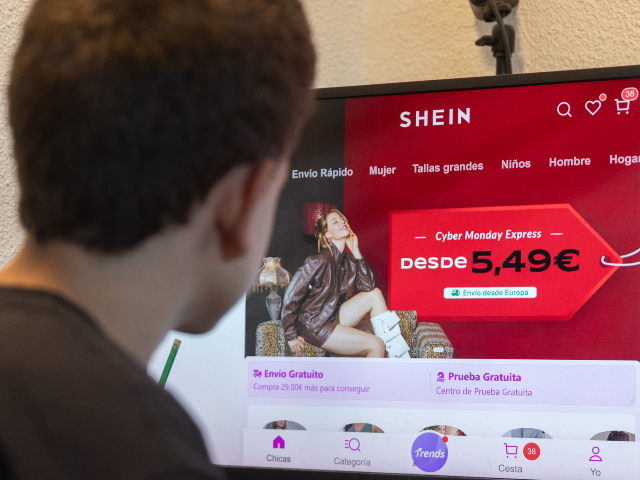
The European Commission (EC) announced an investigation on Tuesday into the Chinese “fast fashion” shopping application Shein over a variety of potential violations, including allegedly “addictive” interfaces to abuse customers and the sale of “childlike” sex dolls on the site.
The French newspaper Le Monde explained on Tuesday that French police were reportedly behind the initial complaint that led to the EC investigation, highlighting the sale on the app of sex dolls with the likeness of children. The investigation will reportedly be conducted under the Digital Services Act (DSA), a European Union law to curtail illicit online content.
Shein, which is currently headquartered in Singapore though it was initially founded in China, reportedly did not deny the sale of the sex dolls, instead announcing following their discovery that the company had immediately removed all sex dolls from its shopping interface. It has also denied wrongdoing and vowed to cooperate in good faith with the investigation.
Shein is a company selling inexpensive clothing and accessories, founded in 2008 but exploding onto the international commerce scene in the early 2020s. The company reported $2 billion in profits in 2023 and launched an ambitious “Marketplace” initiative that year that allowed it to showcase products from global third-party sellers in addition to its in-house inventory. The sex dolls in question, which the EC referred to as “child sexual abuse material” potentially sold by the company, were reportedly a third-party product.
In addition to concerns about illicit and abusive products on its platform, Shein has been engulfed in controversies since its astronomic rise as a global heavyweight fashion retailer, including accusations of stealing designs from small business owners, using materials linked to China’s ongoing genocide and enslavement of the Uyghur people of East Turkistan, and the mysterious appearance of a model on the application resembling accused American murderer Luigi Mangione.
According to both Le Monde and the BBC, the EC is investigating the potential child sex content in addition to other potentially hazardous products, including weapons. The DSA probe will also include an investigation into the “addictive design” of Shein and its potential to take unfair advantage of consumers.
“Protecting minors and reducing the risk of harmful content and behaviors are central to how we develop and operate our platform,” the BBC quoted Shein saying in a company statement, emphasizing that it rapidly removed the “childlike” sex dolls in question, and all other sex dolls, from the website and allegedly cooperated with law enforcement to identify the sellers, which it claimed to ban from the app.
“Over the last few months, we have continued to invest significantly in measures to strengthen our compliance with the DSA,” a Shein spokesperson said, according to the BBC. “These include comprehensive systemic-risk assessments and mitigation frameworks, enhanced protections for younger users, and ongoing work to design our services in ways that promote a safe and trusted user experience.”
Similarly, Le Monde quoted Shein as stating, “We share the commission’s objective of ensuring a safe and trusted online environment and will continue to engage constructively on this procedure.”
The French newspaper noted that the investigation is open-ended and has no deadline for completion. A negative finding could result in significant fines on the fast fashion company.
Shein rose to prominence by gaining popularity on social media, particularly the Chinese social media application Tiktok. Like other Chinese competitors, such as the general goods seller Temu, Shein took significant advantage in the United States of an exemption to certain customs fees and inspections known as de minimis, which allowed packages under $800 in value not to undergo the same rigorous inspections as large shipments. As Shein ships its products directly from Chinese manufacturers to American consumers, the vast majority of its packages were worth less than $800 and thus did not have to undergo scrutiny or pay fees. President Donald Trump signed an executive order in July closing the de minimis loophole, which business journalists documented preceded a collapse in demand for Shein from American consumers.
For years, human rights activists encouraged the U.S. government to investigate Chinese low-priced goods sellers, including Shein, for potential ties to the Uyghur genocide. While the Communist Party of China has oppressed the people of occupied East Turkistan for decades, dictator Xi Jinping dramatically escalated the danger by imposing a policy in 2017 of mass forced sterilization, forced abortions, and imprisonment in concentration camps. At their peak, the U.S. government estimated that China’s concentration camps, which Beijing euphemistically referred to as “vocational training centers,” imprisoned as many as 3 million people. Survivors of the camps testified to being enslaved and forced to work long hours. Global condemnation of the practice prompted China to declare the slaves had “graduated” from “training” camps and bus them to factories nationwide, making tracking the use of slavery to manufacture products in China extremely difficult.
In 2022, following the alleged “graduations,” Bloomberg News reported that investigators had found cotton from East Turkistan in Shein’s clothing, indicating that the company benefitted from Uyghur slave labor.
“Shein is able to offer this array of products at rock-bottom prices not because of any particular competitive advantage, but because it steals intellectual property, infringes copyrights, exploits U.S. trade law, and uses fabric linked to Uyghur slave labor,” Secretary of State Marco Rubio, at the time a senator for the state of Florida, wrote in a letter to colleagues in 2023.
Shein as a company has repeatedly asserted that it is “working hard” to protect its company from benefitting from worker abuse, pointing to, in some circumstances, its move out of China.
“We are actively working to improve our suppliers’ practices, including ensuring that hours worked are voluntary and that workers are compensated fairly for what they do, and also recognize the importance of industry collaboration to ensure continuous improvement and progress in this area,” Shein said in a corporate statement in 2024.
Christian K. Caruzo is a Venezuelan writer and documents life under socialism. You can follow him on Twitter here.
COMMENTS
Please let us know if you're having issues with commenting.