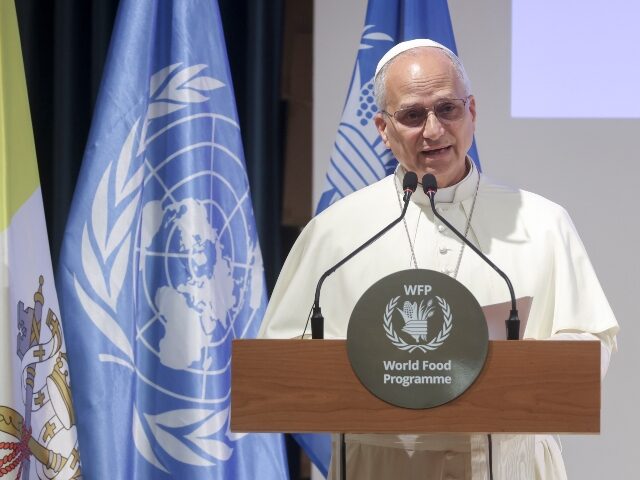

Pope Leo XIV addressed the importance of fighting global hunger during a visit on Monday to the Roman headquarters of the World Food Program (WFP), stating that food insecurity allows for conflict and war to spread and “fuels forced migration.”
While most of the pope’s comments focused on the importance of restructuring the world’s humanitarian aid structures to facilitate greater access to more people, encouraging governments to drop bureaucratic hurdles to food and medicine, the reference to forced migration raises a concern Pope Leo has prioritized throughout his public statements in the past year. During various international engagements, the head of the Catholic Church on earth has condemned human traffickers who aid in illegal mass migration and encouraged those in conflict zones to consider staying in their homelands and contributing to peace. Most recently, in Spain this month, Pope Leo asserted that people have a “right to not have to migrate” that governments must work harder to ensure.
Pope Leo made his comments on Monday in the context of visiting the WFP, an arm of the United Nations tasked with distributing food aid around the world.
The agency won the 2020 Nobel Peace Prize for its work in 88 countries, according to the Nobel Committee, in the context of the Wuhan coronavirus pandemic prompting governments around the world, including the United States, to take authoritarian steps such as shutting down communities and greatly limiting the civil rights of their citizens. The WFP, which is extremely active in conflict zones to help feed civilians, also has a long history of scandals, as with most U.N. agencies. WFP workers have been accused of widespread sexual assault within the agency, corruption, and distributing unhealthy food.
The pope nonetheless congratulated the WFP for its efforts to ensure access to food for some of the most malnourished and marginalized people in the world, condemning a global governance system in which “conflicts are ‘fed’ more readily than people are nourished.”
“[U]nprecedented global productive capacity exists alongside expanding zones of extreme vulnerability,” the pontiff observed, but “humanitarian concerns increasingly risk being relegated to a secondary place among international priorities.”
The pope encouraged governments to work in “reducing unnecessary bureaucracy so that transparency and accountability serve people rather than impede assistance.” He noted that the Catholic Church itself is one of the world’s most successful distributors of humanitarian aid and asked the WFP to expand collaboration with the Vatican.
Turning to an audience of government leaders, Pope Leo outlined reasons they should prioritize ending hunger over other political issues.
“More than merely a humanitarian concern, hunger erodes social cohesion, heightens the risk of conflict and fuels forced migration,” he asserted. “Moreover, it undermines the capacity of States and societies to build resilient institutions, provide effective education and foster sustainable economic development.
“I wish to appeal to the governments and peoples of the world to renew and strengthen their commitment, to increase the resources dedicated to combating hunger and its root causes, and to remove the obstacles that prevent aid from reaching those in need,” the pope requested. “At the same time, such support should also strengthen engagement with the Church and civil society. Reinforcing the capacities of all these actors together will multiply our collective effectiveness in the fight against hunger.”
Pope Leo’s visit to the WFP headquarters follows two major international tours in the past year: his recently concluded trip to Spain and a visit to Turkey and Lebanon in late 2025, the latter his first international visit as the head of the Vatican. Fighting poverty and discouraging mass migration featured throughout his remarks in both visits, encouraging governments of troubled countries to create situations where their citizens, particularly the youth, do not feel compelled to leave.
In Spain’s Canary Islands in mid-June, Pope Leo XIV addressed human traffickers who specialize in bringing Africans across the Mediterranean to places like the Canaries, often with no regard for their safety, resulting in large numbers of deaths. The pope had stern words for the traffickers, urging them to “stop” and “repent.”
“For every life lost, every family deceived … you will have to appear before divine justice,” he warned.
Speaking in Gran Canaria on June 11, the pope delivered a defense of what he described as “the right not to have to migrate” – not just what he saw as an imperative to accept refuges, but government responsibility to ensure that the countries they control do not create migrant crises.
“While there is a right to seek refuge when life is threatened, there is also the right not to have to migrate,” he stated, “the right to remain in one’s own home without hunger, war, persecution, violence, the land becoming uninhabitable, corruption stealing the bread from the poor or weapons destroying the future of children.”
Similarly, during his visit to Lebanon in December Pope Leo said that the Church “does not want anyone to be forced to leave their country.”
“There are times when it is easier to flee, or simply more convenient to move elsewhere,” he continued. “It takes real courage and foresight to stay or return to one’s own country, and to consider even somewhat difficult situations worthy of love and dedication.”
COMMENTS
Please let us know if you're having issues with commenting.