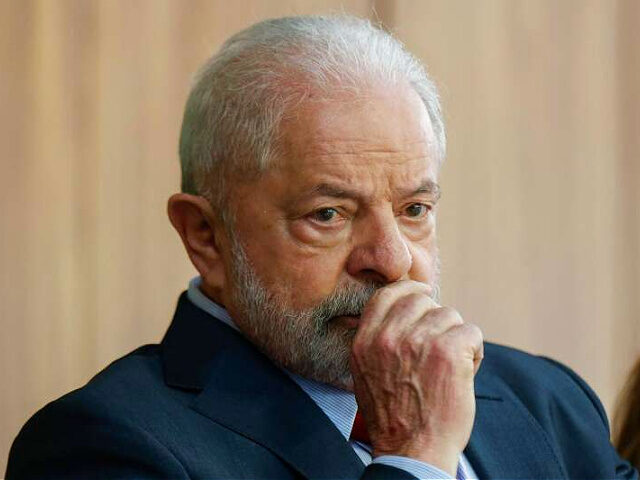

Brazil’s radical leftist President Luiz Inácio Lula da Silva and Supreme Federal Tribunal (STF) Minister and “anti-fake news crusader” Alexandre de Moraes made calls on Thursday for the regulation of social media in the country.
Lula and de Moraes made the remarks in speeches at the opening of Brazil’s 2024 judicial year.
Lula, in his speech, stressed the importance of “democratic regulation” of social media and the need to criminalize those who “incite violence” on digital platforms. Lula also said that companies that host the offending content should be held responsible for crimes committed on their platforms.
“We need to criminalize those who incite violence on social networks. But it is also necessary to hold companies responsible for the crimes that are committed on their platforms – such as pedophilia, encouraging massacres in schools, and encouraging the self-mutilation of adolescents and children,” Lula said.
“We need to dismantle the criminal fake news machine, which during the pandemic spread unfounded suspicions about vaccines, causing the deaths of hundreds of thousands of Brazilians,” he continued.
Since the start of his third presidential term on January 1, 2023, Lula and members of his government have repeatedly made national and international calls for regulating social media in the name of fighting alleged “misinformation.”
Alexandre de Moraes – who, during the 2022 presidential campaign, enacted several censorship rulings that greatly aided Lula’s campaign against conservative former President Jair Bolsonaro – echoed Lula’s demands, claiming there is a “need for general regulation by the National Congress in defense of democracy” and describing the use of mass media as one of the “big problems” of modern democracies.
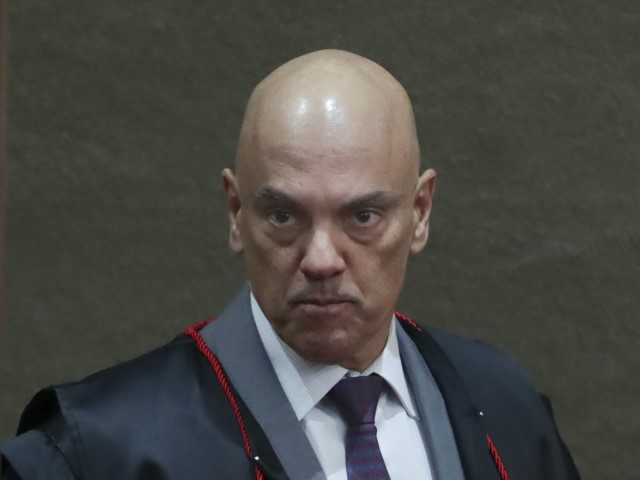
Alexandre de Moraes (Gustavo Moreno/AP)
“There is a need for greater transparency in algorithms and the use of artificial intelligence. Voters’ information and data are obtained without any authorization,” de Moraes said.
“It is no longer possible to allow false speech to be directed, hate speech to be induced, massive disinformation without any responsibility on the part of the so-called big techs,” he continued.
Brazil will hold municipal elections in October. De Moraes expressed “concern” about the possible use of artificial intelligence during this year’s municipal elections.
“The commitment of this Court to regulate – within the framework of the elections and together with the National Congress – to plead for general regulation against fraudulent news, against the dissemination of disinformation,” de Moraes said, “and against the dangerous instrumentalization that social networks are suffering and allowing themselves to be suffered [sic] by political groups with fascist ideas.”
De Moraes has been leading an open-ended “inquiry” since July 2021 into “anti-democratic digital militias” that spread “fake news.” The inquiry was used last year to launch “Operation Venire,” a probe into allegations that former President Bolsonaro had falsified vaccination documents to travel to the United States. As part of the investigation, de Moraes ordered the police to raid Bolsonaro’s home and arrest his former top aide, Mauro Cid.
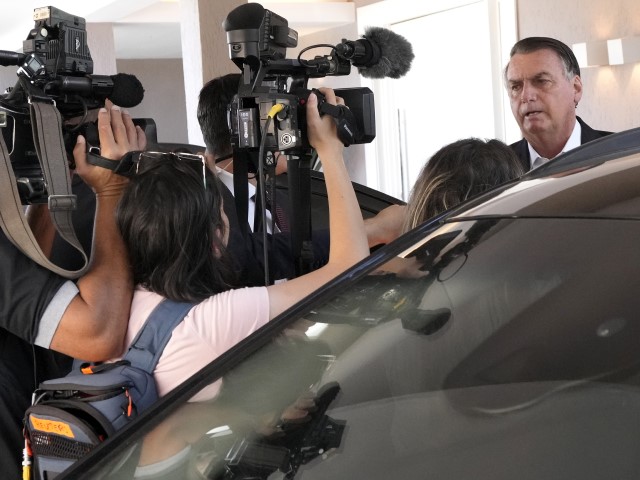
Former Brazilian President Jair Bolsonaro speaks to the press outside his home before getting into a car after Federal Police agents carried out a search and seizure warrant in Brasilia, Brazil, Wednesday, May 3, 2023. When asked about the search of Bolsonaro’s home in Brasilia, the Federal Police press office gave a statement saying officers were carrying out searches and arrests related to the introduction of fraudulent data related to the COVID-19 vaccine into the nation’s health system. (Eraldo Peres/AP)
De Moraes also had congresspersons arrested over content published on social media and forced social media companies to deplatform and restrict access to specific accounts in previous years. Companies that did not comply risked paying hefty daily fines to Brazil.
The STF minister also ordered a raid on Monday on the home of Carlos Bolsonaro, former President Jair Bolsonaro’s son, as part of a probe into illegal espionage activities allegedly committed during Bolsonaro’s presidency.
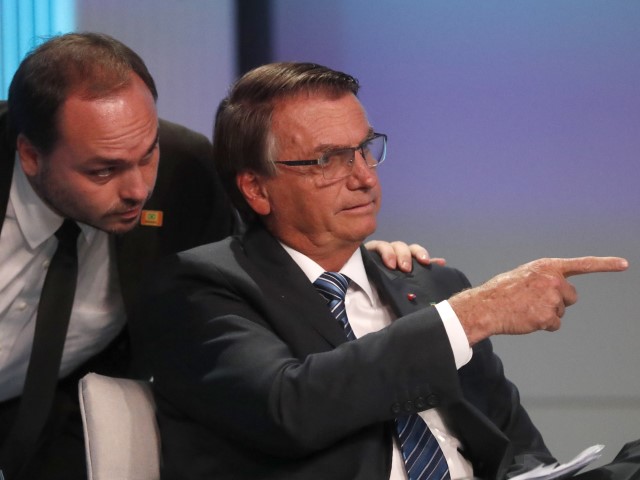
Carlos Bolsonaro, son of Brazil’s President Jair Bolsonaro, who is running for re-election, whispers in his father’s ear during his arrival at the presidential debate in Rio de Janeiro, Brazil, Sept. 29, 2022. Brazil’s federal police carried out a search warrant Jan. 29, 2024, for Carlos Bolsonaro, a Rio de Janeiro city councilman, an officer with knowledge of the operation told The Associated Press. (Bruna Prado, file/AP)
The Brazilian Congress, as part of a broader “democracy package” prepared by former Minister of Justice and Public Security and new STF member Flavio Dino in response to the January 8 riots, is embroiled in an ongoing discussion for a bill that aims to fight “fake news” by regulating and punishing content published on social media that is deemed “hateful” by the Brazilian government. The bill’s debates, frozen since 2023, are expected to resume negotiations during 2024.
Christian K. Caruzo is a Venezuelan writer and documents life under socialism. You can follow him on Twitter here.
COMMENTS
Please let us know if you're having issues with commenting.