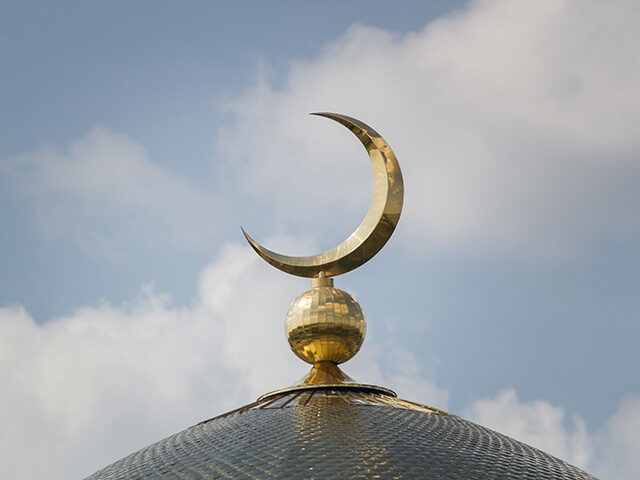

A nearly completed mosque in Punta Cana, Dominican Republic, attracted a crowd of Christian protesters and prompted the government to halt construction this month after evidence surfaced that its construction may not have obtained the proper permits.
On November 15, a crowd of Christians shouting, “Christ is our king!” organized outside of the site of the proposed “Nurul Islam” mosque, which if completed is expected to be the largest Islamic worship center in the country. The Dominican Republic is an overwhelmingly majority Christian country with a small Muslim population, raising questions among residents as to the demand for the existence of such a facility. Protesters and others objecting to the proposed mosque have opposed the project for two main reasons — that the government reportedly found evidence of improper construction permits at the site, and general concerns that Islam is not compatible with Dominican values.
“Christ is our king, Christ is our lord,” one female protester told local journalists at the protest. “We don’t want Allah nor do we want Mohammed – Christ is the king.”
Local reports cited concerns with Islam and its religious tenets generally as part of the motivation for protesters, including reports that some feared “combinations of Islam with voodoo rituals,” common in the Caribbean region.
Protest organizer Isaac Colón, however, focused on the reports that the mosque was an illegal construction, alarming the community surrounding it.
“We are here exercising our right to peacefully protest for various reasons,” Colón explained, according to local newspaper El Faro. “First, the illegality of this mosque, which initially was presented as a one-family residential unit and was later revealed to be, in reality, a mosque, which generates a lack of trust and transparency.”
@prendiendoellive Este es un país cristiano, un pueblo de Dios, nunca al isl-mismo… #cristiano #rd #republicadominicana #catolicos #slam
The Dominican outlet RCC Noticias quoted a local official, Verón municipal district councilman Uridy Marte, who appeared to confirm the reports of permits on the site allowing only a one-family residential unit, not a massive mosque complex.
“If the permit was for a one-family residence, how does it end up being built up as a mosque? Those are two totally different things,” he observed.
Dominican commentators also weighed in to oppose the mosque in various outlets, differing in their reasons but agreeing that the mosque presented a risk. Writing for El Nuevo Diario, Armando Olivero described Dominican identity as inextricably linked to Christianity.
“The Nurul Islam Mosque under construction in Punta Cana is more than a work in progress; it is the sentence that forces the Church to awaken,” Olivero wrote. “It is a battle for the heart of our nation.”
Writing for the independent outlet El Demócrata, Francisco Tavárez counters that the religious nature of the building is irrelevant to the murky legality of the construction.
“The problem is not the edification itself nor the religion practiced there,” he argued. “The Dominican Republic is (and should continue to be) a nation that guarantees religious freedom. The true risk is in permitting any work, of any origin, be constructed at the margins of legally established processes.”
“Tolerating that norms as basic as transparency in the obtaining of permits be violated opens up dangerous spaces: the erosion of institutionality, the weakening of the regulating authority of the State,” he continued, “and the creation of conditions where groups (whether they be economic, political, or religious) can attempt to operate without controls.”
At the time of the protest on November 15, construction of the site was halted and government officials had placed signs around the site declaring that construction had stopped due to violations of the law.
Dominican news outlets offered little information on the origins of the Nurul Islam mosque project. Some unconfirmed reports online, celebrating the development of the project, attributed its funding to “the Cheema Brothers, originally from Pakistan,” and appeared to show Muslims praying at the site while still under construction. Promotion of the site online described the proposed mosque, if completed, as the largest of its kind in the Caribbean.
Reports prior to the protests, and prior to the discovery of the allegedly inappropriate legal permits, noted that fundraising and promotion for the mosque reportedly began in 2013, as its constructors shared information online calling for the expansion of Islam in the country. Its organizers reportedly referred to the goal of the mosque as being to “radiate knowledge and compassion for the Muslims community.” While reports claimed that Islam in the Dominican Republic, which is an upwards of 80-percent Christian country, was growing, only five mosques were reportedly in operation nationwide at the time of the Nurul Islam project.
The stewards of the Nurul Islam mosque appeared to have run several social media pages promoting the project, including an Instagram and Facebook page, but both appear to have been taken down at press time. An apparent official website for the mosque also appears to no longer be active. The information available on the recovered “About” page of the site indeed credits the Cheema Brothers Foundation for leadership in the development of the mosque. “Cheema Brothers” appears to be the parent company of a group of duty-free shops in Punta Cana, but its official website is also not available live at press time. Its social media presence remains accessible, though it offers little information. Breitbart News could not independently confirm that the “Cheema Brothers Foundation” mentioned on the defunct Nurul Islam Mosque website is the same company as the Punta Cana duty-free store corporation.
“Nestled in the heart of Punta Cana, this mosque is a dynamic work in progress, poised to be a radiant source of knowledge and compassion for the flourishing Muslim community in this vibrant destination,” the official mosque website read. “As we extend our warm embrace to locals (Dominicans and Haitians) and global travelers, we offer a harmonious space for worship and enlightenment. More than a place of devotion, this mosque is a gift to the community, dedicated to sharing the profound teachings of Islam with everyone.”
The Council on American-Islamic Relations (CAIR) came to the defense of the Dominican mosque on November 19, publishing a message urging the Dominican government to normalize the permits necessary for the completion of the project.
“We urge the government of the Dominican Republic to uphold the principles of religious freedom and equal treatment of all faiths by allowing the construction of the proposed mosque in Punta Cana,” a statement from the organization read.
CAIR blamed the protests against the mosque on “Islamophobic misinformation” and demanded the Dominican government “ensure that Dominican Muslims are free to practice their faith without harassment or discrimination.”
“We encourage community members to reject fear-mongering and instead embrace mutual respect and understanding,” CAIR added.
CAIR has been declared a terrorist organization by the United Arab Emirates and was named by federal prosecutors as an unindicted co-conspirator in a Hamas-funding operation.
COMMENTS
Please let us know if you're having issues with commenting.