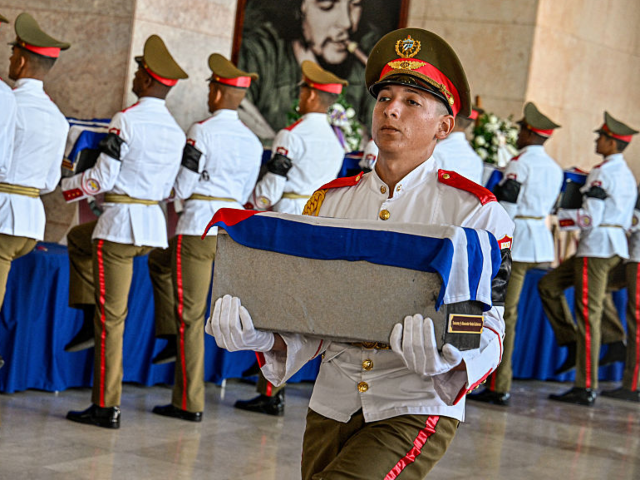
A plane carrying the remains of 32 identified Cuban state security agents killed in the American military operation to arrest deposed Venezuelan dictator Nicolás Maduro landed in Havana on Thursday. Shocking footage of its arrival showed that the remains of the fallen were apparently not large enough for coffins and brought home in small boxes.
The U.S. Delta Force executed an operation on January 3 to aid in law enforcement capture of Maduro, who had ruled Venezuela with an iron fist for over a decade, and his wife and “first combatant” Cilia Flores. The U.S. military successfully extracted the dictator and his wife from the Miraflores palace in Caracas with apparently minimal resistance from Maduro’s security, largely dominated by communist Cuban forces. Washington has stated that no Americans were killed and minimal damage was taken in the operation.
The Communist Party of Cuba confirmed the next day that it had lost 32 military personnel defending Maduro. The revelation debunked years of both Maduro and the Castro regime denying that the Cuban military was operating in Venezuela amid rumors that Maduro, widely hated at home, did not trust fellow Venezuelans with his own security.
Communist Party media aired footage late on Thursday of the remains of its “heroes” arriving back on the island, greeted by dictator Raúl Castro who, at 94 years old, had not been seen in public this year. Alongside him was his figurehead, Miguel Díaz-Canel, and several elderly communists in olive green uniforms. The soldiers leaving the plane emerged carrying small boxes with the remains of those killed in Caracas.
While Cuba was quick to identify its 32 losses, the Venezuelan socialist regime, which remains in power without Maduro, has not yet issued a death toll. Explaining the delay on Tuesday, “interior minister” and wanted alleged drug lord Diosdado Cabello claimed that the regime was struggling to confirm a death count because the remains were too damaged.
“When we don’t talk about the number of people who died or were killed, it’s because the explosions were so strong that, well, there are people we don’t know where they are,” Cabello claimed.
“They were fragmented in such a way that it is impossible — little pieces and the studies that are being done to see the DNA of a piece of human remains, a job that is being carried out by the forensic police with SENAMECF [National Forensic Service] and the IVIC [state-owned research center], which is also contributing to this.,” he added.
The Castro regime also organized nationwide marches to express condolences and outrage over the deaths of their agents. The events served to reaffirm the Communist Party’s commitment to meddling in the affairs of the rest of Latin America, a storied tradition since the time of mass murderer Ernesto “Che” Guevara who was captured and killed attempting to destabilize Bolivia. At one such event on Friday morning, Cuban general and Politburo member Lázaro Alberto Álvarez Casas declared that the soldiers had “fallen far from home, but not from their duty.”
“In taking in their mortal remains, we renew before them the oath of loyalty to the fatherland and unity of the peoples of Latin America,” Álvarez Casas asserted, according to the Communist Party newspaper Granma. “In those difficult hours, when on midnight on January 3, the aggression and cunning attack cast a shadow over Venezuela, there were our combatants, loyal to Fidel, Raúl, to the Party, and to the legacy of internationalism that has marked every chapter of the Cuban Revolution.”
Díaz-Canel, speaking on Raúl Castro’s behalf, threatened the United States in his address before the U.S. embassy in Havana, reopened under leftist President Barack Obama.
“Cuba does not have to make any political concessions, nor will that every be on the negotiating table for an understanding between Cuba and the United States,” Díaz-Canel declared in footage shared by independent journalist Mag Jorge Castro.
“To the empire that threatens us now we say, Cuba is millions! We are a people willing to combat if we are hurt with the same unity and loyalty of the 32 Cubans fallen on January 3,” Díaz-Canel promised.
The Castro regime has expanded its use of Granma to threaten the United States since the arrest of Maduro. In an article last week, for example, the Communist Party newspaper claimed that it had compiled outraged sentiments from the Cuban people on social media — omitting that the regime has been caught in the past fabricating false social media profiles to give the inaccurate appearance that Cubans support it.
“They know that, if they come here, they come to die,” one alleged social media comment read, referring to American soldiers. “If I were them, I would be worried if their psychopathic president decides to send them. I would be very much so. A sure path to death.”
President Donald Trump, following Maduro’s arrest, has affirmed that his working relationship with the remainder of the chavista apparatus would deprive Cuba of free resources to sustain the 67-year-old regime.
“THERE WILL BE NO MORE OIL OR MONEY GOING TO CUBA – ZERO! I strongly suggest they make a deal, BEFORE IT IS TOO LATE. Thank you for your attention to this matter,” he wrote in a post on his website, Truth Social, last week.
COMMENTS
Please let us know if you're having issues with commenting.